
Full-request API visibility
Treblle captures complete request data with no sampling and presents it as a single source of truth for API visibility, analysis, and follow-up workflows.

Treblle is a runtime intelligence platform for APIs that helps teams discover, govern, secure, document, test, and analyze API activity across existing stacks.
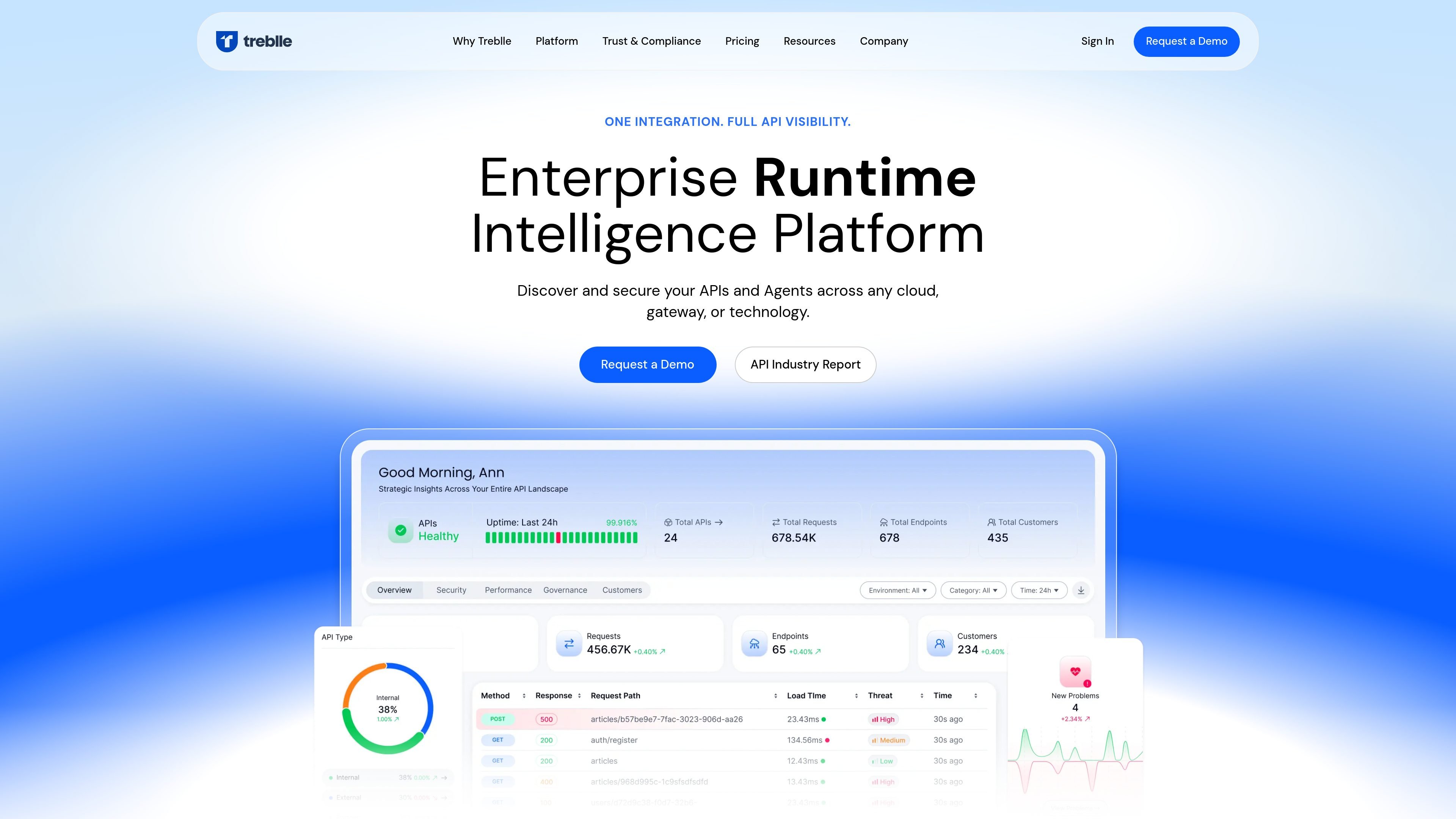
Treblle is a runtime intelligence platform for APIs and related agentic workflows. It is positioned to help teams discover, govern, secure, document, test, analyze, and monitor APIs across existing clouds, gateways, frameworks, and deployment environments.
The product centers on a single integration that captures complete request data without sampling. From there, Treblle uses runtime traffic and design-time API specs to build an inventory of APIs, surface drift and risk, support governance checks, and provide visibility for engineering, security, and leadership teams.
Treblle captures complete request data with no sampling and presents it as a single source of truth for API visibility, analysis, and follow-up workflows.
The platform discovers APIs from code repositories, API gateways, and live traffic so teams can build a more complete inventory of what is actually running.
Design-time governance scores OpenAPI specs, evaluates standards before release, and can block low-quality specs in CI/CD.
Runtime monitoring and security features focus on live traffic, including drift detection, OWASP checks, shadow endpoint detection, and consumer fingerprinting.
Treblle supports API analytics, documentation, testing, observability, security, compliance, discovery, cataloging, and agentic AI capabilities as part of the platform and plan tiers.
Deployment options include SaaS, private cloud, on-premises, and air-gapped environments, with the same platform capabilities across deployment models.
Use Treblle to identify APIs from repositories, gateways, and live traffic, then compare what is running in production with what is documented.
Use design-time scoring and governance rules to evaluate OpenAPI specs before release and catch drift when services change over time.
Use live request data to detect shadow endpoints, OWASP issues, consumer fingerprints, and other runtime risks on production traffic.
Use request-level telemetry, analytics, and API intelligence to trace degradation, understand bottlenecks, and improve response times.
Use audit trails, compliance monitoring, and deployment models such as on-premises or air-gapped to support regulated environments.
Treblle is designed for teams that want API observability, governance, security, compliance, analytics, documentation, and agentic AI control from one platform. The product pages describe it as fitting enterprise teams, engineering leadership, platform engineering, InfoSec, and product teams.
Treblle is positioned to sit on top of an existing stack rather than replace it. The site says it works across 40+ languages and frameworks, supports multiple clouds, gateways, and deployment models, and can be deployed without changing gateway configuration.
The how-it-works page describes a single integration point that captures complete, unsampled request data. Treblle then uses that data for discovery, design and governance checks, runtime visibility, security, and analytics.
The pricing page shows Core, Growth, and Enterprise plans. Core has published pricing, while Growth and Enterprise use custom pricing; the Enterprise plan also adds options such as unlimited workspaces, SSO, on-prem/BYO cloud, and support for compliance-oriented deployment needs.
Yes. The deployment page lists SaaS, on-premises, air-gapped, and private cloud options, and the pricing page confirms on-premises or BYO cloud support on Enterprise.