
Stateful actors
Rivet Actors provide durable, stateful compute for Node.js or Bun backends, with state kept close to the running workload for quick reads and writes.

Rivet provides infrastructure for AI agents and stateful workloads with durable actors, agent runtime tooling, and flexible deployment on Cloud, VPC, self-hosted, or air-gapped environments.
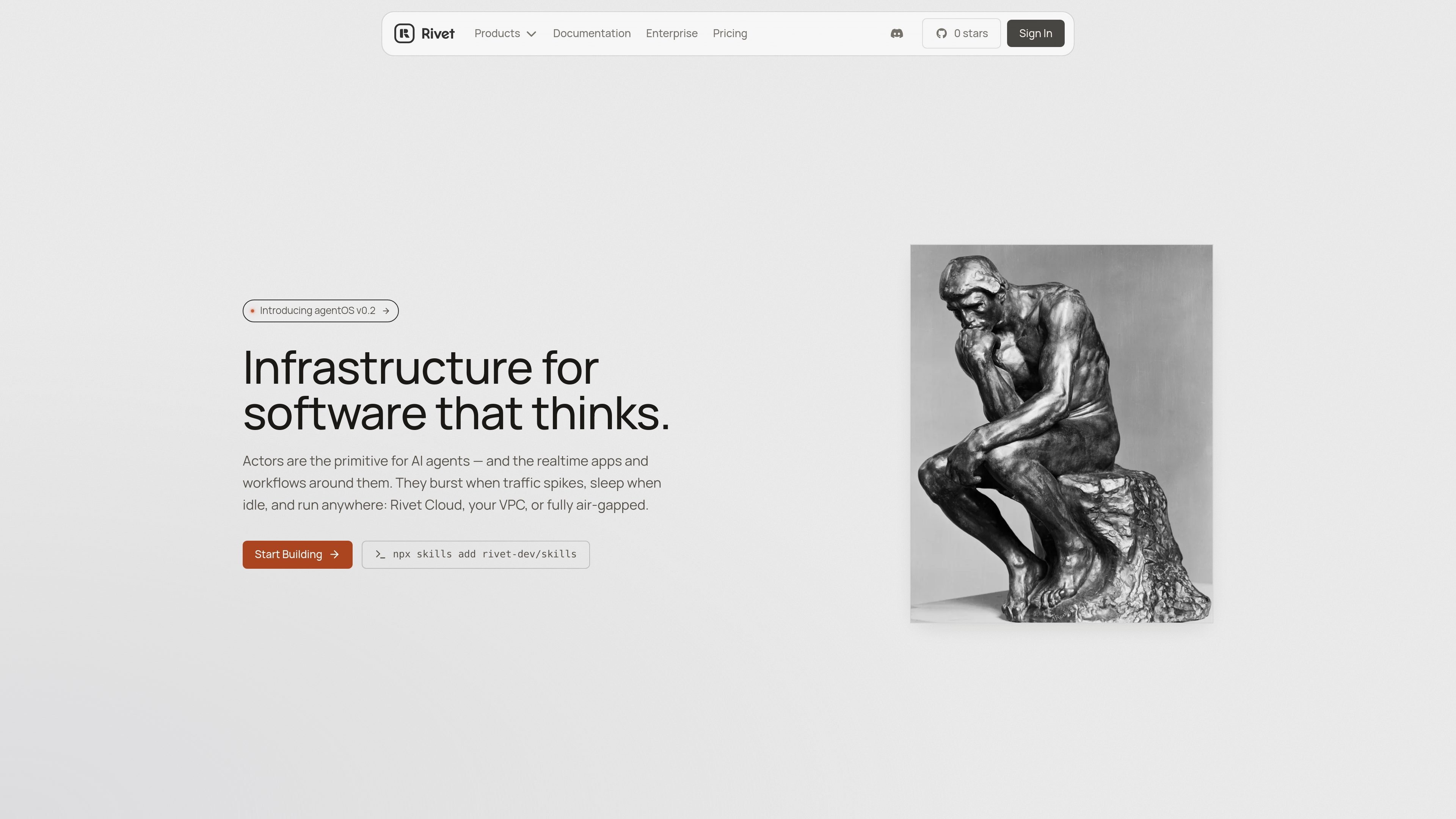
Rivet is infrastructure for long-lived, stateful software and AI agents. The product combines Rivet Actors, which provide durable compute for applications and realtime workflows, with agentOS, a portable in-process operating system for agents.
The site presents Rivet as something you can run in Rivet Cloud, inside your own VPC, on a self-hosted deployment, or in air-gapped and on-prem environments. It is positioned for teams building agents, realtime apps, and backend systems that need durable state, scheduling, and observability.
Rivet Actors provide durable, stateful compute for Node.js or Bun backends, with state kept close to the running workload for quick reads and writes.
Actors can run indefinitely, hibernate when idle, scale to zero, and burst to thousands of instances when traffic increases.
The platform includes built-in WebSockets, durable workflows, queues, and scheduling for multi-step and realtime systems.
agentOS is a lightweight in-process OS for agents, built on Wasm and V8, with a stated ~6 ms cold start and 22 MB RAM footprint.
The system can mount external sources such as S3, SQLite, Google Drive, or the host filesystem as a filesystem for agents to use.
Rivet includes observability tools such as a SQLite viewer, workflow state inspection, event monitoring, and a REPL for debugging actors and agent sessions.
Build agents that need durable memory, long-running execution, and a portable runtime that can sit inside an existing backend.
Run realtime applications that rely on WebSockets, stateful sessions, and coordinated workflows without building the orchestration layer from scratch.
Handle background jobs, timers, queues, and multi-step processes that must survive idling and resume cleanly later.
Deploy in environments with strict boundary requirements, including customer VPCs, regulated networks, or fully air-gapped infrastructure.
Connect a custom Node.js hosting platform by exposing `/api/rivet`, setting the required environment variables, and linking the app from the Rivet dashboard.
Rivet is built for long-lived, stateful workloads and agents. The docs describe actors as long-lived processes with durable state, realtime events, and built-in hibernation, while the home page positions agentOS as a portable OS for agents.
The source shows several deployment paths: Rivet Cloud, your own VPC, customer environments, air-gapped networks, self-hosted infrastructure, and supported platforms such as Vercel, Railway, Kubernetes, AWS, and GCP through the custom platform flow.
The pricing page shows Free, Hobby, Team, and Enterprise Edition options. Free and paid cloud tiers have usage limits and included allowances, while Enterprise Edition is a custom on-prem offering for running Rivet in private or regulated environments.
The custom platform docs say your app must expose a publicly accessible /api/rivet endpoint, and that you configure RIVET_ENDPOINT and RIVET_PUBLIC_ENDPOINT before connecting it from the Rivet dashboard.
The documentation lists Node.js and Bun as the primary setup path, with additional options for React, Next.js, Rust beta, Effect.ts beta, Cloudflare Workers, and Supabase Functions.