
Deep clinical AI
Measures, localizes, visualizes, and characterizes disease so clinicians can work from more than a simple abnormality flag.

RapidAI is a clinical AI platform for healthcare organizations, combining imaging analysis with PACS, EHR, reporting, and care-team workflows.
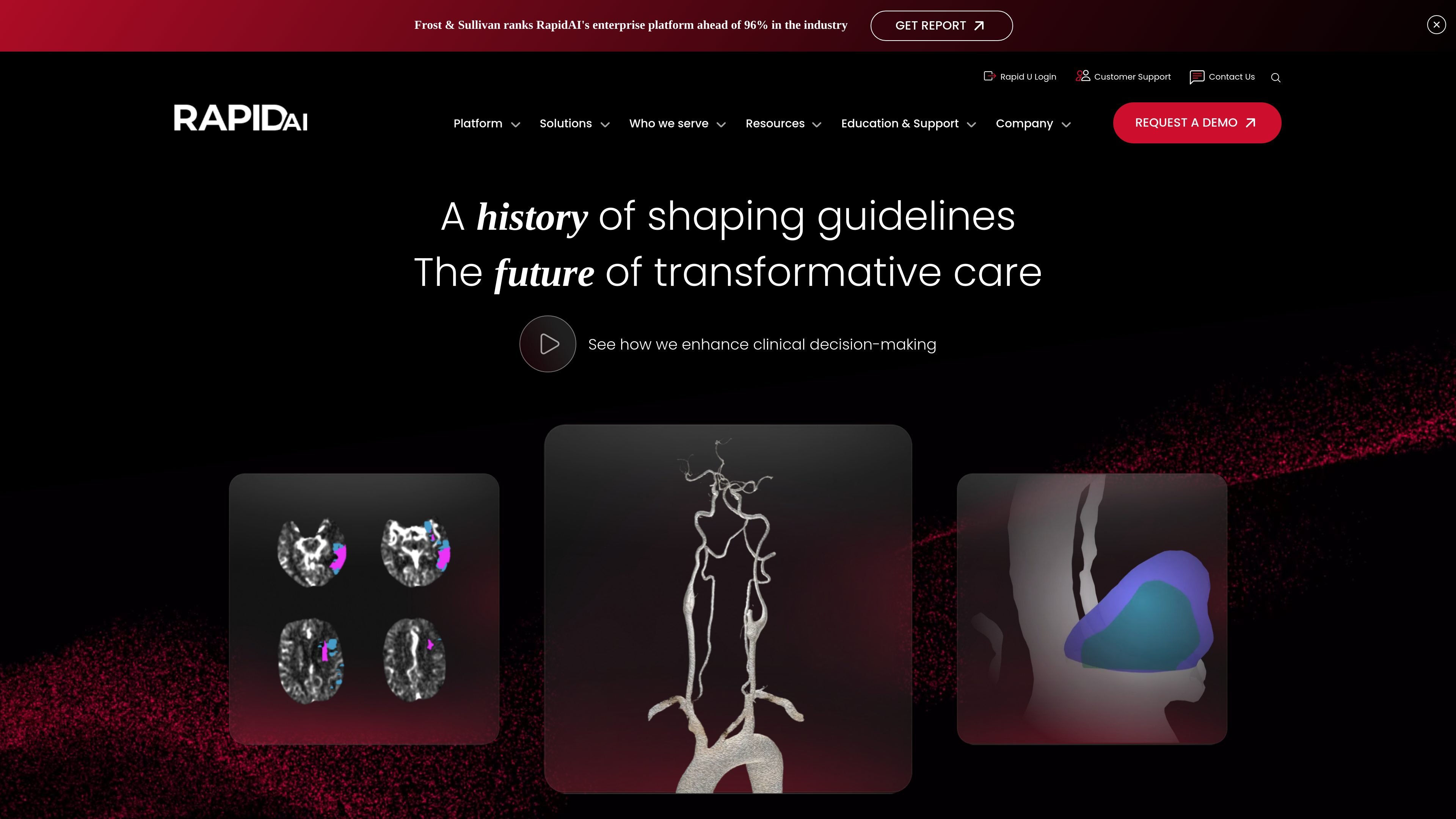
RapidAI is a clinical AI platform for healthcare organizations that want imaging-based decision support across service lines. The platform centers on deep clinical AI, workflow integration, and enterprise infrastructure so clinicians can use AI findings in the context of day-to-day care.
The product is designed to help teams move from detection to action. Its source pages describe capabilities for triage, localization, quantification, characterization, visualization, and longitudinal tracking, along with workflow tools that connect PACS, EHR, worklists, reporting systems, and care-team communication.
RapidAI also presents separate solution areas for neurovascular, cardiac and vascular, radiology, and life sciences. The platform is built to support clinicians, radiology teams, care teams, hospital administrators, and IT groups that need shared imaging intelligence across the health system.
Measures, localizes, visualizes, and characterizes disease so clinicians can work from more than a simple abnormality flag.
Surfaces AI findings inside PACS, EHR, worklists, reporting systems, and care-team tools to reduce navigation between systems.
Supports real-time case coordination through secure mobile, desktop, and workstation tools, including in-app messaging and case sharing.
Provides imaging performance, care pathway, and operational trend visibility for hospital-wide review of utilization, volume, AI adoption, and improvement opportunities.
Uses enterprise infrastructure with cloud speed, on-prem option architecture, SSO, encryption, isolation, audit visibility, and monitoring.
Supports curated third-party AI integrations and custom requests so hospitals can consolidate tools on a single platform.
Radiologists can review prioritized studies, inspect AI outputs in the DICOM viewer, and stay focused on interpretation while the platform surfaces actionable findings in workflow.
ED, neurology, cardiology, and intervention teams can share case images, message one another, and track patient status across the patient journey.
Hospital leaders can review imaging performance, utilization, AI adoption, and care pathway trends to identify operational improvement opportunities.
Clinicians working in neurovascular and cardiac and vascular programs can use disease-specific AI support for stroke, aneurysm, aortic, and pulmonary embolism workflows.
RapidAI is built around deep clinical AI for healthcare teams that need imaging-based decision support across acute care and specialty workflows. The platform is positioned for clinicians, radiology teams, care teams, and hospital administrators working across service lines such as neurovascular, cardiac and vascular, and radiology.
The platform combines deep clinical AI with workflow integration so users can review AI outputs in context, coordinate cases in real time, and route information through PACS, EHR, worklists, reporting systems, and care-team tools.
The source materials describe outputs such as triage, localization, quantification, characterization, visualization, and longitudinal tracking. In practice, that means the platform is intended to help teams identify suspected cases, review regions of concern, measure findings, and follow change over time.
The platform pages emphasize deep clinical AI, workflow integration, and enterprise infrastructure, but they do not provide full implementation details, pricing, or a complete list of supported integrations on the captured pages.