
Adaptive mini-test workflow
The platform uses an adaptive question set, described as Fast CAT, to estimate readiness with fewer questions than a full test.

R.test is an AI-powered test prep platform for Digital SAT, ACT, and PSAT/NMSQT, with score predictions, insights, and study priorities.
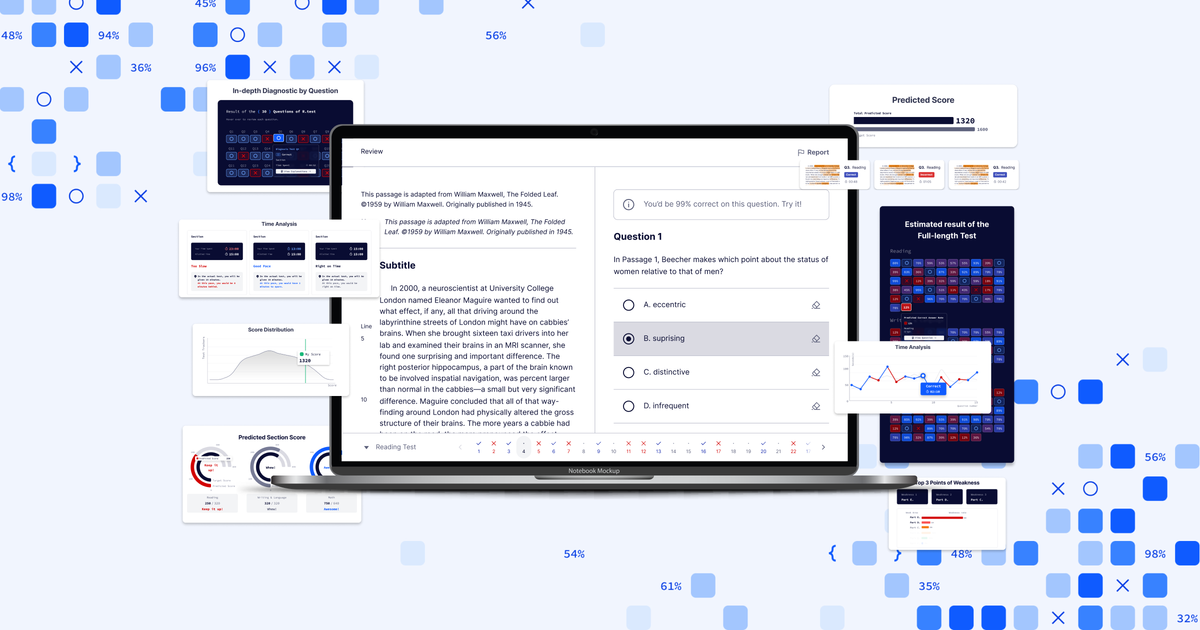
R.test is an AI-powered assessment platform for standardized test prep. It is built to predict a student’s score with a smaller set of questions than a full-length exam and to point out strengths and weaknesses in the process.
The site presents R.test for Digital SAT, ACT, and PSAT/NMSQT preparation, with an AP option marked as coming soon. It offers a faster mini-test workflow alongside a full-length practice test, aiming to give students, parents, counselors, tutors, and teachers a quicker way to evaluate readiness and study priorities.
The platform uses an adaptive question set, described as Fast CAT, to estimate readiness with fewer questions than a full test.
R.test Mini is designed to finish in about 40 minutes on average, with the site also describing it as taking about one quarter of the usual test time.
The report surfaces a predicted score, a target score comparison, and areas for improvement so users can see where to focus next.
The ACT page says the analytics report provides 10 types of personalized insights, and the home page highlights top areas for improvement.
The site shows step-by-step visual explanations as part of the assessment experience and report outputs.
The ACT page includes a full-length option with real test conditions, while the mini test is positioned as a faster diagnostic alternative.
Students can take the mini test to estimate readiness quickly and decide which topics need more study before committing to a full-length practice exam.
Tutors, counselors, and teachers can use the report to identify a student’s top areas for improvement and guide follow-up instruction.
Learners preparing for Digital SAT or ACT can use the full test option when they want a more realistic practice session under full test conditions.
Students with limited time can use the mini test to get a faster diagnostic and a structured report without sitting through a full exam.
Families evaluating test-prep tools can use R.test as a lower-effort way to review performance trends and compare where a student stands now versus a target score.
R.test Mini uses AI to predict a score from fewer questions than a full-length test. The source describes it as a faster diagnostic option that still produces an analytics report.
The source says R.test Mini can be completed in about 40 minutes on average, though the exact time can vary by test.
The analytics report is described as showing a predicted score, a target score comparison, and areas for improvement. The ACT page also says the report includes 10 types of personalized insights.
The site presents R.test for Digital SAT, ACT, PSAT/NMSQT, and mentions AP as coming soon. The ACT page and home page both focus on exam preparation and diagnostic assessment.
The source shows both R.test Full and R.test Mini. The Mini version is positioned as a faster diagnostic, while the Full version is described as full-length real test conditions.