
Import existing scenarios
Bring in test knowledge from OpenAPI specs, Postman collections, spreadsheets, existing tests, and product docs so teams can start from what they already maintain.

Qodex is a continuous testing platform for engineering, QA, and security teams to run real scenarios on pull requests and deploys, with evidence when behavior breaks.
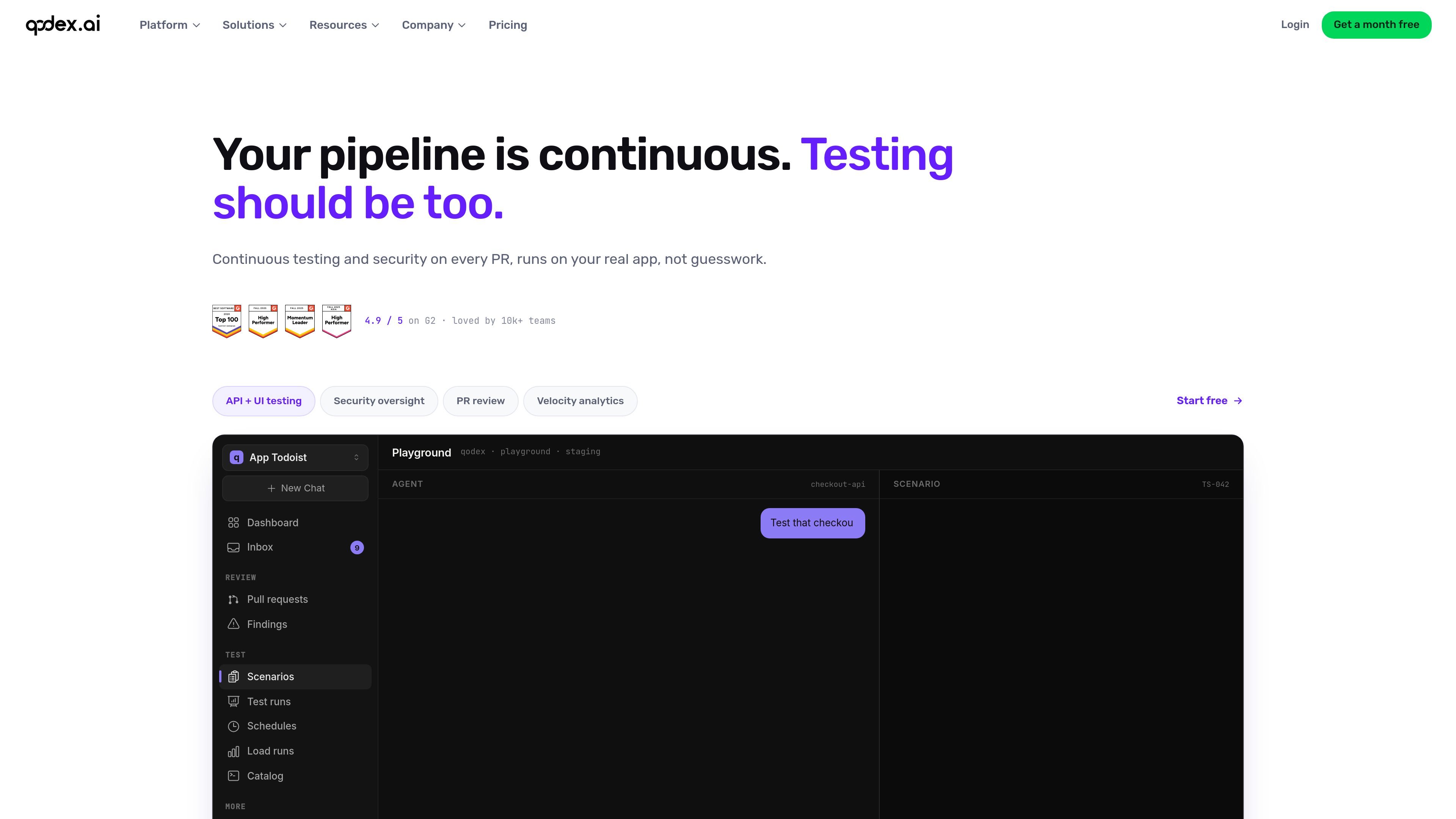
Qodex is a continuous testing platform for teams that want to turn scattered test knowledge into durable scenarios and run them against the real application as code changes move through review and deployment. The product is positioned around GitHub pull requests, the CLI, platform chat, schedules, and deploy checks, with the goal of keeping coverage current as the product changes.
The site frames Qodex as a system of record for test scenarios rather than a one-off test runner. Teams can import scenarios from OpenAPI, Postman, spreadsheets, existing tests, and product docs, then use Qodex to manage coverage, execute scenarios on the app, and collect request, response, and screenshot evidence when something breaks.
Bring in test knowledge from OpenAPI specs, Postman collections, spreadsheets, existing tests, and product docs so teams can start from what they already maintain.
Keep scenarios in one team-owned place instead of scattered spreadsheets, threads, or individual memory. The site describes this as a living record for how the software should behave.
Run scenarios on pull requests, in the CLI, in platform chat, on schedules, and on deploy checks so verification happens where work is already moving.
Capture the failing request, response, and screenshot when a scenario breaks, giving reviewers concrete evidence instead of guesses.
Cover API and UI testing, including multi-step API flows, auth profiles, browser runs, natural-language UI steps, and a UI Pages catalog on higher plans.
Include OWASP-aligned security probes and file findings against the PR, with stronger security controls and compliance features on higher tiers.
Use Qodex to run scenarios on every pull request so reviewers can see whether a change actually broke behavior, along with the failing request, response, and screenshot.
Use it as a coverage management layer to centralize scenarios that live in spreadsheets, Postman, or old test files, then expand them as the product evolves.
Use the API and UI scenario runners to exercise real customer flows, including multi-step API paths, auth profiles, browser checks, and natural-language UI steps.
Use OWASP-aligned probes and PR-filed findings to surface security issues in the same workflow as code review and CI.
Use scheduled or webhook-triggered runs to re-check behavior outside the PR flow, keeping scenarios current between releases.
Qodex runs your test scenarios against the real app on pull requests, in the CLI, in platform chat, on schedules, and on deploy checks. The source describes it as a continuous testing system rather than a one-time test runner.
The pricing page shows an Individual free tier, a Startup plan, and a Scale plan for larger organizations. Exact pricing is only stated for the free tier and by starting point for Startup, so the product uses a mix of self-serve and quote-based entry points.
Qodex surfaces the failing request, response, and screenshot when a scenario fails. The source also says it can import scenarios from OpenAPI, Postman collections, spreadsheets, existing tests, and product docs.
The source positions Qodex as complementary to code review and security workflows: it runs tests against the real app and includes OWASP-aligned security probes, but it does not claim to replace pentests or audits.
Qodex is presented for engineers, QA leads, and security teams. The site emphasizes shared test scenarios, PR checks, deploy checks, and coverage management across the team.