MiniMax icon

MiniMax

Reclamar

MiniMax is a general AI platform with multimodal models, an open developer platform, and subscriptions for individuals and teams for coding, agents, and AI apps.

MiniMax

What is MiniMax

MiniMax is a general artificial intelligence technology company. According to the official website, it has been continuously developing multimodal foundation models since its founding in early 2022, and it provides AI-native products and open platform services to users worldwide. The page highlights coverage of multiple modalities, including text, audio, images, video, and music, and says it serves developers, enterprises, and individual users.

From the product line perspective, MiniMax’s core offerings include M3 for coding and agent tasks, M2.7 for complex productivity and office delivery, as well as applications such as MiniMax Code, MiniMax Hub, MiniMax Audio, and Xingye. For developers, the platform provides API access and Token Plan options; for individuals and small teams, it offers monthly subscriptions and desktop versions.

Core capabilities

Million-token context handling

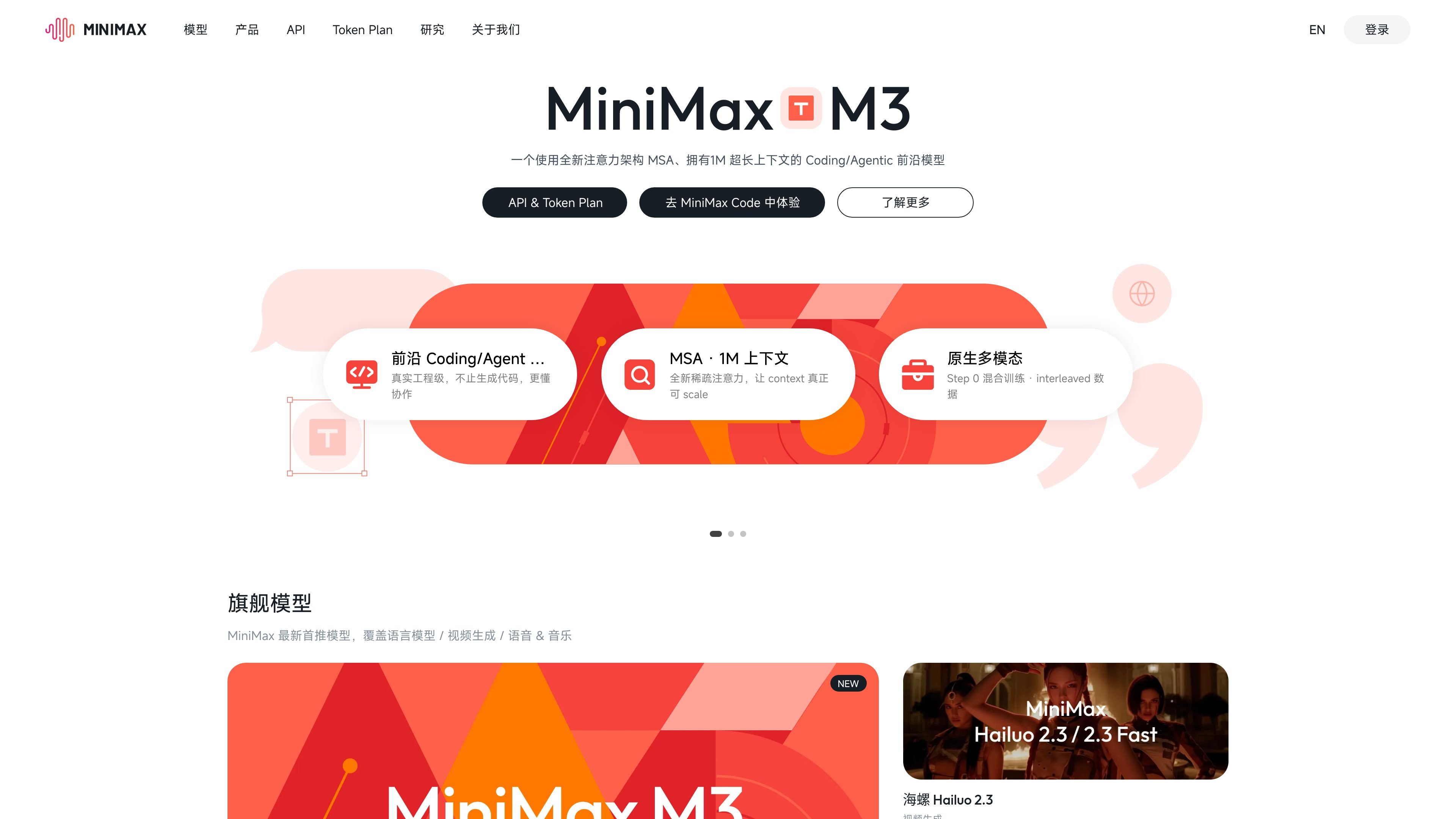
M3 uses the MiniMax Sparse Attention (MSA) architecture. The API supports up to a 1M-token context window, and the documentation says at least 512K tokens are available, making it suitable for long-context coding, long-horizon agents, and long-document tasks.

Native multimodal understanding

M3 is described as a native multimodal model that learns multimodal representations from the start of training, for unified processing of text and visual semantics rather than shallow multimodal capability added later.

For coding and agentic workflows

M3 emphasizes coding, tool calling, autonomous task decomposition, and multi-step reasoning, with the goal of producing code that can be delivered directly and agent tasks that can keep running.

Complex productivity tasks

M2.7 emphasizes complex agent building, real software engineering, log troubleshooting, code security, machine learning, and office document editing tasks, covering more productivity-oriented scenarios.

Dual-track API and subscription access

The pricing page divides the products into API usage with real-time billing and monthly subscriptions. The subscription side includes Token Plan and Team Edition, respectively for individuals, small teams, and seat-based allocation scenarios.

Multiple access paths

The model pages provide quick-start API integration examples and mention access points such as MiniMax Code, the open platform, and a desktop version, showing that the product is aimed at both developers and non-developers.

Use cases

  • Long-context coding and code delivery

    Suitable for coding tasks that require long-context processing, such as large codebase modifications, cross-file refactoring, long-horizon debugging, and continuously iterated agent workflows. M3’s 1M context window and tool-calling capabilities are designed for this kind of workflow.

  • Agent task execution

    Suitable for agent scenarios that require autonomous task decomposition, tool use, and multi-step reasoning, such as information retrieval, browsing, experiment execution, and long-running automation tasks. The M3 page highlights these capabilities directly.

  • Complex engineering and productivity tasks

    Suitable for productivity scenarios such as software engineering, log troubleshooting, code security, machine learning experiments, and complex project delivery. M2.7’s examples and benchmarks focus on these workloads.

  • Office document processing

    Suitable for office document workflows that require complex editing and multiple rounds of revision, such as high-fidelity editing and content organization in Excel, PPT, and Word. M2.7 specifically emphasizes these capabilities.

  • Platform integration and personal use

    Suitable for users who want to integrate model capabilities through APIs or get started quickly with Token Plan and the desktop version. The pricing page and model pages provide different entry points for choosing based on usage preferences.

Pros and Cons

Pros

  • Covers multimodal capabilities such as text, audio, images, video, and music, with a relatively complete product lineup.
  • M3 offers a 1M-token context window and emphasizes coding, agent, and native multimodal capabilities.
  • M2.7 is more oriented toward complex productivity and software engineering scenarios, including code, logs, office documents, and complex skills interactions.
  • Provides API access, subscription plans, a desktop version, and an open platform entry, making it convenient for different types of users.

Cons

  • The public information on the source site focuses more on product and capability introductions, and some integration details, full pricing, and plan boundaries are not expanded in the collected text.
  • Different models emphasize different capabilities, so users need to distinguish M3, M2.7, and related products before choosing the appropriate access method.

FAQ

What billing options does MiniMax offer?

MiniMax offers enterprise API billing and monthly subscription plans for individuals and small teams. The pricing page says the two plans use separate Key systems, but the full price list is not included in the collected text.

What is the difference between M3 and M2.7?

M3 is designed for coding and agent tasks, with an emphasis on a 1M context window, native multimodal capabilities, and tool-calling. M2.7 focuses on complex agent building, software engineering delivery, and office task handling.

How can MiniMax models be used?

MiniMax Code is a desktop Coding Agent version adapted for MiniMax models. The model page also mentions open platform API access, as well as subscription and platform access options for AI Coding Tools.

What products and capabilities does MiniMax mainly offer?

The source materials show that MiniMax models cover multimodal capabilities including text, audio, images, video, and music, and that MiniMax has launched AI-native products such as MiniMax Code, MiniMax Hub, MiniMax Audio, and Xingye.

Quick Facts

Brand
MiniMax
Category
General AI platform
Main products
MiniMax M3, MiniMax M2.7, MiniMax Code, MiniMax Hub, MiniMax Audio, Xingye
Access methods
API, Token Plan, Team Edition, desktop version
Target users
Developers, enterprises, individuals, and small teams
Website domain
minimaxi.com