
Modular expert kits
The site says experts can turn know-how into modular assets such as playbooks, knowledge bases, skills, and agents, which are then grouped into kits.

Leapility is an AI-agent platform that helps experts turn know-how into subscribable kits built from knowledge bases, skills, playbooks, and agents.
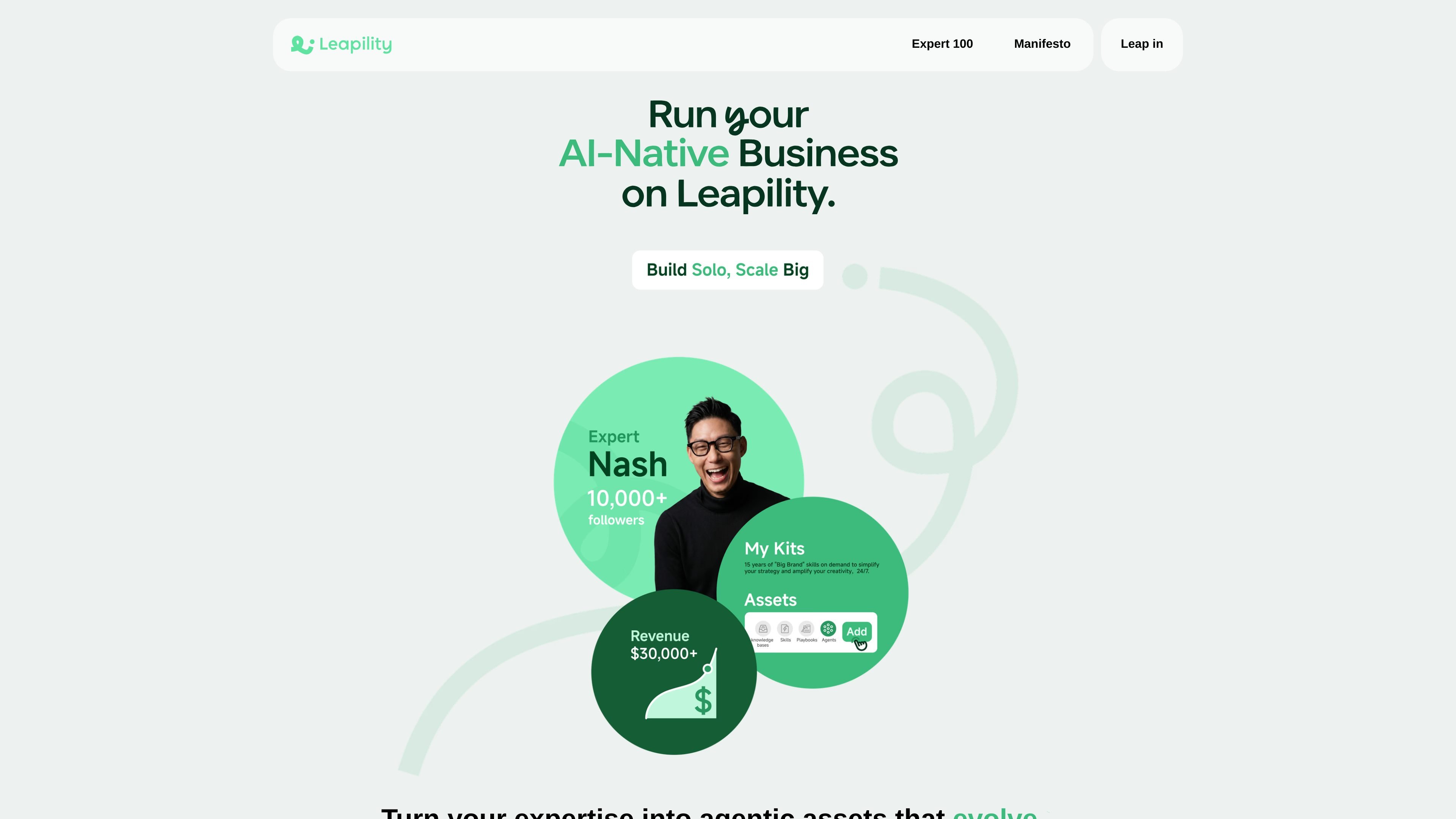
Leapility is an AI-agent platform focused on turning professional expertise into subscribable agent kits. Its homepage frames the product as a way to help experts scale value instead of time by converting knowledge into reusable assets that can be published, distributed, and monetized.
The site positions Leapility for people who already have audience or domain expertise but want a more scalable offer than one-off services, static courses, or consulting hours. It presents a structure built around knowledge bases, skills, playbooks, and agents, with the broader goal of making expertise more adaptable and commercially reusable.
The site says experts can turn know-how into modular assets such as playbooks, knowledge bases, skills, and agents, which are then grouped into kits.
Leapility describes its kits as living AI assets that can evolve over time, which is positioned as a way to keep expertise current instead of freezing it in static content.
The site states that kits can be published and sent to an agent for installation, indicating a workflow for packaging and distributing expert assets.
Leapility says it lets experts create, protect, and monetize professional knowledge as subscribable AI Agent Kits, combining packaging and commercialization in one system.
The homepage says the platform enables black-box delivery so experts can share value without giving away underlying IP.
Leapility describes itself as a neutral asset layer accessible across platforms through MCP and CLI, suggesting portability outside a single model or ecosystem.
A consultant with repeatable expertise can package that work into standardized kits instead of rebuilding the same engagement for each client. The source specifically says the platform is meant to help high-ticket services become more scalable.
A creator with an audience can turn long-form content into a subscribable companion agent that subscribers return to over time. The homepage contrasts this with one-off courses that people forget.
An expert whose knowledge changes frequently can keep a live knowledge base behind the kit instead of relying on static documents. The site emphasizes evolvable assets that stay current as expertise develops.
A founder or solo operator can use the AIM model described on the site to shape expertise into A-Agent, i-Influence, and m-Marketability, then distribute and monetize the resulting assets.
A team that wants to share expertise without exposing the full underlying IP can use Leapility’s black-box delivery model. The site says this helps experts distribute value while retaining ownership.
Leapility positions itself as a platform for turning professional expertise into subscribable AI agent kits. The source material emphasizes creating, protecting, and monetizing knowledge assets, but it does not provide a full onboarding walkthrough.
The site describes modules such as Knowledge Base, Skills, Playbook, and Agent, suggesting experts assemble reusable assets into kits. It also mentions publishing and distributing those kits, but it does not document the full setup sequence in detail.
The homepage names knowledge craftspeople, seasoned consultants, and content influencers as intended users. Those groups are framed as people with audience or expertise who want a scalable product instead of one-off services or static content.
The homepage says Leapility is a neutral asset layer and notes access across platforms through MCP and CLI. Beyond that, the source does not list specific integrations or platform compatibility details.
The pricing page currently returns a 404, so the source does not confirm current plans, trial terms, or pricing structure.