
AI-powered cluster analysis
Analyze Kubernetes cluster state and receive AI-generated explanations that help identify likely causes of issues.

K8sGPT is an AI-powered Kubernetes troubleshooting tool for diagnosing cluster issues with CLI, operator, MCP workflows, and external or local AI models.
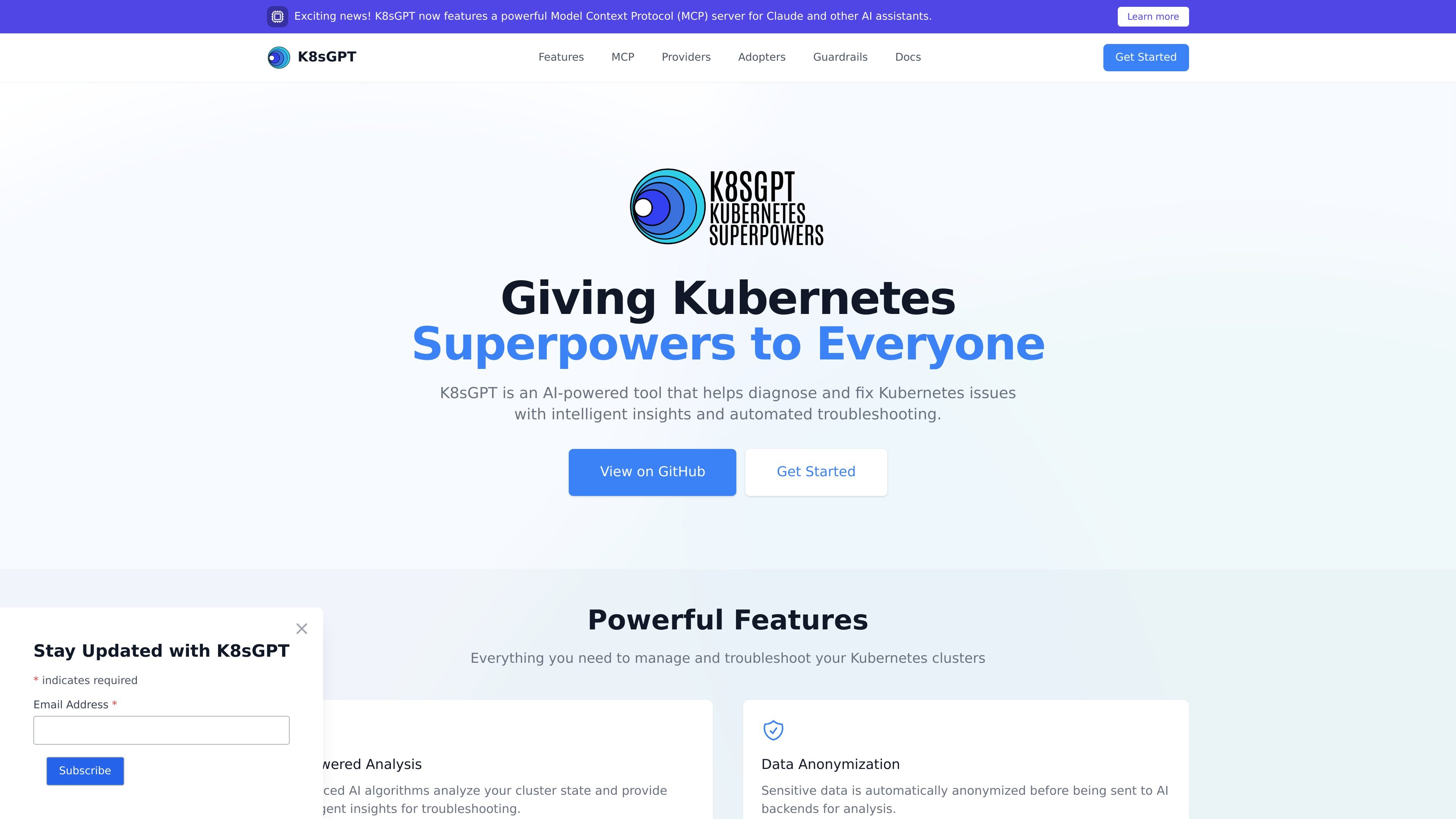
K8sGPT is an AI-powered Kubernetes troubleshooting tool that helps diagnose cluster issues and surface explanations from your Kubernetes state. The site positions it as a way to give Kubernetes SRE-style capabilities to more users, with both CLI usage and operator-based deployment.
The product can work with external AI providers or local models, and it includes guardrails such as data anonymization, selective analyzers, and optional auto-remediation. It also offers a Model Context Protocol server that exposes cluster analysis, resource inspection, logs, events, and troubleshooting prompts to compatible AI assistants.
Analyze Kubernetes cluster state and receive AI-generated explanations that help identify likely causes of issues.
Automatically anonymize sensitive data before sending it to external AI backends for analysis.
Use built-in analyzers without an AI backend when you want local diagnostics or a simpler workflow.
Choose from supported providers such as OpenAI, Azure OpenAI, Google Vertex AI, Amazon Bedrock, IBM WatsonX, Ollama, Cohere, and Hugging Face.
Apply suggested fixes automatically for some issues, with the option to keep remediation manual.
Expose Kubernetes operations through the Model Context Protocol so AI assistants can analyze clusters, inspect resources, read logs, and manage analyzer filters.
Use K8sGPT to inspect a cluster when you need a plain-language explanation of resource issues, events, or logs and want help narrowing down the likely cause.
Run it with a local model or built-in analyzers when you want to keep analysis inside your environment or avoid sending data to an external AI backend.
Connect it through MCP to give an AI assistant access to cluster analysis, resource listing, log inspection, and guided troubleshooting prompts.
Deploy the operator in a Kubernetes environment when you want a cluster-native setup instead of relying only on a standalone CLI.
Use the configuration controls to limit analyzers, manage remediation behavior, and fit the analysis workflow to a specific team or cluster.
K8sGPT is presented as an AI-powered tool for diagnosing and fixing Kubernetes issues. It analyzes cluster state, can explain findings with AI backends, and also offers built-in analyzers that can run without an AI backend for simpler diagnostics.
The installation guide shows several supported installation paths: direct CLI download, Kubernetes operator deployment, Homebrew, APT, YUM/DNF, and Docker.
The home page and MCP docs show both local Stdio mode and HTTP mode. Local assistants such as Claude Desktop can connect in Stdio mode, while HTTP mode supports network access and webhook integrations.
The home page lists multiple AI providers, including OpenAI, Azure OpenAI, Google Vertex AI, Amazon Bedrock, IBM WatsonX, Ollama, Cohere, and Hugging Face. The docs also note support for local AI models.