
One account for multiple products
HYVOR groups several website products under one account, including Hyvor Talk, Hyvor Blogs, Hyvor Post, and Hyvor Relay. That lets teams manage related website tools without separate logins for each product.

HYVOR builds privacy-first website tools for comments, blogs, newsletters, and developer email workflows. One account across products; HYVOR Enterprise adds SSO, support, self-hosting, and user management.
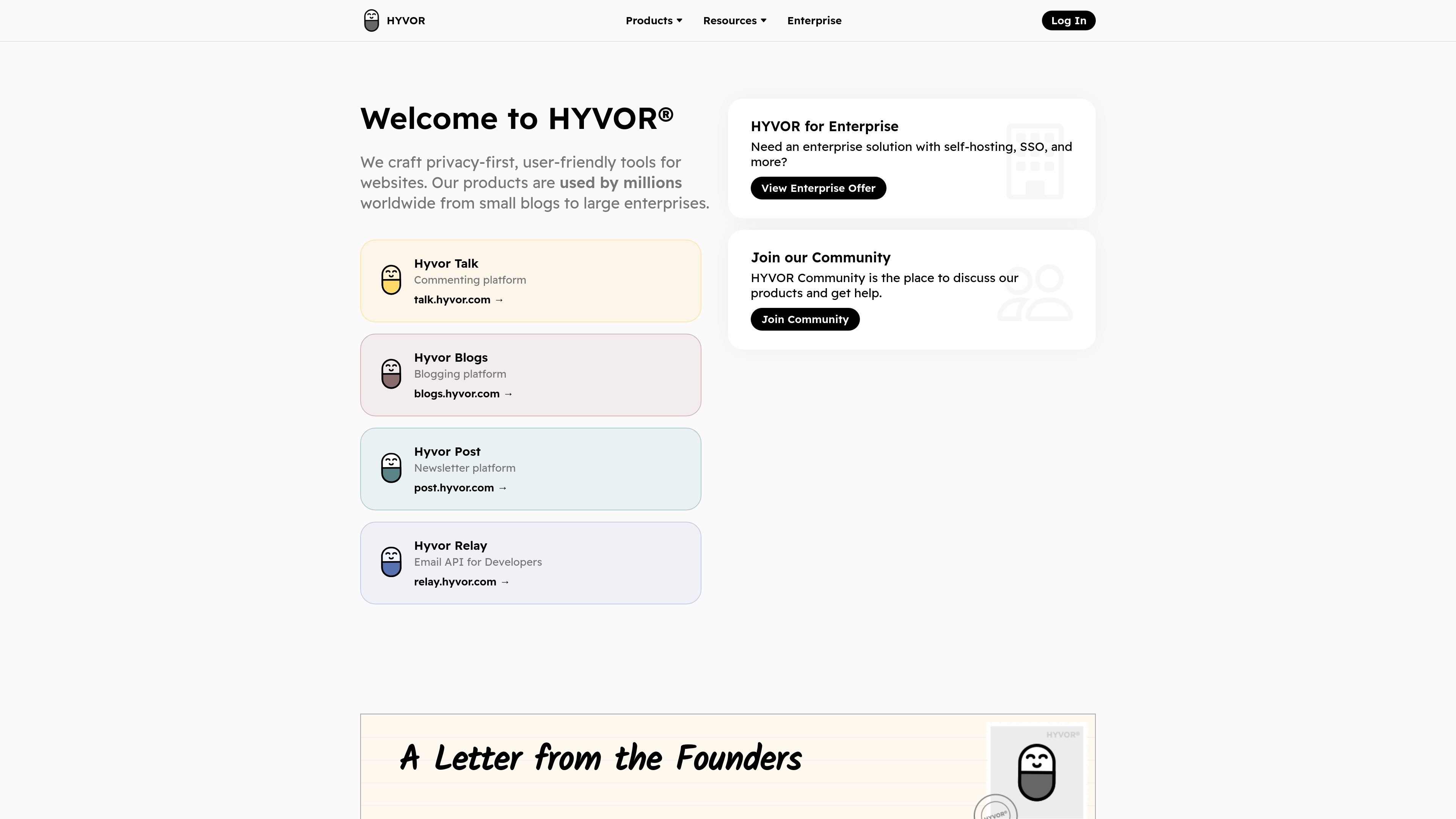
HYVOR is a product company that builds privacy-first tools for websites. Its public lineup includes Hyvor Talk for commenting, Hyvor Blogs for publishing blogs, Hyvor Post for newsletters, and Hyvor Relay for email APIs for developers.
The site emphasizes a shared account experience across products, so users can create one HYVOR account and then work from product consoles for the services they need. The docs also note that the same account session is valid across hyvor.com subdomains, which makes it easier to move between consoles and manage multiple website tools from one place.
HYVOR positions its products for a wide range of website owners, from small blogs to larger enterprises. For larger teams, HYVOR Enterprise adds SSO, user management, priority support, self-hosting options, and other organization-level controls.
HYVOR groups several website products under one account, including Hyvor Talk, Hyvor Blogs, Hyvor Post, and Hyvor Relay. That lets teams manage related website tools without separate logins for each product.
Hyvor Talk is a commenting platform for websites, built as the company’s first product and described as privacy-friendly and fully featured.
Hyvor Blogs is positioned as a blogging platform for creating blogs, giving website owners a separate product for publishing content.
Hyvor Post is a newsletter platform for sending newsletters, aimed at creators and teams that want to publish email updates from a HYVOR account.
Hyvor Relay is described as an open-source email API for developers, and the enterprise page notes that it is currently available for self-hosting.
The enterprise offering adds OIDC SSO, user management, priority support with SLA, security audits and NDAs, compliance support, and access to an enterprise Slack channel.
Use Hyvor Talk when you want to add comments to a website and manage them through a dedicated console.
Use Hyvor Blogs when you need a separate blogging platform for creating and publishing blog content.
Use Hyvor Post when your team wants to send newsletters from the same HYVOR account used for other products.
Use Hyvor Relay when you need an email API for application-driven email sending, with the option to self-host the product in enterprise contexts.
Use HYVOR Enterprise when your organization needs SSO, user permissions, priority support, compliance review support, or a self-hosted deployment.
HYVOR provides a shared account for its products, and the docs say one account works across all hyvor.com subdomains. Users can log in to product consoles for Talk, Blogs, Post, Relay, and Fortguard.
The docs say you can sign up with a username, email and password, or use Google or Apple sign-in. Email signups require verification before use.
The enterprise page says HYVOR Enterprise includes SSO, priority support, self-hosting, user management, SLA support, security audits, NDA support, and access to an enterprise Slack channel.
HYVOR says its products are designed for websites and include a commenting platform, blogging platform, newsletter platform, and an email API for developers.