
Persistent assignments
Hyperagent turns a prompt into a longer-lived assignment. The homepage says you can brief it once, then the agents research, build, deliver, and keep the work current.

Hyperagent is a hosted system of agents that produces work such as websites, documents, dashboards, and video for teams. It can be reached through Slack, Telegram, webhooks, or scheduled runs, and is designed to keep deliverables current over time.
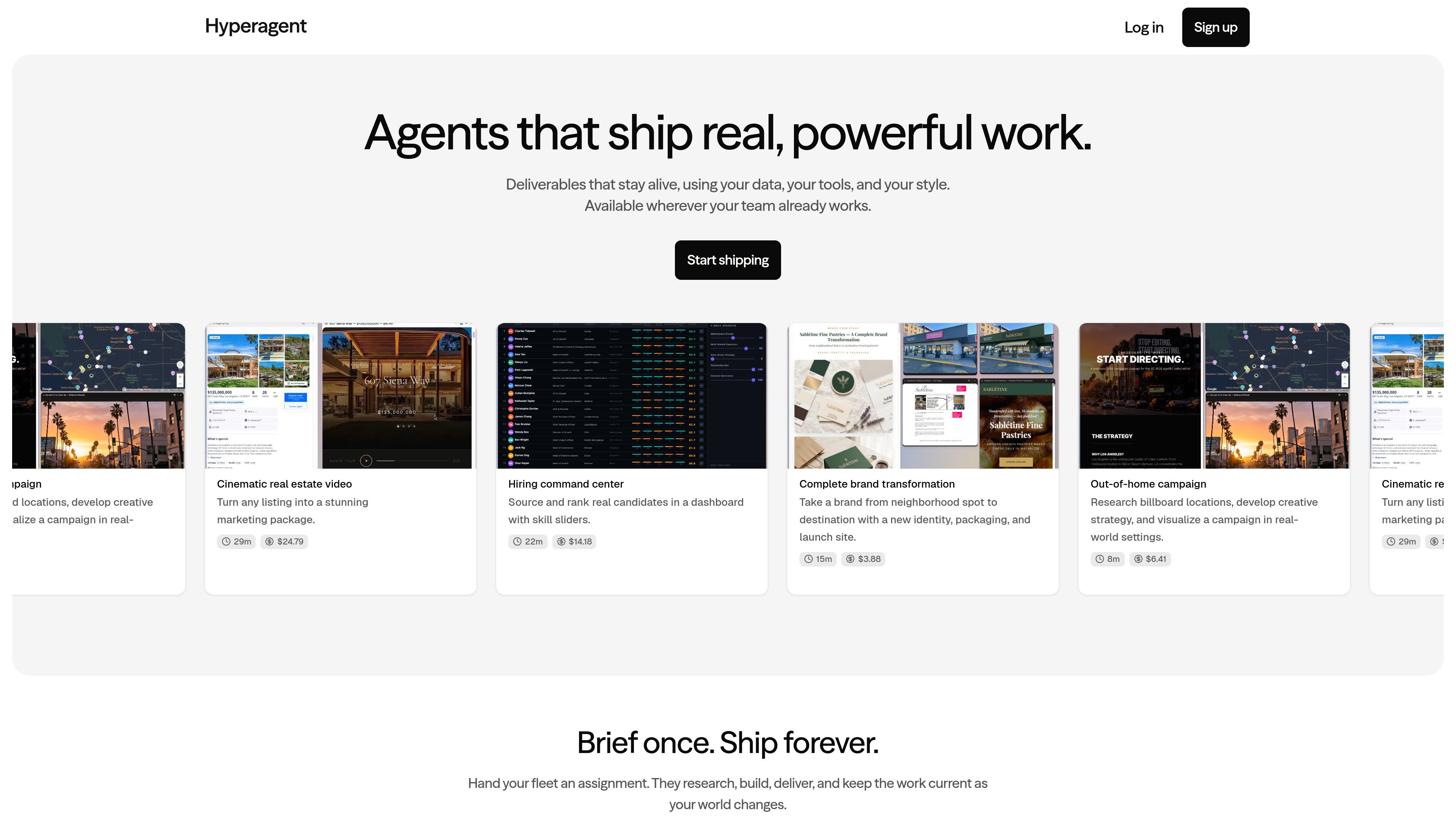
Hyperagent is a hosted system of agents that does real work for teams. The homepage positions it as a way to brief an assignment once and have agents research, build, deliver, and keep the result current as circumstances change.
The product is aimed at work that produces concrete deliverables rather than a single chat response. The source material shows examples such as campaign research, real estate marketing, hiring dashboards, brand transformation, websites, documents, slides, dashboards, and video, with delivery available through channels such as Slack, inboxes, Telegram, webhooks, or scheduled runs.
According to the site, Hyperagent agents work with real browsers and real shells, have their own computing environments, and can show searches, decisions, and artifacts while they execute. The privacy policy also confirms support for linking third-party products and services to enable features and functionality, though the sources do not enumerate a full integration catalog.
Hyperagent turns a prompt into a longer-lived assignment. The homepage says you can brief it once, then the agents research, build, deliver, and keep the work current.
The site says agents use real browsers and real shells, with access to the stack you would hand to a new hire. That points to execution that can gather information, code, and operate tools rather than only draft text.
Hyperagent describes outputs as living deliverables that stay alive and can be kept up to date as conditions change. This makes it suitable for work that needs maintenance after the first delivery.
The homepage lists multiple output formats, including websites, video, slides, documents, dashboards, apps, and sites. It also mentions fully functional websites with live HTML that are built and hosted rather than pasted into a document.
Hyperagent says work can be delivered to Slack, inboxes, or anywhere else, and that you can manage a fleet of agents from one command center. That gives teams a central place to deploy and monitor agent work.
The homepage says Hyperagent shows every search, decision, and artifact as it is built, and that it learns as it goes and generates new memories and skills.
Use Hyperagent when you need a one-off assignment turned into an artifact that can keep updating. The homepage frames this as briefing the fleet once and then having it research, build, deliver, and maintain the work.
Teams can use it to produce campaign-style deliverables such as billboard research and creative strategy, based on the example of an out-of-home campaign on the homepage.
The site shows a real estate video example and says Hyperagent can create marketing packages, so it fits workflows where a listing or similar asset needs packaged output in a polished format.
The homepage includes a hiring command center example that sources and ranks candidates in a dashboard with skill sliders, which suggests it can support structured recruiting research and comparison workflows.
Hyperagent can also be used for publishing and internal communication assets, including briefs, decks, docs, and dashboards, especially when the output needs to be updated as source information changes.
Hyperagent is a hosted system of agents for producing work such as websites, briefs, dashboards, documents, and video. The homepage says the agents research, build, deliver, and keep work current as your world changes.
The homepage says Hyperagent works where your team already works: you can @-mention it in Slack, connect Telegram, use a webhook, or run it on a schedule.
The source material shows Hyperagent connected to Slack, Telegram, webhooks, and scheduled runs. The privacy policy also says certain features let you link third-party products and services to enable functionality, but it does not list specific named integrations beyond that.
The homepage emphasizes that agents have their own computing environment, use real browsers and real shells, and can see searches, decisions, and artifacts as they are built. That suggests a workflow focused on visible execution rather than opaque output generation.
The pricing URL currently returns a 404 on the site, so the public pricing structure is not available from the provided sources.