
Ambient scribing
Glass can capture a clinical encounter in real time and help produce documentation, so the note is drafted while the visit is still in progress.

Glass Health is an AI clinical platform for ambient scribing and decision support, helping clinicians document visits, review evidence, and plan next steps.
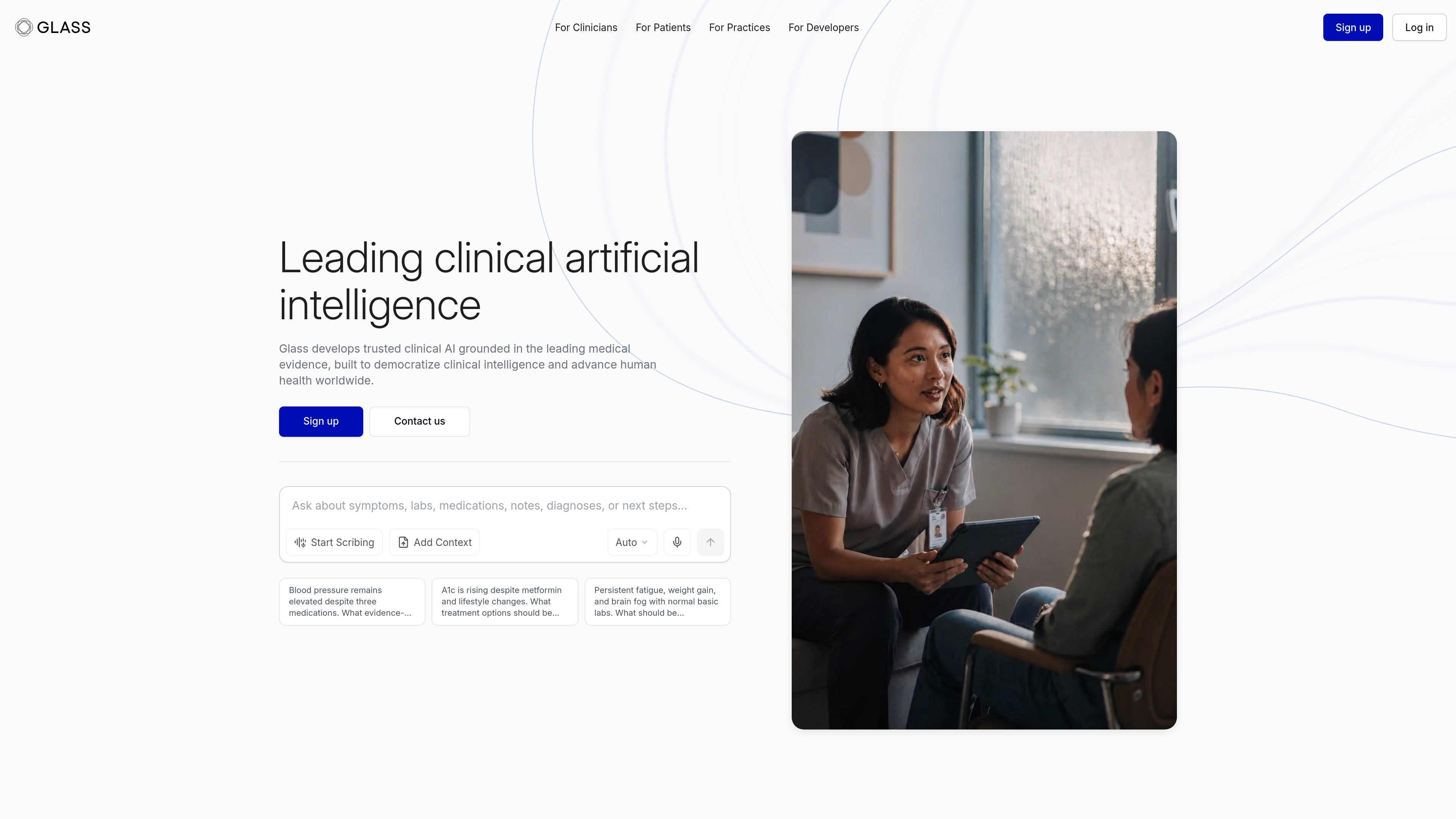
Glass Health is an AI-powered clinical platform for ambient scribing and clinical decision support. It is designed to help clinicians document visits, work through diagnostic questions, and plan next steps with evidence shown alongside the answer.
The site also presents separate experiences for patients, practices, and developers. For clinicians and practices, Glass focuses on in-visit support, chart preparation, after-visit documentation, billing assistance, and EHR-connected workflows; for patients, it organizes records, labs, wearable data, and health goals into a living overview.
Glass can capture a clinical encounter in real time and help produce documentation, so the note is drafted while the visit is still in progress.
The product surfaces suggested questions, differential diagnoses, and possible next steps while a case is unfolding, with evidence behind each answer.
Glass provides evidence-grounded answers that cite peer-reviewed literature, clinical guidelines, and FDA drug information, allowing clinicians to review sources before acting.
For practices, Glass suggests E/M levels, ICD-10-CM diagnosis codes, and CPT or add-on codes based on the documented encounter, along with the reasoning behind each suggestion.
The site says Glass works with existing EHR environments through SMART on FHIR and also functions without an EHR connection, which lets teams start before integration is complete.
Glass can organize patient context such as records, labs, wearable data, and goals into a single view, which the patient-facing pages present as a living health overview.
During a live patient encounter, Glass can draft the note and surface relevant questions, differentials, and next-step considerations as the conversation unfolds.
Before a visit, clinicians can use Glass to pull chart context, recent results, medications, and history into one view so the encounter starts with less searching.
After the visit, practices can review drafted notes, handoffs, and patient instructions, then use coding suggestions to support billing review.
Patients can use Glass to review records, labs, wearable trends, and care gaps in a single overview, then prepare more specific questions for the next appointment.
Organizations can provision clinicians under one admin console and keep access under a single BAA and control layer instead of separate personal accounts.
Glass supports ambient scribing, clinical decision support, and evidence-based answers for clinicians. The site also shows patient- and practice-focused experiences, but it does not publish a full implementation guide on the pages provided.
The pricing page lists four plans: Lite at $0 per month for students, Starter at $18 per month for trainees, Pro at $81 per month for board-certified professionals, and Max from $180 per month for clinics and health systems.
Yes. The site says Glass can work with an EHR through SMART on FHIR and lists support for Athena, Epic, eCW, and Elation on the pricing page. It also says the product can be used without an EHR connection.
The site says Glass is HIPAA compliant, offers BAAs for providers and organizations, and includes PHI safeguards such as encryption and access controls.
Glass positions separate experiences for clinicians, patients, practices, and developers. The pages provided indicate those audiences, but only the clinician and practice flows are described in detail.