
Pipeline modeling with operational views
Apache Hamilton standardizes how teams express data, machine learning, and LLM pipelines, and the hosted UI adds catalog, observability, lineage, and versioning in one place.

Dagworks provides open source and hosted tools for reliable AI workflows, centered on Apache Hamilton for data, ML and LLM pipelines, and Apache Burr for stateful apps and agents.
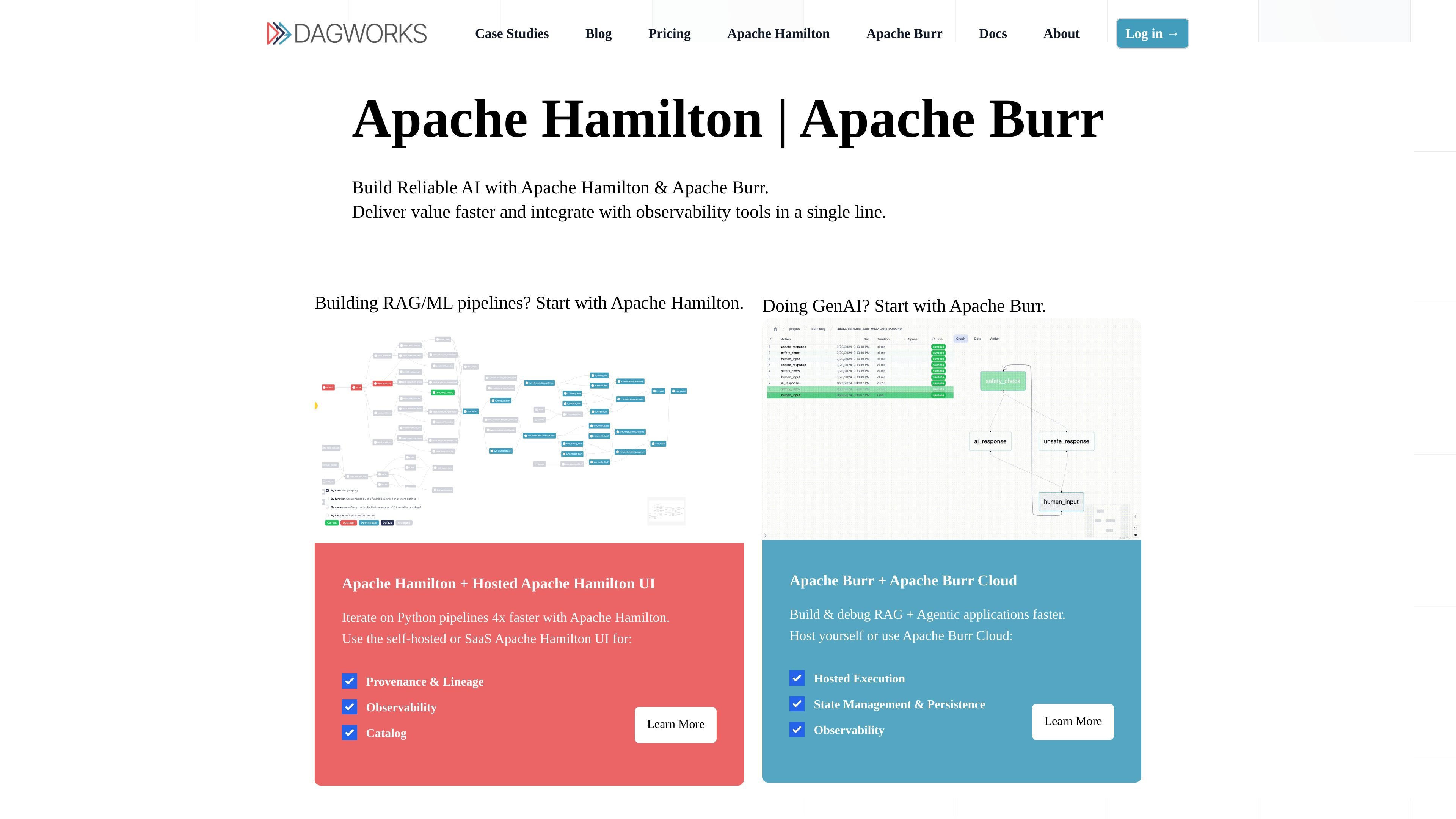
DAGWorks builds open source and hosted tools for reliable AI workflows. Its main products are Apache Hamilton for data, machine learning, and LLM pipelines, and Apache Burr for stateful applications and agents.
The platform centers on adding observability, lineage, cataloging, tracing, and persistence with a small integration step rather than requiring teams to rebuild existing Python workflows. The site presents both self-hosted and cloud options, with hosted UIs for Hamilton and Burr and open source foundations underneath.
Apache Hamilton standardizes how teams express data, machine learning, and LLM pipelines, and the hosted UI adds catalog, observability, lineage, and versioning in one place.
Apache Burr standardizes stateful applications and agents, with a focus on tracing and observability for application behavior.
The Hamilton page says the UI can help resolve issues faster with lineage and pipeline comparison views that show how data, code, and models connect and change over time.
The product presents self-populating lineage, code, catalog, and execution views to reduce onboarding time and make existing workflows easier to understand.
The Burr offering includes telemetry UI and pluggable persistence for self-hosted use, plus hosted execution, state management, persistence, and observability in the cloud version.
DAGWorks says Apache Hamilton runs wherever Python runs and can be used with current orchestration systems, data warehouses, notebooks, web and streaming services, and modeling libraries.
Use Apache Hamilton when you need to define data, ML, or LLM pipelines in Python and want lineage, catalog, observability, and versioning to appear with minimal extra setup.
Use Apache Burr when you are building stateful applications, RAG systems, or agentic workflows and need hosted or self-hosted execution, state management, and observability.
Use the hosted Hamilton UI to trace how data, code, and models relate, compare pipeline versions, and understand changes over time during debugging or maintenance.
Use the product to help new team members understand existing workflows through self-populating lineage, code, catalog, and execution views.
Use the open source frameworks with your current Python-based stack, including orchestration systems, notebooks, warehouses, web services, streaming services, and modeling libraries.
DAGWorks offers hosted Apache Hamilton UI on DAGWorks and Apache Burr Cloud, alongside open source Apache Hamilton and Apache Burr options. The pricing page states that everybody gets a 14-day trial at the Team level, and that Apache Burr Cloud pricing is coming soon.
Apache Hamilton standardizes how individuals and teams express data, machine learning, and LLM pipelines, with catalog, observability, lineage, and versioning available through the hosted UI. Apache Burr standardizes how stateful applications are written and executed, with tracing and observability through a single-line integration.
The source describes Apache Hamilton as useful for data, machine learning, and LLM pipelines, and Apache Burr for stateful applications, agents, RAG, and agentic applications. The Hamilton page also mentions use with orchestration systems, data warehouses, notebooks, web and streaming services, and modeling libraries.
The source does not list a complete integration catalog, but it does state that Apache Hamilton runs wherever Python does and can be used with current orchestration systems, data warehouses, notebooks, web and streaming services, and modeling libraries.
The Hamilton and Burr pages both describe hosted and self-hosted/open source options. The hosted products add UI, execution, persistence, observability, and related workflow views on top of the open source frameworks.