
Unified revenue modules
The platform is organized around revenue teams, with separate Sales Box, Marketing Box, Support Box, and Success Box modules that can be used together for end-to-end RevOps workflows.

Corefactors is a RevOps-enabled CRM platform for sales, marketing, support, and success teams. It combines lead management, automation, reporting, and customer service workflows in tiered plans for small businesses through enterprises.
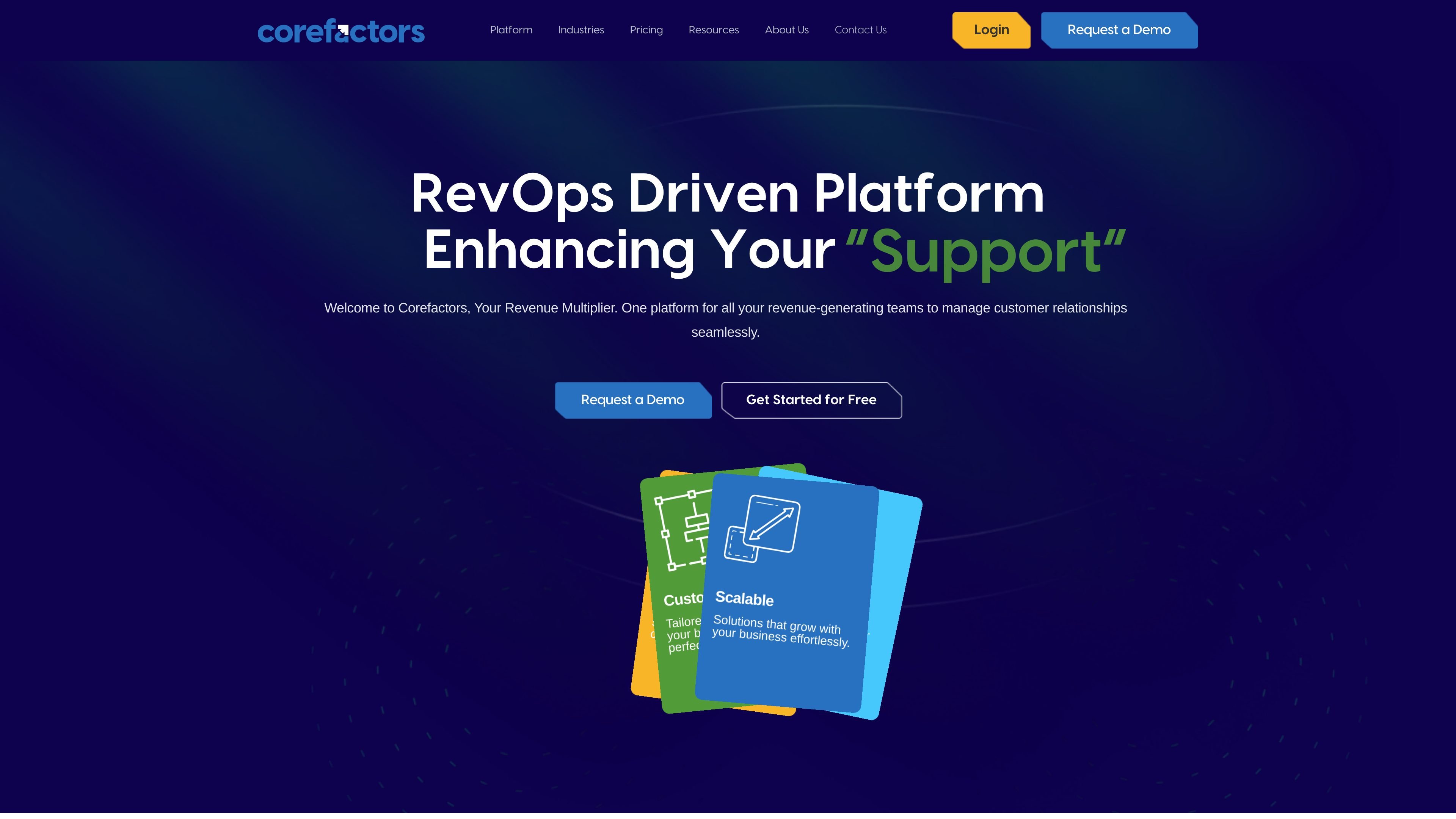
Corefactors is a RevOps-enabled CRM platform that brings sales, marketing, support, and success teams into one system. The site positions it as an all-in-one workspace for tracking customer interactions, automating repetitive work, and reducing revenue leakage across the customer lifecycle.
The product is offered in tiered plans for micro businesses through large and mid-large enterprises, with modules such as Sales Box, Marketing Box, Support Box, and Success Box. Across the site, Corefactors emphasizes customization, scalability, and team alignment rather than a single narrow CRM use case.
The platform is organized around revenue teams, with separate Sales Box, Marketing Box, Support Box, and Success Box modules that can be used together for end-to-end RevOps workflows.
Pricing tiers include capabilities such as lead management, lead scoring, automated workflows, marketing reports, retention management, and ticketing, showing coverage across the customer lifecycle.
The plans reference custom dashboards, reports, lead stage dashboards, productivity and comparison reports, and CRM Intelligence, which support visibility into pipeline and operational performance.
The source lists integrations as part of the plans, ranging from 1 integration in Seed to 10 integrations in Orchard, plus items such as webhooks, WhatsApp Business integration, Meta Ads CPL integrations, and telephony-related tools.
The pricing page includes mobile app access, virtual number call configuration, international calling, attendance management, geo-tracking, and team layout features for distributed sales and service operations.
Corefactors emphasizes configurable setup with custom dashboards, reports, and workflows, along with multi-factor authentication and encryption on the homepage to support controlled deployment.
Use the Sales Box and related lead tools to capture, score, follow up on, and manage opportunities in a single workspace. The pricing page also references productivity reports, mobile access, and call configuration for field-heavy selling teams.
Use the marketing-oriented modules to run campaigns, build landing pages and email workflows, and track marketing reports and lead-stage activity. The source also mentions Meta Ads CPL integrations and mass email/SMS capabilities.
Use Support Box and Success Box to manage ticketing, retention, and customer management after the sale. This fits teams that need one system for service requests and account continuity rather than a separate support tool.
Use the platform when different departments need shared data, dashboards, and workflows instead of isolated tools. The homepage and RevOps CRM page repeatedly frame Corefactors as a cross-functional system for sales, marketing, success, and support.
Use the tiered plans when a business wants to start with basic lead management and later expand into automation, reporting, integrations, and enterprise-oriented team controls as needs grow.
Corefactors is positioned as a RevOps-enabled CRM platform that unifies sales, marketing, support, and success workflows on one system so teams can track interactions and reduce revenue leakage.
Yes. The pricing page shows tiered paid plans for different business sizes, with monthly, quarterly, and annual billing options. It also includes a Starter option for micro and small businesses.
The source presents Corefactors as suitable for startups through enterprises, with modules and pricing tiers aimed at small, medium, large, and mid/large enterprises.
Corefactors includes modules and features for sales, marketing, success, and support, including lead management, workflows, marketing reports, retention management, and ticketing.
The site highlights customization, scalability, user-friendliness, security, and integrations, but the available source text does not provide a complete integration catalog or full implementation detail.