
Natural-language browser automation
Tell BrowserOS what you need in plain language, and the built-in agent handles clicking, typing, and navigation inside the browser.

BrowserOS is an open-source AI browser that automates web tasks from plain-language prompts on macOS, Windows, and Linux, with Chrome extensions and MCP integrations.
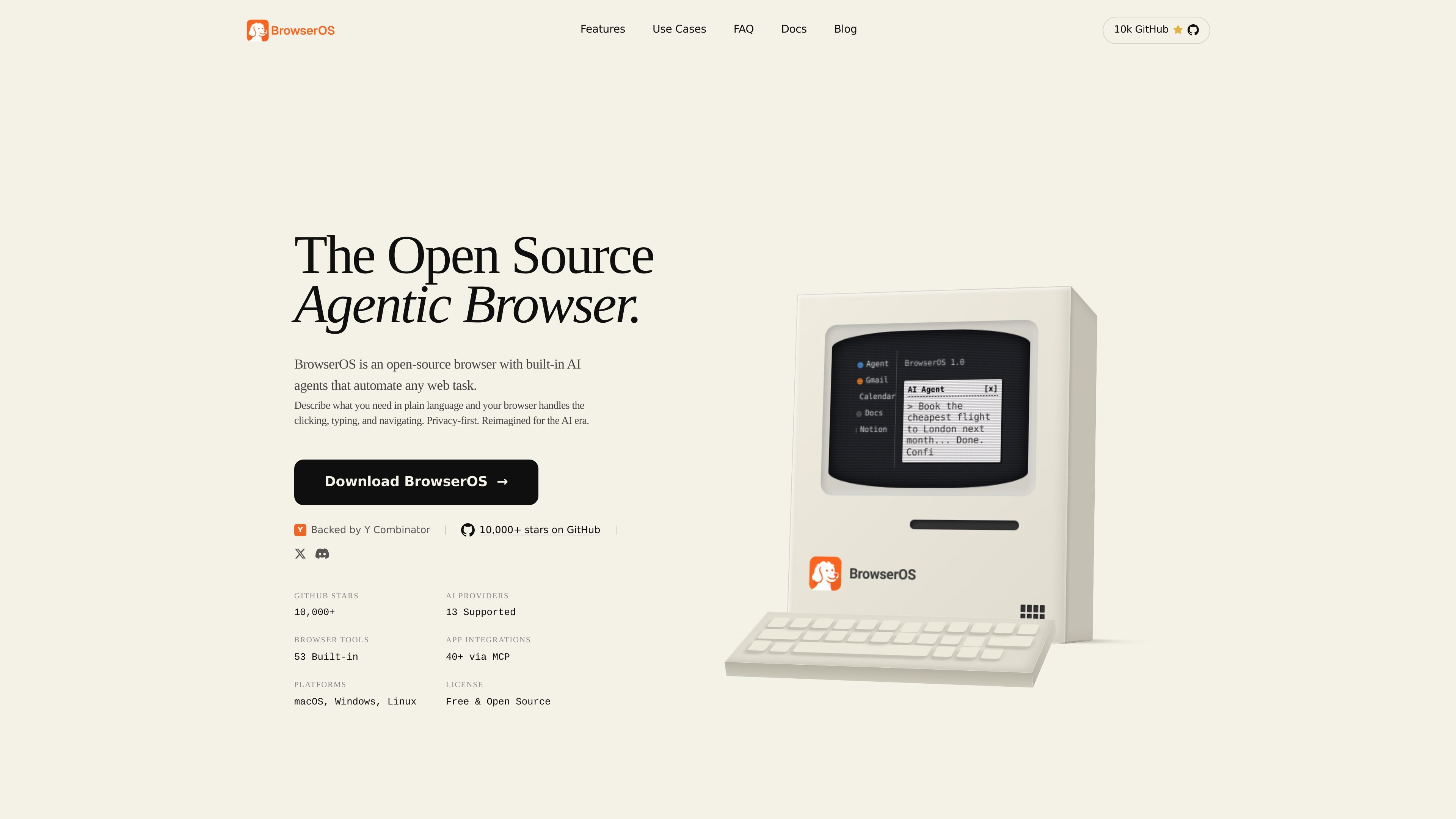
BrowserOS is an open-source browser with built-in AI agents that automate web tasks from plain-language prompts. It is positioned as a privacy-first Chrome alternative for people who want browser automation without relying on a separate app or terminal workflow.
The product runs on macOS, Windows, and Linux, supports Chrome extensions, and offers a Chromium-based browsing experience with AI features layered into the browser itself. The site highlights local execution, support for multiple AI providers, and integration with common work tools through MCP.
Tell BrowserOS what you need in plain language, and the built-in agent handles clicking, typing, and navigation inside the browser.
The browser can browse the web, read local files, and carry out multi-step workflows without requiring terminal commands or extra setup.
Connect a model from providers such as Claude, Gemini, Kimi, OpenAI, OpenRouter, or a local runtime like Ollama and LM Studio, then switch between providers when needed.
Use 40+ built-in integrations through MCP for apps such as Gmail, Slack, Notion, and Calendar, and add custom MCP servers when needed.
Schedule tasks to run automatically and build workflows with loops and conditions for repeatable browser operations.
Use the bundled BrowserOS MCP server with Claude Code, Gemini CLI, or Codex to control browser tasks from the terminal.
Founders can ask for a daily briefing that combines calendar events, Slack highlights, and inbox summaries into one automated workflow.
Developers can drive the browser from Claude Code, Gemini CLI, or Codex to test staging sites, inspect issues, and automate browser checks.
Sales teams can pull open deals, draft follow-up emails, and update CRM notes across tools such as Salesforce and HubSpot.
Researchers can schedule recurring scraping runs to track competitor pricing and organize results in Google Sheets.
Executives and assistants can triage email, create Notion tasks, and block calendar time from a single prompt.
BrowserOS is an open-source browser with built-in AI agents that automate web tasks from plain-language prompts. It focuses on privacy-first, local execution rather than a browser that only adds chat on top.
BrowserOS supports macOS, Windows, and Linux. The site says system requirements are similar to Chrome or Safari standards.
Yes. BrowserOS is a Chromium fork, so Chrome extensions work, and the site says bookmarks, passwords, and extensions can be imported from Chrome.
BrowserOS is free and open source. Cloud AI providers such as OpenAI and Anthropic charge based on usage, while local models through Ollama and LM Studio are described as always free.
BrowserOS supports 11+ AI providers, including Moonshot Kimi, Anthropic Claude, Google Gemini, OpenAI, OpenRouter, and local models through Ollama and LM Studio. The site also says you can switch providers and use your own API keys.