
Prompt-to-PRD workflow
Describe an idea in natural language and let Ardor clarify requirements, define success metrics, and create PRDs with test cases before building starts.

Ardor is a multi-agent software development platform that helps teams move from a natural-language idea to a production-ready agentic app. It combines prompt clarification, visual agent design, build orchestration, deployment, and monitoring in one cloud workflow.
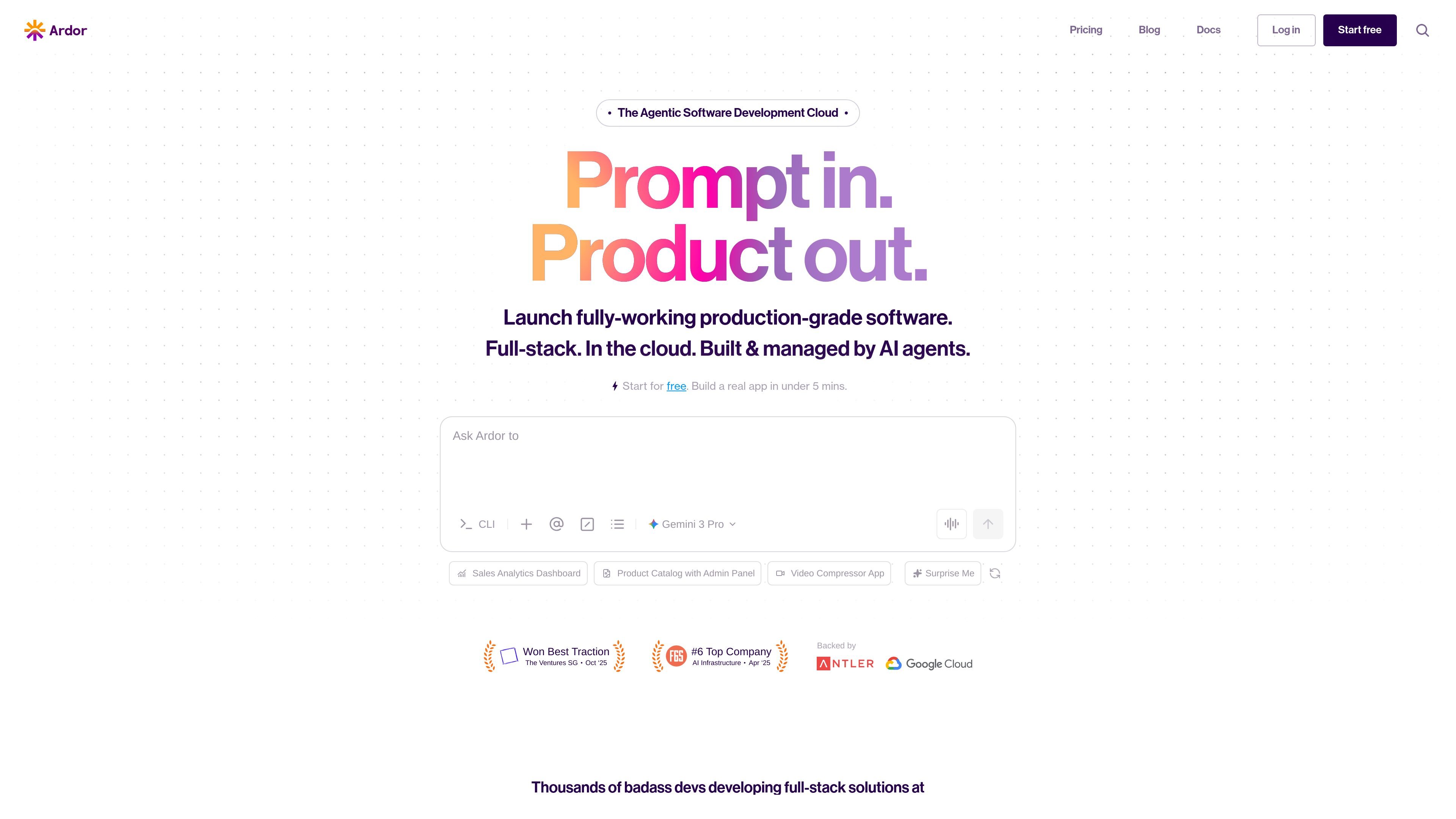
Ardor is a multi-agent, full-stack software development platform for building and deploying agentic software. The site presents it as a cloud product that moves a project from an initial prompt through specification, code generation, infrastructure, deployment, and monitoring.
Its workflow is aimed at turning product ideas into production-ready software with less manual coordination across tools and stages. Users can start from a prompt, shape the requirements, design agents visually in Ardor Canvas, review the build as it progresses, and launch with deployment and monitoring support.
Describe an idea in natural language and let Ardor clarify requirements, define success metrics, and create PRDs with test cases before building starts.
Use Ardor Canvas to design AI agents visually in a low-code, Miro-like workspace with drag-and-drop components and code blocks.
Review and approve architecture and plans while Ardor handles integrations, configurations, and real-time building of the solution.
Refine products with feedback loops, A/B testing, automated updates, and performance optimization guided by the Copilot.
Deploy production-ready solutions with blue/green strategies, health monitoring, and rollback readiness for zero-downtime launches.
Monitor solutions with autonomous debugging and monitoring features that are available on paid plans.
Teams can move from a product idea written in plain language to a structured specification with success metrics and test cases before implementation begins.
Builders who prefer a visual workflow can assemble AI agents on a canvas instead of working only through prompts or code.
Product teams can review architecture, watch the build progress in real time, and iterate with testing and updates as requirements change.
Teams preparing for launch can use the deployment flow to push production-ready software with blue/green strategies and rollback readiness.
Operators on paid plans can use autonomous monitoring and debugging to watch for issues after launch and respond before problems affect performance.
Ardor is a multi-agent, full-stack software development platform that takes a product from spec generation through code, infrastructure, deployment, and monitoring. The source pages describe a workflow that starts from a natural-language prompt and continues through building, iterating, and launching.
The pricing page shows a free plan for curious builders, plus paid Starter and Pro plans. It also lists Teams and Enterprise options, with some plans marked as coming soon.
The pricing page says the free plan includes one solution, queued Copilot requests, and no credit top-ups. Paid plans process requests instantly, allow additional credits, and include guest users and other advanced capabilities depending on plan.
The homepage describes Ardor Canvas as a low-code, Miro-like experience for visually designing AI agents by dragging and dropping components. The workflow also includes prompt clarification, architecture review, real-time building, iteration, and deployment.
The source pages do not provide a full integrations list or detailed platform compatibility information. They do indicate that Ardor handles integrations and configurations during the build process.