
OpenAI-compatible API access
Use API2D with software, websites, and SDKs that can point to a custom OpenAI-compatible endpoint. The site positions this as a 'fill in your key and go' workflow.

API2D is an OpenAI-compatible API platform for connecting supported apps and SDKs to AI models through a custom endpoint, with request caching and key management.
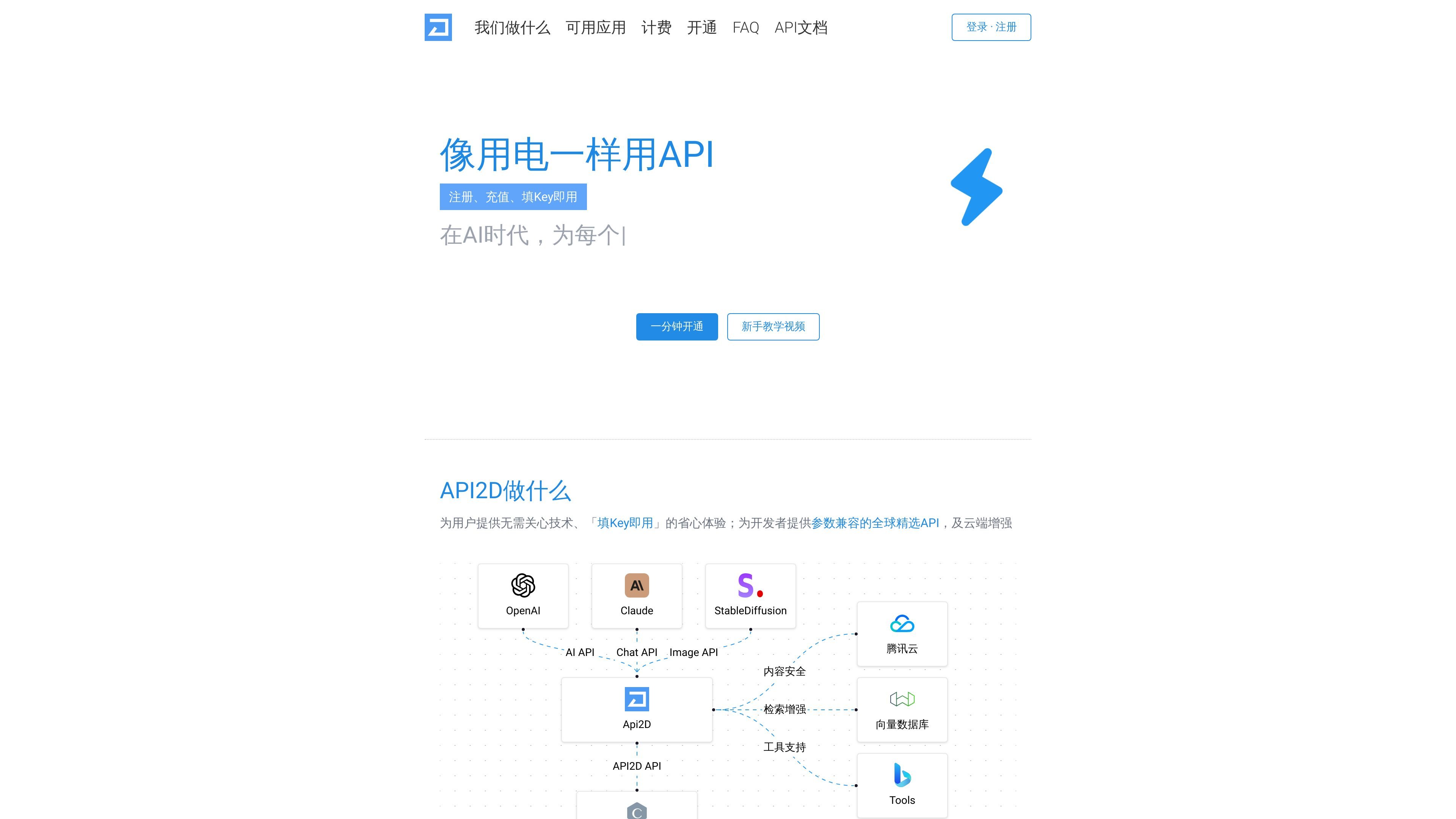
API2D is an API service for developers and application users who want to connect to AI models through an OpenAI-style interface. The site describes it as a 'fill in your key and use it' experience that reduces setup work for supported apps, websites, and SDKs.
Its core offering is parameter-compatible access to a range of APIs, including OpenAI-style models along with Claude, Stability, vector databases, and Azure TTS. The product also adds server-side features such as caching, knowledge-base and search enhancements, and key management tools for grouped usage or reseller-style distribution.
Use API2D with software, websites, and SDKs that can point to a custom OpenAI-compatible endpoint. The site positions this as a 'fill in your key and go' workflow.
The service supports OpenAI's major interfaces as well as Claude, Stability, vector databases, and Azure TTS, based on the site FAQ and product summary.
API2D servers cache identical requests for 24 hours. Cached responses do not consume points, and users can opt out with a request header when fresh responses are needed.
The site describes server-side enhancements such as knowledge-base, search, and business plugin APIs, which can be added through ForwardKey and grouped settings.
Users can create and manage keys in groups, assign defaults such as a model, and add built-in search or drawing capabilities. The site also says agent/reseller functionality is available for qualified accounts.
API2D includes a compatibility/tutorial area for many popular apps, plus documentation and setup guidance for connecting supported clients.
Connect an existing chat app, browser plugin, or desktop client that already supports a custom OpenAI base URL, then point it at API2D instead of a direct provider endpoint.
Build or prototype against OpenAI-style APIs while also reaching other supported services such as Claude or Stability through a single platform.
Reduce repeat-request spend in high-frequency conversational workflows by relying on API2D's 24-hour caching for identical request bodies.
Set up grouped keys with defaults and add search, drawing, or other server-side enhancements when you need more controlled distribution or team-specific behavior.
Follow the site's compatibility tutorials to configure specific apps and SDKs, especially when you need a documented setup path for a popular client.
API2D is intended for software, websites, and SDKs that already support OpenAI-style APIs and allow a custom API base URL or address. The site points users to its compatibility app tutorials after login.
API2D charges by points (P) tied to token usage rather than a fixed monthly fee. The site says pricing is generally about 1.5 times the official provider price, except for the 3.5 yuan recharge tier, and that some requests have a minimum charge of 1P.
The site says API2D supports most OpenAI interfaces, Claude, Stability, vector databases, and Azure TTS. It also notes that some requests can benefit from caching and that not every capability is identical to the consumer ChatGPT product because API2D follows API-style interfaces.
API2D supports WeChat, Alipay, Chinese bank cards, and Stripe credit cards according to the pricing page.
The site says cached requests are free, cache entries last 24 hours, and users can bypass cache with the `x-api2d-no-cache: 1` request header.