
EHR connectivity
March Health says it connects with Epic, Cerner, and other EHRs through FHIR/HL7 standards so clinicians can keep existing workflows in place.
March Health is a healthcare AI platform for hospitals and health systems with a patient-level digital twin for readmission reduction, safety monitoring, discharge planning, and in-workflow clinical guidance.
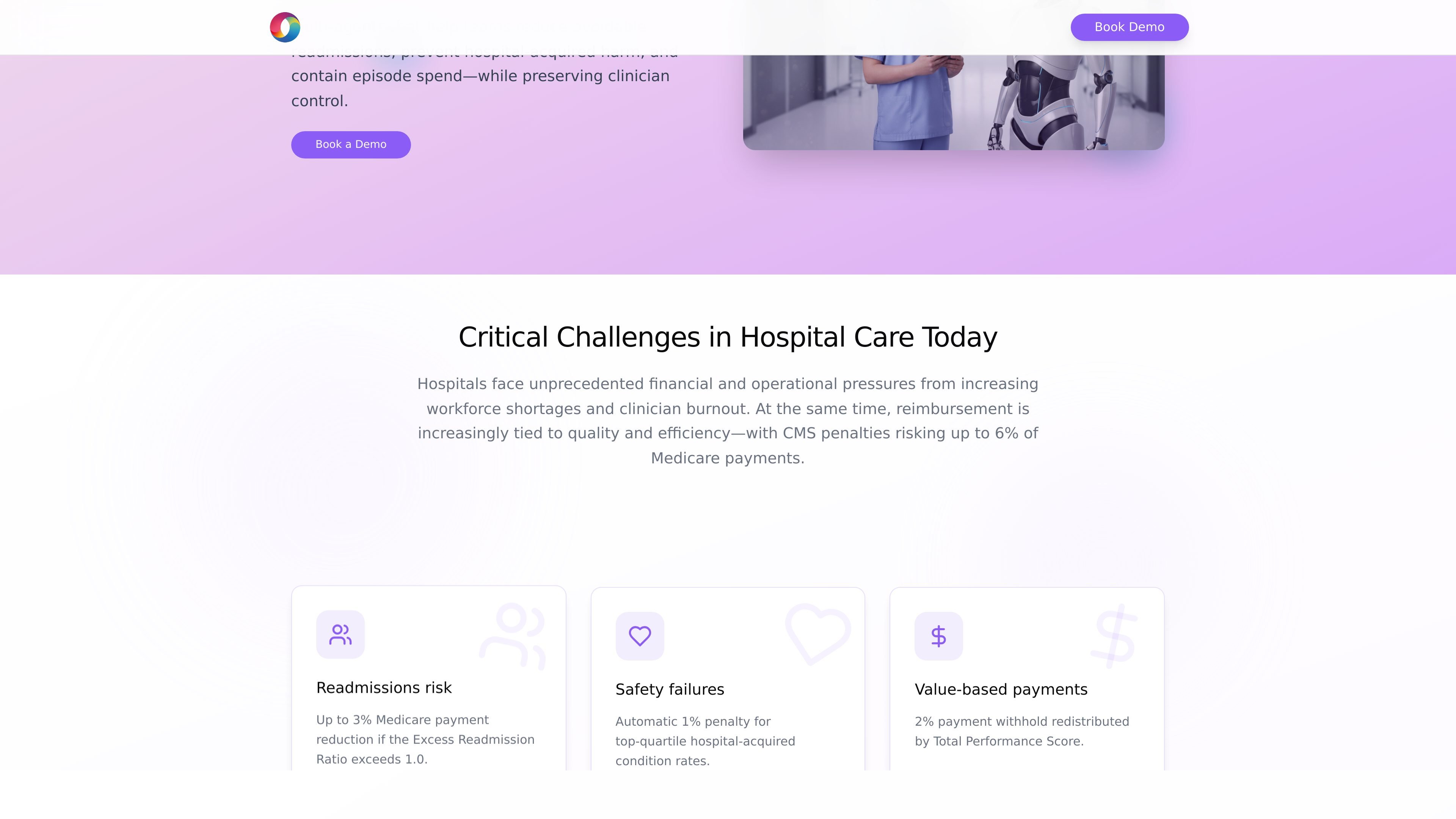
March Health is a healthcare AI platform centered on a patient-level digital twin for hospitals and health systems. It is designed to help care teams reduce avoidable readmissions, prevent hospital-acquired harm, and manage episode spend while keeping clinicians in control.
According to the site, the platform connects to existing EHR environments, combines medical history with labs, imaging, and real-time data, and uses specialized AI agents to monitor risk and support discharge planning and documentation. The output is delivered inside clinician workflows as guidance rather than as a separate standalone tool.
March Health says it connects with Epic, Cerner, and other EHRs through FHIR/HL7 standards so clinicians can keep existing workflows in place.
The platform creates a patient-level digital twin using medical history, labs, imaging, and real-time data.
Specialized agents monitor infection risk, readmission risk, and safety events, while other agents assist with discharge planning and documentation.
The system surfaces next-best-action recommendations inside the EHR to help clinicians make faster, evidence-based decisions.
March Health says outcomes are fed back into the system so recommendations can be refined over time.
The site also highlights embedded digital coaching and ambient AI as patient-facing support tools.
Care teams can use March Health to surface readmission risk and support discharge decisions for patients who need closer follow-up before leaving the hospital.
Hospitals can monitor infection risk and safety events to support earlier intervention and reduce avoidable harm during inpatient care.
Clinicians can receive in-workflow next-best-action guidance while documenting care, which may reduce manual effort during routine decision-making.
Health systems can use the platform to connect outcomes back into the model and refine recommendations over time as practice patterns and evidence change.
The site positions March Health as a digital twin platform for hospitals and health systems. It connects to EHR data, builds a patient-level digital twin, and returns next-best-action guidance inside the workflow.
The homepage says March Health connects with Epic, Cerner, and other EHRs using FHIR/HL7 standards, with guidance delivered inside clinician workflows.
March Health says it supports readmission risk, infection risk, safety events, discharge planning, documentation, and continuous improvement based on outcomes.
The site states that the platform is developed with Mayo Clinic expert curation and is designed to meet FDA Clinical Decision Support guidelines and enterprise HIPAA and SOC 2 standards.
The pricing page is blocked by a cookie challenge in the collected sources, so pricing details are not visible from the provided evidence.