
Multiple deployment paths
Deploy models from Hugging Face, Git, Docker, or the CLI, then use automatic redeploy to keep endpoints in sync with code changes.

Inferless is a serverless GPU inference platform for deploying custom machine learning models from Hugging Face, Git, Docker, or the CLI. Autoscaling and per-second billing.
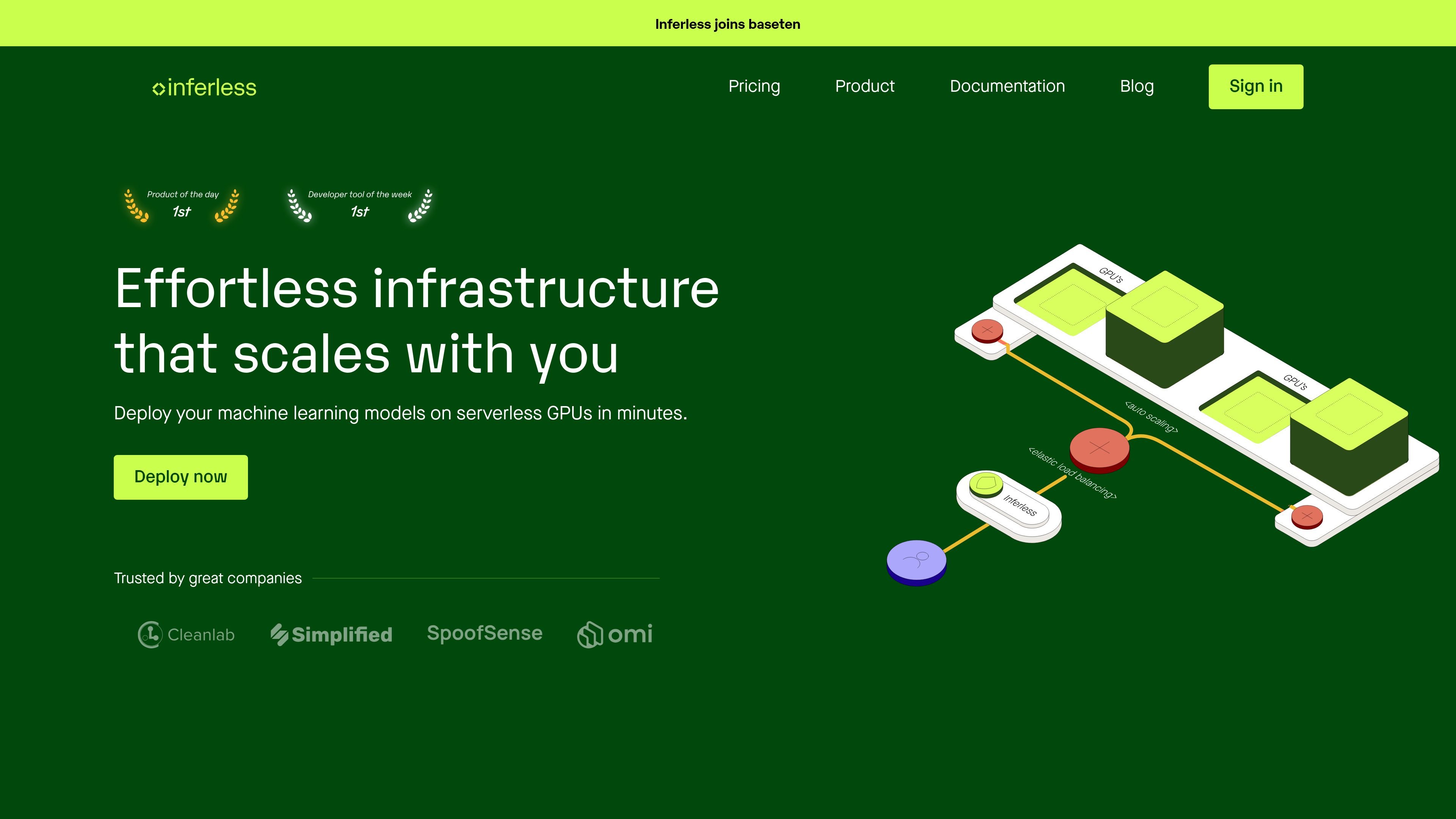
Inferless is a serverless GPU inference platform for deploying custom machine learning models. It is built to take a model from file to endpoint in minutes and is positioned for production workloads that need GPU-backed inference without managing infrastructure directly.
The platform supports deployment from Hugging Face, Git, Docker, or the CLI, and it adds operational controls such as automatic redeploy, custom runtimes, writable volumes, monitoring, dynamic batching, and private endpoint settings. The pricing page shows pay-per-second billing on NVIDIA T4, A10, and A100 GPUs, with shared and dedicated instance options.
Deploy models from Hugging Face, Git, Docker, or the CLI, then use automatic redeploy to keep endpoints in sync with code changes.
Scale model endpoints from zero to hundreds of GPUs, with an in-house load balancer that adjusts capacity based on demand.
Customize the container environment to include the software and dependencies your model needs at runtime.
Use NFS-like writable volumes with simultaneous connections to multiple replicas for model files and other shared data.
Enable server-side request combining to increase throughput for workloads that benefit from batching.
Inspect call and build logs, and configure endpoint behavior such as scale-down, timeout, concurrency, testing, and webhook settings.
Deploy GPU-backed inference for computer vision, NLP, recommendation, or scientific computing models without managing GPU clusters directly.
Handle workloads that fluctuate heavily by scaling endpoints from zero to hundreds of GPUs as requests increase or fall off.
Serve models that benefit from request combining, using dynamic batching to improve throughput under load.
Run model updates through automated redeploy flows so changes in Hugging Face, Git, Docker, or CLI-based workflows reach the endpoint with less manual re-importing.
Choose shared or dedicated GPU instances based on whether the priority is lower cost or more consistent resource allocation and isolation.
Inferless is designed for deploying GPU-based machine learning models. The source examples mention computer vision, NLP, recommendation, and scientific computing workloads, along with models such as Llama2 13B, Stable Diffusion ControlNet, and Vicuna 7B.
The home page says you can deploy from Hugging Face, Git, Docker, or your CLI. It also supports automatic redeploy so model updates can be pushed without manual re-imports.
Inferless uses pay-per-second billing. Charges are based on the time your model runs in a healthy state and the machine type you select, and the pricing page says there are no upfront costs.
The pricing page says first-time calls can have a 10–20 second cold start, while later calls depend on inference time. That means latency can vary depending on whether the model is already warm.
Inferless says shared instances split GPU resources across users for a lower-cost option, while dedicated instances reserve the full GPU for one user and are positioned for more consistent performance and data isolation.