
Built-in HTTP services
Each container exposes Linux capabilities through HTTPS endpoints, including terminal, files, display, browser, SQLite, code, curl, notifications, pipe, notes, watch, app, and tunnel services.

Hoody is a bare-metal computing platform that exposes containers, terminals, displays, and other Linux services as HTTP endpoints. It is aimed at developers and teams who want persistent, URL-addressable environments for building, testing, and running software.
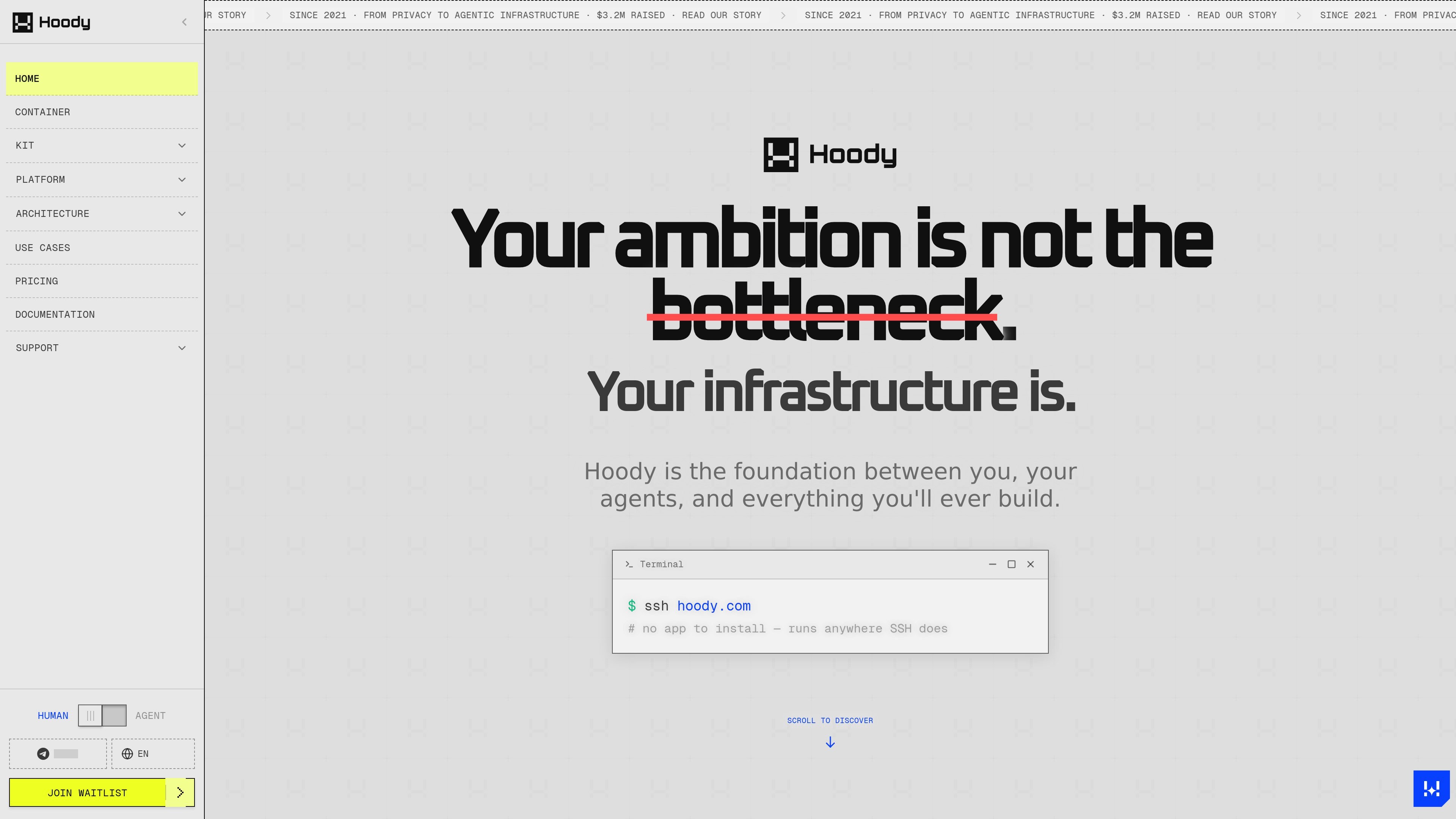
Hoody is a computing platform built around the idea that containers, terminals, displays, databases, browser sessions, and AI agents can all be addressed through the same HTTP protocol. Its homepage describes it as “computers that are URLs,” and the platform presents each container as a real Linux computer with multiple built-in services exposed as secure HTTPS endpoints.
The product is centered on bare-metal machines rather than shared virtualized infrastructure. The site emphasizes fast boot times, persistent containers, snapshots, and URL-based access so teams can run workloads, inspect state, and hand live environments to other people or agents without adding separate deployment layers.
Each container exposes Linux capabilities through HTTPS endpoints, including terminal, files, display, browser, SQLite, code, curl, notifications, pipe, notes, watch, app, and tunnel services.
Containers boot in seconds and start with 18 live endpoints without extra deployment glue. The container page shows one POST request creating a container and then surfacing URLs for each service.
Containers support start, stop, restart, pause, resume, copy, sync, and snapshot actions through HTTP verbs. The site also says state can be restored or branched from snapshots.
The container page says isolation is kernel-enforced with separate filesystem, network, and process namespaces, plus per-container firewall controls and hardened kernel settings.
The pricing page describes bare-metal servers with no shared hypervisor, no virtualization overhead, and persistent machines that run until stopped. It also says containers are unlimited on a machine.
Hoody AI is described as a pay-as-you-go gateway with transparent markup, container-based auth, zero API keys in code, and an MCP client built in.
Spin up a frontend, API, and database in separate containers, then work against live URLs instead of local-only services. The homepage explicitly describes this as a way to build and test an app, snapshot the environments, and point a domain to production.
Run commands over the terminal endpoint, inspect files, query SQLite, and use the browser or display endpoints from a shared container. This suits developers who want a live environment they can address remotely with URLs.
Use snapshots, copy, and sync to preserve state, clone environments, or restore a machine after changes. The container page frames these actions as HTTP operations on the container itself.
Connect an AI agent to the same URL-based primitives that humans use, including terminal, browser, code, and other service endpoints. The product describes its direction as agentic infrastructure and has a separate agent-mode surface in progress.
Use the free machine for hobbies and learning, then move to dedicated bare-metal servers when the workload needs more CPU, RAM, storage, or domains. The pricing page positions this as the path from experimentation to production.
Hoody presents itself as infrastructure for containers, terminals, displays, and AI agents that share the same HTTP protocol. The site says containers are created through HTTP and expose built-in services as live URLs.
The site emphasizes containers that boot in seconds, persist by default, and expose services over HTTPS. It also highlights bare-metal servers, so the product is aimed at developers and teams building and running software on hosted machines.
The container page says each container comes with 18 built-in HTTP services, and the docs preview says the launch docs will cover APIs, service guides, and integration recipes. The public docs page is still marked coming soon.
The pricing page shows a free machine for hobby projects and dedicated bare-metal servers from $29.90/mo. It also lists Hoody AI as pay-as-you-go with a transparent 5% markup.
The docs page says the public documentation is coming soon, and the agent-mode page is also marked coming soon. That means some workflows and integrations are still being finalized publicly.