
General-purpose agent model family
The Seed2.0 series is described as a set of general-purpose agent models in Pro, Lite, and Mini sizes, with improved multimodal understanding and stronger LLM and agent performance.

ByteDance Seed is ByteDance’s AI research and model platform, covering foundation models for language, speech, vision, multimodal interaction, robotics, and science. Its public pages highlight Seed2.0 and other specialized models for real-world and multimodal tasks.
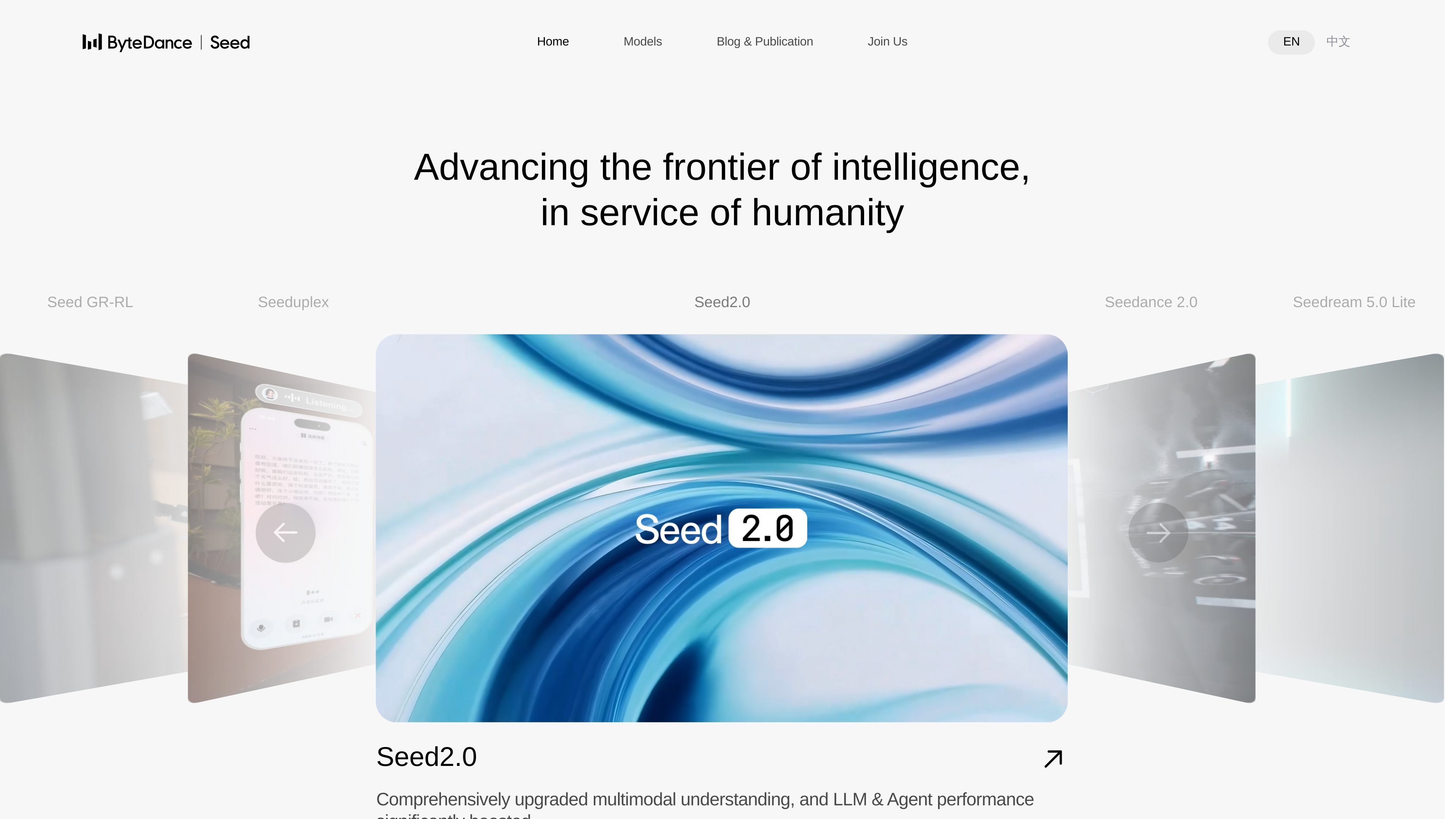
ByteDance Seed is ByteDance’s research and model platform for general intelligence work, launched by the Seed team in 2023. The site presents Seed as a portfolio of foundation models and research efforts spanning LLMs, speech, vision, multimodal interaction, world models, infrastructure, AI for Science, and robotics.
The public model catalog includes general-purpose models such as Seed2.0 and Seed1.8, along with specialized systems for image generation, video generation, speech, simultaneous interpretation, 3D generation, robot learning, and scientific modeling. The product pages position these models for real-world tasks such as multimodal understanding, complex instruction following, interactive content generation, and long-horizon execution.
Seed2.0 is the most detailed product page in the source set. It describes a three-model family—Pro, Lite, and Mini—focused on production deployment, with unified understanding across audio, image, video, and text, plus agent and coding capabilities. The page also emphasizes evaluation results, practical workflows, and documentation links such as Model Card, Tech Blog, Try Now, and API.
The Seed2.0 series is described as a set of general-purpose agent models in Pro, Lite, and Mini sizes, with improved multimodal understanding and stronger LLM and agent performance.
Seed2.0 natively supports unified understanding across video, image, audio, and text, and the late-April update to Seed2.0 Lite adds audio input for omni-modal understanding.
The Seed2.0 page highlights real-world task execution, including long-horizon, multi-step instructions and complex workflows, with a focus on stability and reliability.
The model page shows interactive use cases such as turning a single image into a web page, real-time fitness assistance, and complex chart understanding and reconstruction.
The catalog includes specialized models for speech, image, video, 3D, robotics, and science, such as Seeduplex, Seedream 5.0 Lite, Seedance 2.0, Seed3D 2.0, Seed LiveInterpret 2.0, Seed GR-RL, and Protenix.
The Seed2.0 page includes API and Model Card links, indicating that the models are presented with product documentation and programmatic access entry points.
Use Seed2.0 when a product or internal team needs a general-purpose model that can handle long-horizon instructions, multimodal inputs, and agent-style workflows in a single system.
Use the vision and multimodal models for tasks such as extracting structured information from images, understanding charts, or turning an image into a web page.
Use Seedance 2.0 for multimodal audio-video generation tasks where text, image, audio, and video inputs need to be combined in one workflow.
Use Seeduplex or Seed LiveInterpret 2.0 for speech-oriented applications that need duplex interaction or simultaneous interpretation with low-latency behavior.
Use Seed3D and robotics models for 3D generation, geometric reconstruction, or long-horizon dexterous manipulation research and prototyping.
The source shows a model catalog and several model pages, but it does not provide a single account or signup flow description. The pricing page currently resolves to a 404-style page, so there is no usable pricing detail to summarize.
Seed2.0 is presented with Pro, Lite, and Mini variants. The Seed2.0 page says the series is designed for large-scale production deployment and for complex real-world tasks.
The model catalog lists Seed2.0, Seedance 2.0, Seedream 5.0 Lite, Seeduplex, Seed LiveInterpret 2.0, Seed GR-RL, Seed3D 2.0, Seed1.8, Seed1.6, Seed1.5-VL, and other research and model releases.
The source explicitly mentions model cards, tech blogs, API, and a Try Now entry on the Seed2.0 page, but it does not document the setup steps or supported platforms in detail.