Startup boilerplate
Provides starter code for login, payments, email sending, SEO, a blog, and UI components so a new product can begin with common building blocks already in place.
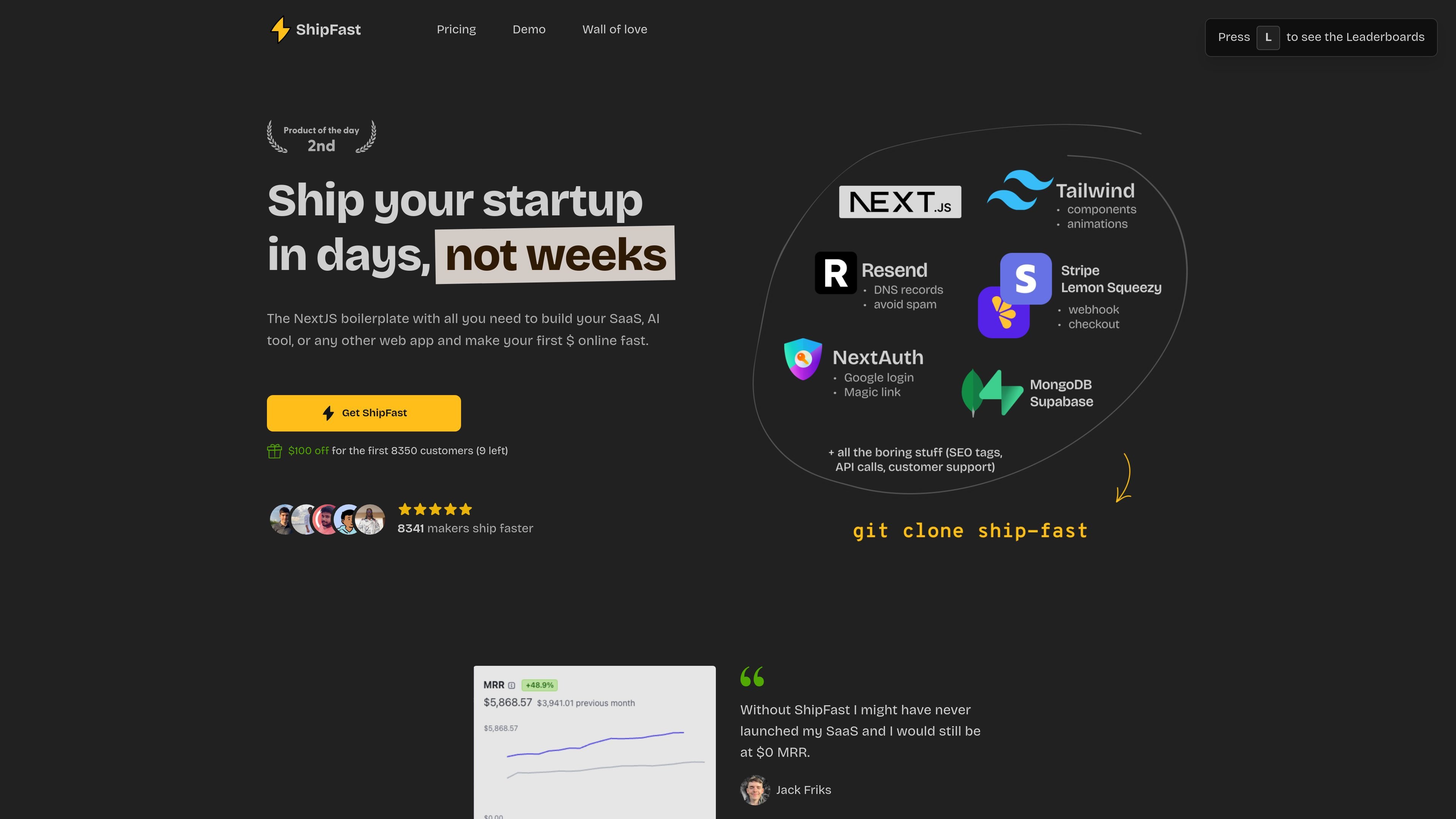
ShipFast is a Next.js boilerplate for building SaaS products, AI tools, and other web apps with starter code for login, payments, email, SEO, and database setup. It is aimed at makers who want to launch faster on a React and Next.js stack.
ShipFast is a Next.js boilerplate for building SaaS products, AI tools, and other web apps with the common startup plumbing already prepared. The homepage describes it as a way to get a product in front of customers quickly, and the documentation walks through local setup, project structure, and environment configuration.
The site emphasizes the parts that usually slow down a launch: emails, Stripe webhooks, login, SEO, database setup, and reusable UI sections. It also presents the codebase as usable with either JavaScript or TypeScript, and with either the `/app` router or `/pages` router, so teams can fit it into the Next.js structure they already prefer.
ShipFast is positioned for makers who want to ship faster and avoid rebuilding the same foundation on every project. The leaderboard page extends that idea into a public showcase, where opted-in startups are ranked by revenue and displayed to other visitors.
Provides starter code for login, payments, email sending, SEO, a blog, and UI components so a new product can begin with common building blocks already in place.
Supports both JavaScript and TypeScript, and the documentation shows paths for both the `/app` router and `/pages` router.
Includes documented setup for transactional email, payment processing, database connections, and authentication with Google OAuth and magic links.
Shows configuration guidance for environment variables and local development so users can run the project from a fresh clone.
Offers copyable sections and UI pieces such as pricing, FAQ, and blog components to reduce repeated front-end work.
Includes a Discord community and leaderboards, with the leaderboard page showing revenue-ranked startups verified by Stripe.
A founder can start from a codebase that already includes login, payments, email handling, SEO setup, and database wiring instead of assembling each piece from scratch.
An AI product builder can use the included boilerplate and UI sections to move from idea to a working app without first building the same foundation repeatedly.
A solo developer can follow the documentation to clone the repo, install dependencies, configure environment variables, and run the starter locally.
A maker who wants to compare results with others can use the leaderboard and Discord community features to share progress and see opted-in revenue rankings.
A team that already uses Next.js can adopt the starter with either router style and with either JavaScript or TypeScript, depending on their existing codebase.
ShipFast provides a Next.js starter with boilerplate for common startup needs such as login, payments, emails, a blog, UI components, and database setup. The documentation also covers how to set it up locally and configure environment variables.
The documentation shows setup paths for both the `/app` router and the `/pages` router, and the codebase is available in JavaScript and TypeScript. The site says it works with React and Next.js, so it fits developers comfortable with that stack.
The homepage says ShipFast includes options for Mailgun or Resend for transactional email, Stripe or Lemon Squeezy for payments, and MongoDB or Supabase for data storage. It also mentions Google OAuth and magic links for authentication.
The pricing page on the site was unavailable, so the public materials here do not confirm plan names, billing cadence, or exact pricing beyond the homepage pricing section and discount messaging.
The homepage positions ShipFast as a starter for SaaS, AI tools, and other web apps, with the goal of helping solo makers launch faster and avoid repetitive setup work.