
Text and image moderation
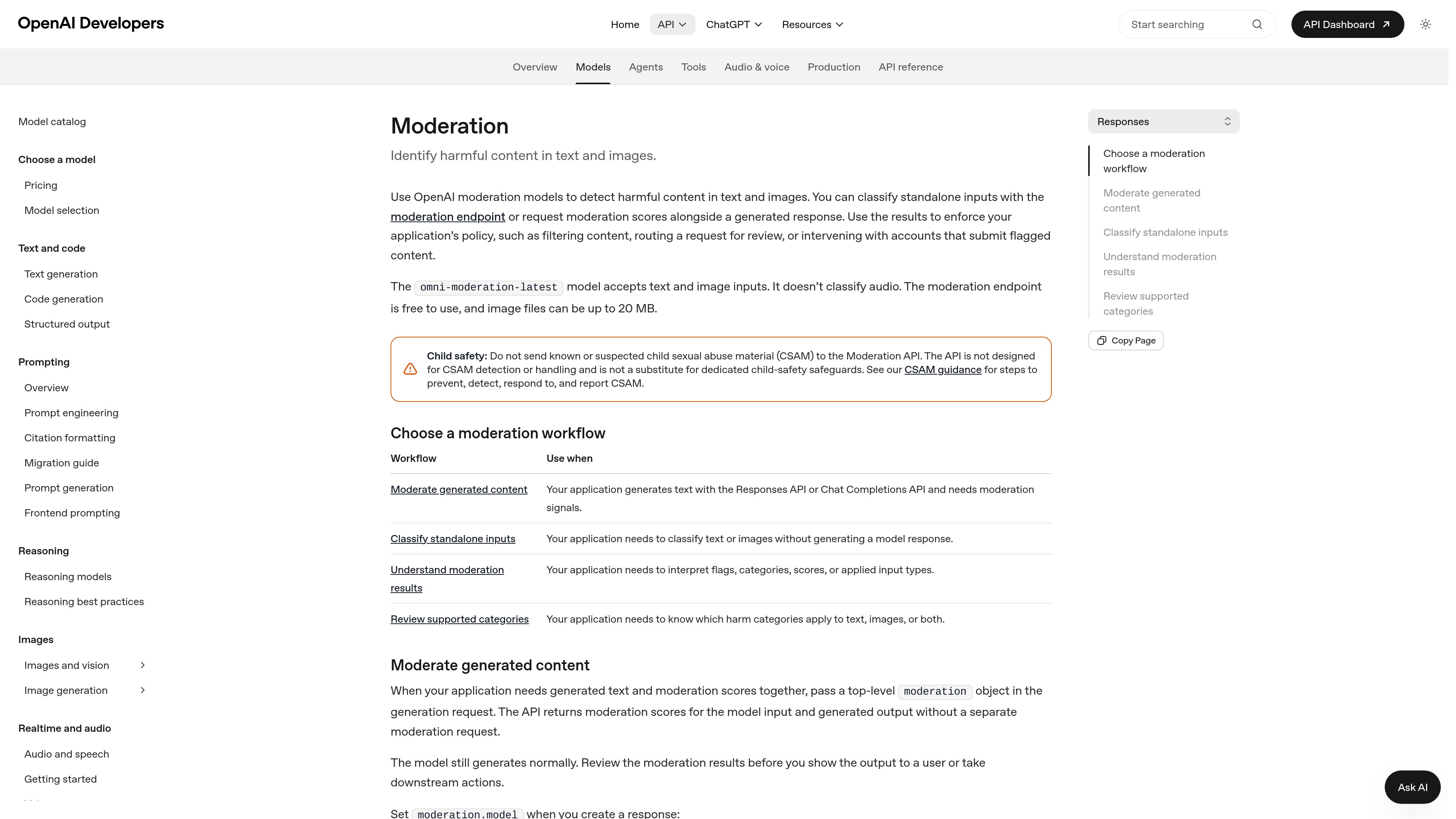
The `omni-moderation-latest` model accepts text and image inputs. It does not classify audio, and image files can be up to 20 MB.

OpenAI Moderation helps applications identify potentially harmful content in text and images. Developers can classify standalone inputs or receive moderation signals alongside generated responses through the OpenAI API.
OpenAI Moderation is an OpenAI API capability for identifying potentially harmful content in text and images. Applications can submit standalone inputs to the moderation endpoint or request moderation results as part of a response-generation request. The returned signals can support application policies such as filtering content, routing items for review, or taking action on accounts that submit flagged material.
The `omni-moderation-latest` model accepts text and image inputs. It does not classify audio, and image files can be up to 20 MB.
Use the moderation endpoint when an application needs to assess text or images without generating a model response.
Add a moderation object to a Responses API or Chat Completions API generation request to receive moderation scores for the model input and generated output without making a separate moderation request.
Results can include a flagged status, moderation categories, and scores. Applications should review these results before displaying generated output or taking downstream action.
Moderation results can be incorporated into application rules for filtering, human review, or intervention on accounts that submit flagged content.
Classify text or images before publishing them in a community, marketplace, or other user-facing experience, then apply the application’s content policy.
Request moderation signals alongside generated text and inspect the input and output results before showing a response to a user.
Use categories, scores, and flagged statuses to send selected items to a human-review workflow instead of applying the same action to every submission.
Assess supported combinations of text and images when an application accepts both modalities, while handling audio through a separate approach.
The documented `omni-moderation-latest` model accepts text and image inputs. It does not classify audio. Image files can be up to 20 MB.
Yes. The moderation endpoint can classify standalone text or images without generating a model response.
Yes. For requests made through the Responses API or Chat Completions API, add a top-level moderation object with a moderation model. The API returns moderation results for the model input and generated output while the model still generates normally.
The results can inform actions such as filtering content, routing a request for review, or intervening with accounts that submit flagged content. OpenAI advises reviewing results before displaying generated output or taking downstream actions.
No. The documented guidance says not to send known or suspected child sexual abuse material to the Moderation API. It is not designed for CSAM detection or handling and is not a substitute for dedicated child-safety safeguards.

sightengine.com
用于审核和分析图像、视频、文本与音频的 API 平台

arena.im
Arena 是面向网站和应用的社区互动平台,提供评论、实时博客、群聊、投票和 AI 辅助审核功能,帮助出版商、媒体、品牌及电商团队将受众互动引导至自有平台。

communityone.io
CommunityOne 是面向 Discord 社区的 AI 支持、管理、互动、发现与分析平台,帮助服务器运营者自动化日常工作,并了解成员在 Discord、网站和 YouTube 评论中的互动。

sendbird.com
面向企业的 AI 客户体验平台,支持聊天、客服、内容审核和 AI 辅助互动
thehive.ai
Hive provides APIs for understanding, searching, moderating, and generating text, image, video, and audio content. Developers can use its pre-trained and open-source models for content workflows such as moderation, classification, brand protection, and media generation.

canopy.us
Canopy 是一款面向家庭和成人的内容过滤与家长控制应用,可过滤网站、社交媒体和 AI 聊天机器人中的露骨图片、视频及文字,同时不会屏蔽整个互联网。