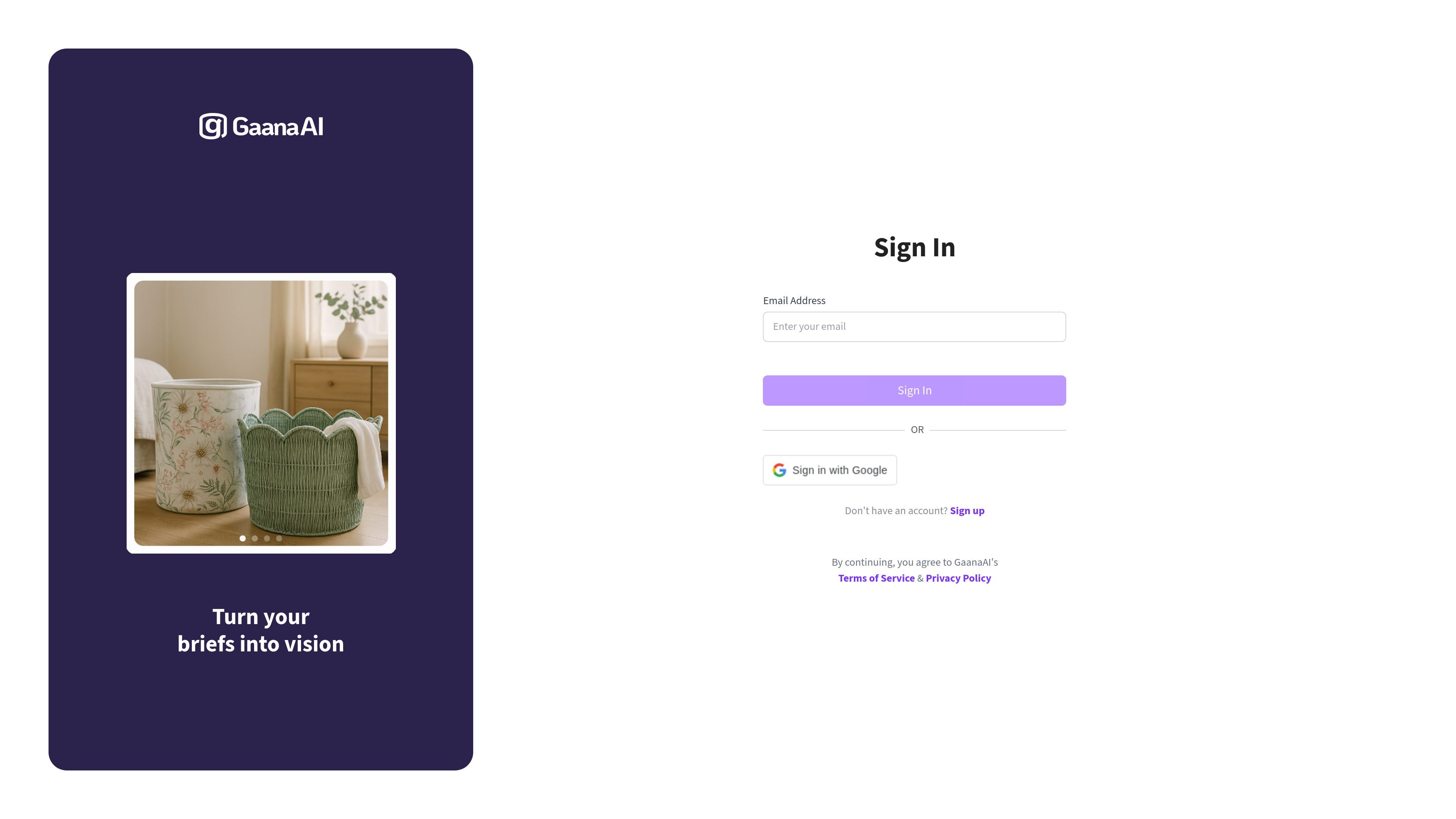
Email- and phone-based registration
A sign-up form collects first name, last name, email, and phone number, giving the product a clear account-registration entry point.
GaanaAI is a web app with a brief-to-vision positioning and a simple account-based entry flow. The public pages show sign-up and sign-in screens rather than a detailed feature tour, so the clearest documented behavior is account creation followed by access to the app.
The sign-up form asks for first name, last name, email, and phone number, and the site says the email is used to send an OTP code. That suggests GaanaAI uses code-based verification before users can continue into the product, but the collected pages do not describe the full creation or generation workflow beyond the tagline.
A sign-up form collects first name, last name, email, and phone number, giving the product a clear account-registration entry point.
The sign-up page notes that the email address is used to send an OTP code, indicating code-based account verification.
The interface offers both sign-up and sign-in paths, so returning users can access the app without creating a new account.
The product promise, "Turn your briefs into vision," indicates that the app is built around converting written inputs into visual output or a vision-oriented result.
The pages include Terms of Service and Privacy Policy consent language, which is part of the account creation flow.
A new visitor can create an account using basic contact details and receive an OTP code by email to continue into the app.
Someone who already has access can use the sign-in page to return to the app without re-registering.
A user with a short brief or concept can use GaanaAI’s stated brief-to-vision positioning as the starting point for exploring a visual outcome.
A user deciding whether to proceed can evaluate the product from the landing page’s limited public information and account requirements before signing up.
The source pages show a sign-up flow that collects first name, last name, email, and phone number, and says the email will be used to send an OTP code. It does not show the rest of the onboarding flow.
The product pages do not describe specific output formats. The visible message, "Turn your briefs into vision," suggests a brief-to-visual workflow, but the rendered pages do not explain the exact outputs.
The collected pages do not show a pricing table, plan names, or limits. The pricing URL currently renders a sign-in page instead of plan details.
The source pages present a sign-in and sign-up flow, which suggests account access is required, but they do not document team features or shared workspaces.
Claude 是 Anthropic 的 AI 助手,适用于网页、iOS、Android 和桌面端,支持写作、编码、研究与团队协作;提供免费和付费方案,满足个人与组织使用。
ChatGPT 是 OpenAI 推出的 AI 聊天产品,可通过对话式网页界面帮助你提问、撰写文案并迭代优化想法。
Claude Mythos 5 是 Anthropic 面向网络安全和生物研究的可信访问模型,在网络安全、生物研究与医疗健康基准中表现出色,定价另行公布,不包含在标准 Claude 套餐内。
Mintlify 是面向开发者和内部知识站点的 AI 原生文档平台,集文档编写、API 参考、搜索、分析和 AI 辅助工作流于一体,帮助团队发布并维护文档。
AstroGrid 是一款免费的浏览器端 3D 宇宙引擎,可实时探索太阳系、银河系、星系和深空天体,适合学生、教师和天文爱好者了解宇宙尺度。
FreeLLMAPI 是一款兼容 OpenAI 的代理,通过单一 `/v1` 端点路由多个 LLM 提供商的免费额度请求,支持自动故障转移、加密密钥存储和内置管理面板,适合个人实验。