
Plan and feature checks
Define customer plans and feature costs in one place. Each consume request checks the customer’s plan, whether the feature is available, and whether the balance covers the requested action.

An API for managing customer plans, feature access, credits, and usage tracking while keeping billing with your existing provider or custom system. Helps usage-based SaaS and API products make runtime access decisions and record consumption.
QuotaMint is an application-level API for customer plans, feature access, credits, and usage tracking. A backend asks whether a customer can use a feature and what it costs; QuotaMint checks the plan and balance, returns an allow-or-deny decision, and records the consumption.
It works alongside existing billing rather than replacing it. Teams keep their payment provider or custom billing system, while QuotaMint centralizes runtime access rules, balances, usage history, and retry-safe consumption for usage-based products.
Define customer plans and feature costs in one place. Each consume request checks the customer’s plan, whether the feature is available, and whether the balance covers the requested action.
Record consumption and keep balances, usage history, and counters available for inspection instead of maintaining separate application tables and logs.
Pass a stable idempotency key with a request so retries return the original result without consuming credits a second time.
Continue using Stripe, Paddle, Razorpay, Lemon Squeezy, or a custom billing system. The application tells QuotaMint which plan a customer has, while payment collection remains with the billing provider.
Manage plans, feature costs, customer balances, and feature access in a dedicated dashboard, keeping product access logic out of scattered backend code.
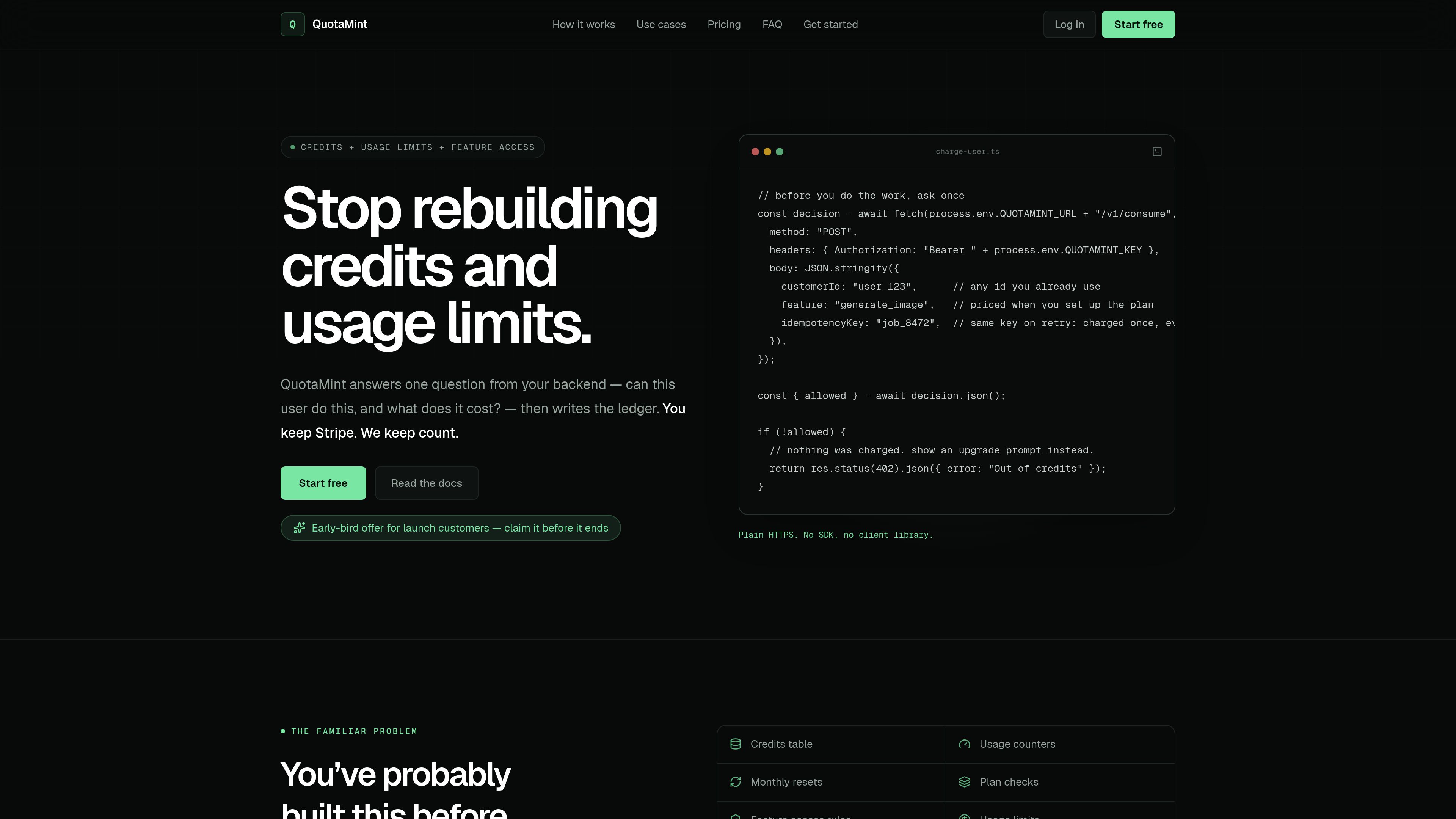
Call the service directly over HTTPS without an SDK or client library. The documented example uses a bearer key and the POST `/v1/consume` endpoint.
Meter image, text, video, token, document, or agent-run features with different credit costs and deny a request when the customer has insufficient balance.
Apply plan-specific usage limits and feature access checks before processing API work, while recording each accepted consumption in a central ledger.
Enable or disable product capabilities by customer plan without duplicating plan-condition logic throughout the application backend.
Use a stable job identifier as the idempotency key when workers or queues may retry a request, preventing the same operation from consuming credits twice.
Keep subscription and payment workflows in an established billing system, then synchronize the customer’s plan to QuotaMint for runtime usage decisions and credit tracking.
No. QuotaMint is designed to complement billing systems. The site says customers can keep Stripe, Paddle, Razorpay, Lemon Squeezy, or custom billing, while QuotaMint handles runtime access, credits, and usage tracking.
The backend sends a customer ID and feature to `POST /v1/consume`, optionally with an idempotency key. QuotaMint checks the plan, feature access, and balance, then returns an allow-or-deny result and records an allowed consumption.
A denied call is presented as a normal decision rather than a service error. The example shows the application returning a 402 response with an “Out of credits” message without charging the customer.
The caller supplies the same stable idempotency key when retrying the same operation. QuotaMint returns the original result and does not consume the credits again.
The site describes it for AI SaaS, usage-based API products, B2B SaaS, and credit-based applications that need plan checks, feature access, or metered consumption.
Traffic data is for reference only.

litellm.ai
LiteLLM is an LLM gateway and OpenAI proxy for managing authentication, load balancing, spend tracking, and access across 100+ LLMs through one OpenAI-compatible layer.

weaveos.com
Weave Router is an intelligent model router for coding agents. It evaluates coding tasks and routes requests across open and closed models, helping developers keep existing agent workflows while managing speed, quality, and model spend.

www.experientiallabs.ai
Experiential Labs is an open-source AI gateway that gives teams one endpoint and API key for hosted models, customer-owned keys, and local or custom models. It adds routing, budgets, access control, attribution, and optional intelligence features for agent traffic.

maritime.sh
Maritime is a platform for deploying, managing, and scaling AI agents with isolated micro-VMs and a live API endpoint. Build customer-facing agents, custom workflows, and per-customer deployments.

easyrouter.io
EasyRouter is an AI model gateway that unifies access to third-party model APIs through one interface, with standard formats and usage-based billing.

www.jurniti.com
jurniti is a managed hosting platform that keeps AI agents online in dedicated Firecracker microVMs. It offers BYOK model credentials, a web dashboard, CLI, MCP access, persistent storage, and flat-rate or usage-based plans for continuous or burst workloads.