
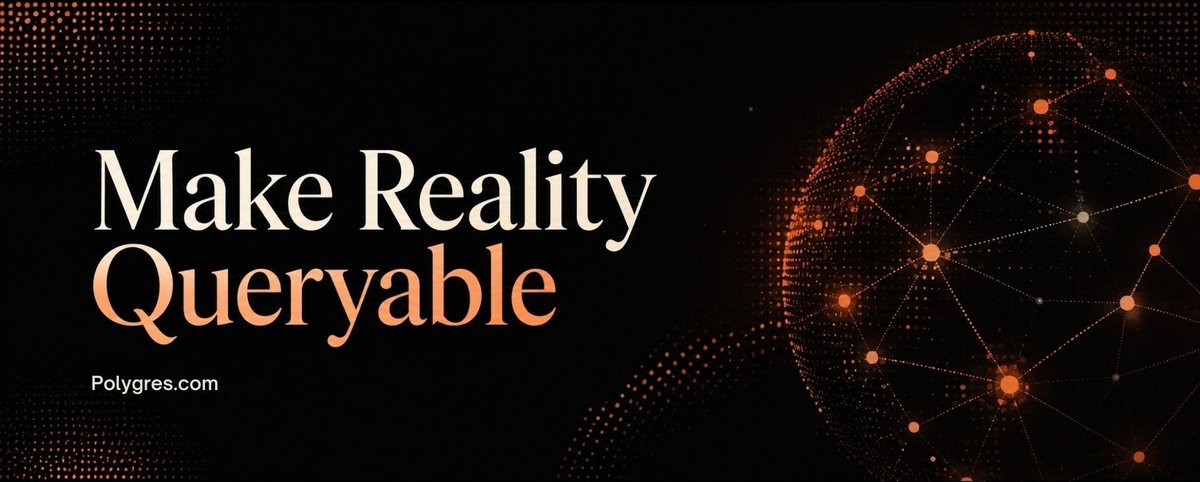
Native graph traversal
Polygres runs graph retrieval over existing foreign-key relationships, with multi-hop traversal, shortest paths, and neighborhood search over tables already in Postgres.

Polygres is a PostgreSQL-based platform for agent workflows, combining graph traversal, vector search, and hybrid retrieval in one system. Self-host it or use managed cloud hosting to turn live database rows into queryable context for AI agents.
Polygres is a PostgreSQL-based database platform aimed at agent workflows that need relational data, graph traversal, and vector search in one place. The product positioning centers on turning rows, relationships, and embeddings into retrievable working memory for AI agents.
The site describes managed PostgreSQL hosting alongside an open-source SDK and retrieval APIs. Its core idea is to let agents query live database tables directly, fuse different retrieval signals into one ranked answer, and return token-ready context without requiring a separate vector store or sync layer.
Polygres runs graph retrieval over existing foreign-key relationships, with multi-hop traversal, shortest paths, and neighborhood search over tables already in Postgres.
The platform combines dense HNSW vector search with sparse, full-text, filtered, quantized, and late-interaction search methods, then merges the results in a single fusion pass.
Retrieval returns a ranked context block that includes semantic matches, graph hops, and scalar filters, so an agent can consume one result instead of stitching together several systems.
The site describes the system as working directly against live tables, without a separate vector store, sync layer, or glue code.
A live playground lets visitors inspect how semantic, lexical, and typed graph signals are fused for user-memory and Wikipedia-style queries.
Use Polygres when an agent needs to answer a question by combining relational records, graph hops, and vector similarity in one retrieval step, such as tracing a failed order through payments and disputes.
Use the platform for connected-memory demos or internal assistants where semantic search alone is not enough and relationships between records matter to the result.
Apply it to applications that need one ranked answer from several retrieval modes instead of separate passes for graph search, keyword search, and embedding lookup.
Use the public playgrounds to inspect how the system behaves on sample datasets before wiring it into a production agent or schema.
Polygres combines PostgreSQL hosting with native graph traversal, HNSW vector search, and hybrid retrieval APIs. The site positions it for agent workflows that need relational, graph, and semantic retrieval in one query.
The pricing page shows a self-hosted free tier and managed cloud plans. The homepage also says you can deploy a managed instance in seconds or point the open-source SDK at an existing schema.
The public demo pages show live retrieval playgrounds for user-memory search and Wikipedia search. They are intended to demonstrate how Polygres fuses semantic, lexical, and graph signals into one ranked result set.
The Pocket page describes a separate CLI package that folds codebases or files into a queryable memory layer for coding agents. It is presented as coming soon, with support for tools like Claude Code, Codex, and Cursor mentioned on the page.
Traffic data is for reference only.
| May | 0 |
|---|---|
| Jun | 0 |
| Jul | 11598 |
Traffic analytics are not available yet.

caveman.so
Caveman is a token-efficiency stack for AI agents and production workflows. It helps teams reduce eligible context, route traffic, and measure verified savings across local tools, a TypeScript SDK, and a managed cloud layer.

blaxel.ai
Agent Drive is Blaxel’s distributed cloud filesystem for AI agents. It mounts in sandboxes as a regular path, allowing multiple agents to share files and session context concurrently.

openfang.sh
OpenFang is an open-source agent operating system built in Rust for running, configuring, and supervising autonomous agents, with local or self-hosted deployment, templates, custom manifests, messaging channels, and browser or API control.

www.agentconnect.md
AgentConnect lets teams bring ACP agents such as Claude Code, Codex, and Gemini CLI into Slack, Telegram, Discord, and GitHub, where they can take on work in the channels teams already use to collaborate. It’s open source and self-hostable, with roles, tools, memory, and configurable triggers for agent workflows.

mino.ai
TinyFish is an enterprise platform for AI web agents that combines live search, page fetching, browser automation, and multi-step workflows. It helps teams work with dynamic or authenticated websites at scale.
cursor.com
Cursor is an AI coding agent that helps developers turn ideas into software faster with next-action suggestions, agentic workflows, and cloud-based task execution.