
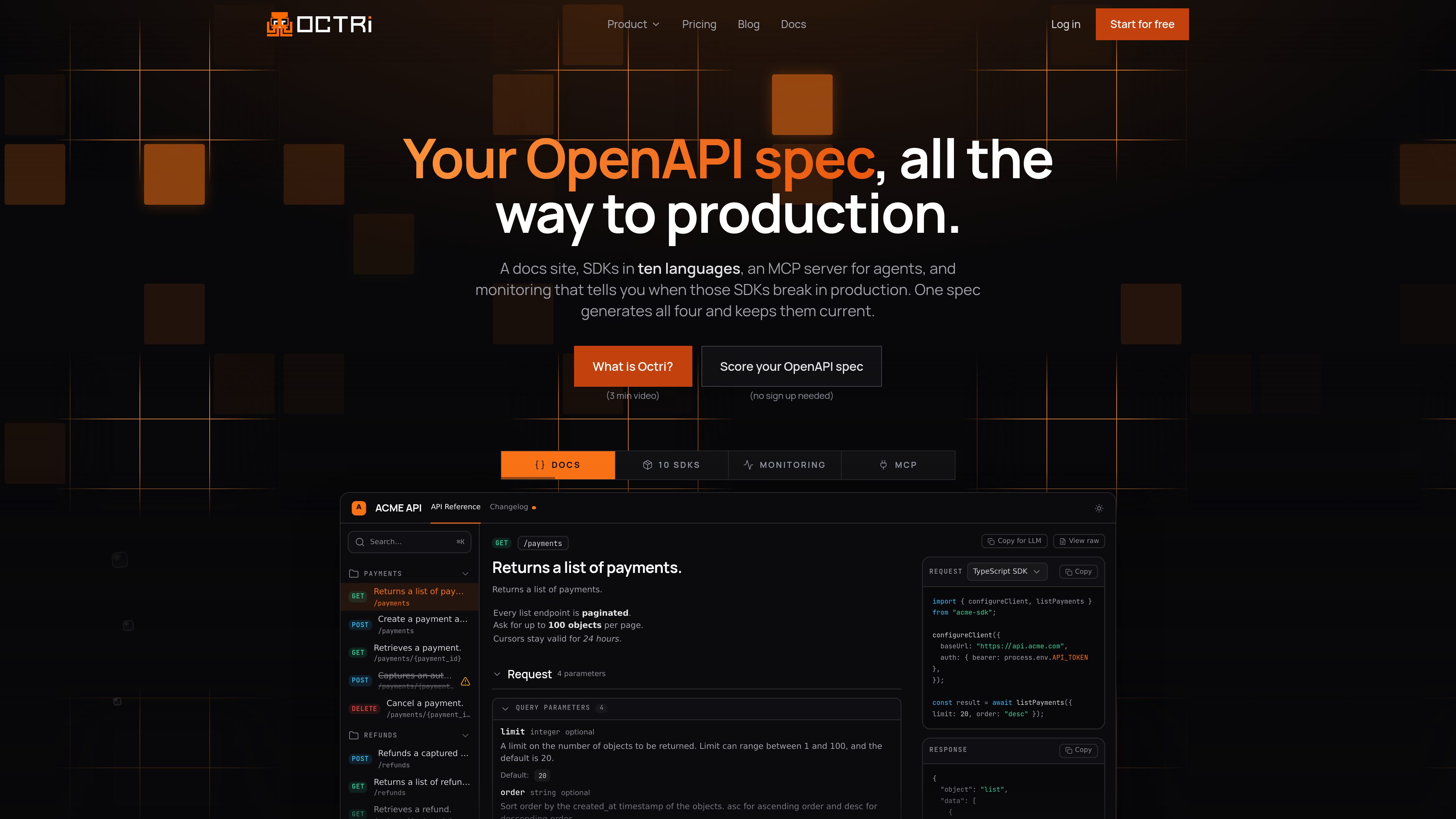
Generated API documentation
API Studio creates hosted reference pages from an API definition, covering endpoints, fields, nested fields, response errors, deprecations, and runnable cURL, JavaScript, and Python examples.

Turn OpenAPI definitions into hosted docs, SDKs, MCP tools, and SDK-based monitoring.
Octri is a developer platform for taking an API definition from specification to production-facing tooling. From one OpenAPI, Swagger, Postman, or AsyncAPI source, it can produce a hosted documentation site, client SDKs, an MCP server for agent access, and monitoring for the generated SDK clients. The platform is intended for API teams that want these outputs to remain aligned as their specification changes.
Its documentation product combines generated reference material with a live playground, search, AI-assisted documentation and chat, and an agent-readable index. Its SDK product generates clients in up to ten languages and exposes options such as pagination, streaming, retries, timeouts, output formats, and request hooks. Monitoring provides issue tracking and configurable alerts for problems observed in production clients.
API Studio creates hosted reference pages from an API definition, covering endpoints, fields, nested fields, response errors, deprecations, and runnable cURL, JavaScript, and Python examples.
Review what a generation run will touch, edit reference content before publishing, and preserve those edits during later regenerations unless you explicitly remove them.
SDK Studio generates client libraries from the same specification, with the homepage documenting support for ten languages and controls for pagination, streaming, retries, timeouts, output formats, and request hooks.
Published documentation includes Markdown content, an llms.txt index, and endpoints exposed as callable tools. Octri also includes an MCP server in its product plans for connecting API capabilities to agents.
Monitoring tracks issues from SDK clients and supports alert conditions including 5xx spikes, new issues, regressions, authentication failures, latency, rate limits, and webhook delivery failures.
GitHub sync is available on every plan; a merged specification change rebuilds a draft and presents a diff for approval before publication.
An API team can point Octri at an OpenAPI, Swagger, Postman, or AsyncAPI document and publish searchable reference pages with a live console, examples, schemas, and an agent-readable index.
Teams that update their specification through GitHub can review a generated diff, selectively regenerate changed pages, and keep manually edited explanations in place across future runs.
A team can generate SDKs from the API contract, configure client behaviors such as pagination and retries, and provide language-specific methods that follow the same source definition.
Developers can expose documented endpoints as callable tools through the MCP workflow, allowing an agent to search the API documentation and invoke supported operations.
Engineering or operations teams can use client monitoring to review errors and regressions, then configure Slack or webhook alerts for conditions such as 5xx responses, 401 failures, latency, or 429 rate-limit surges.
API Studio accepts OpenAPI 3.0 and 3.1, Swagger 2.0, Postman, and AsyncAPI files in JSON or YAML.
Yes. You can edit reference documentation before publishing. Octri stores edits per page, and later regeneration runs leave those edits in place unless you ask to remove them.
Octri advertises SDK generation in ten languages. Plans include different numbers of languages, and eligible paid plans can add languages for a flat monthly fee; Business includes all ten.
No. Octri states that one plan covers all four products. They can be switched on later without redoing existing setup.
Enterprise plans can run the generator and documentation renderer inside your own infrastructure. Other tiers are hosted by Octri.
Traffic data is for reference only.