
Super-agent workflow
The homepage describes DeerFlow as a LangChain-based framework for building super agents that can handle tasks ranging from minutes to hours.

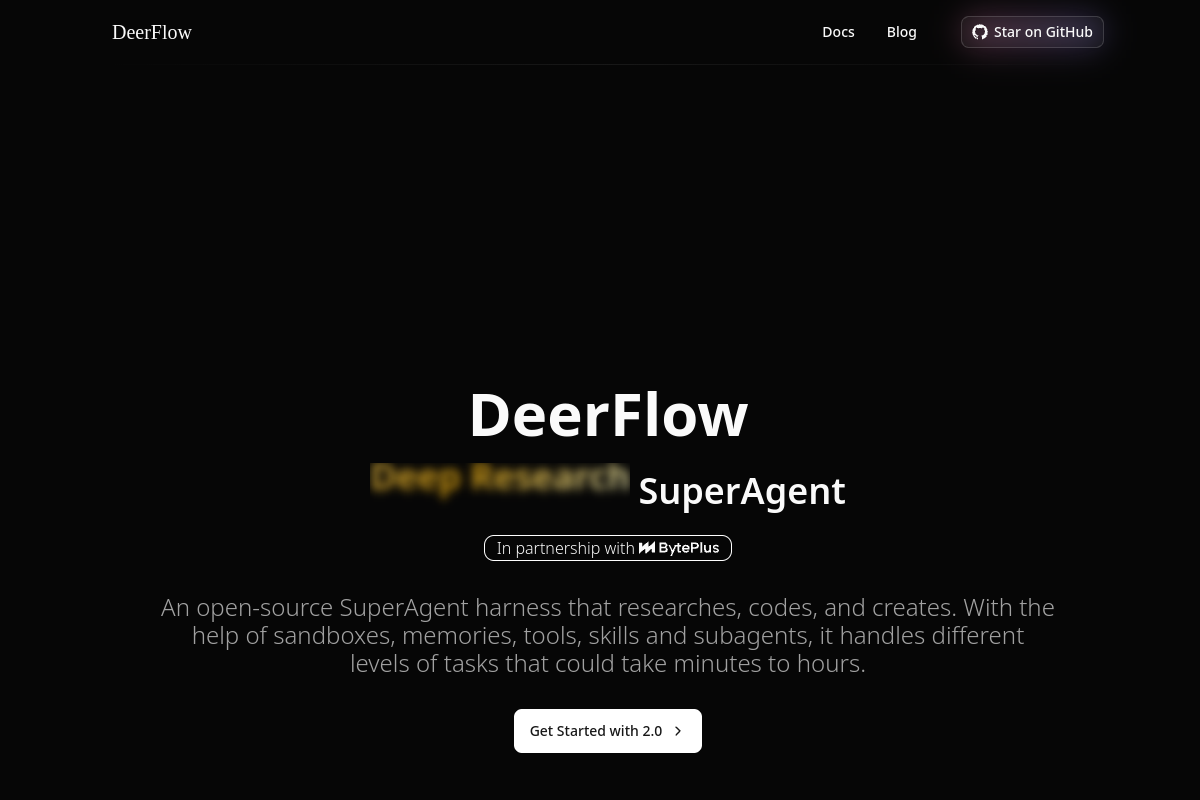
DeerFlow is an open-source, LangChain-based framework for building super agents that research, code, and create with sandboxed tools, memory, and subagents. It supports long-running, multi-step tasks such as deep research, analysis, and content generation.
DeerFlow is an open-source, LangChain-based framework for building super agents. The homepage describes it as a system that can research, code, and create with the help of sandboxes, memories, tools, skills, and subagents.
Its core purpose is to support long-running, multi-step work that may take minutes to hours. The site positions DeerFlow around deep research and task execution, with example workflows that include trend forecasting, data analysis, narrative-to-video generation, and explanatory content creation.
The homepage describes DeerFlow as a LangChain-based framework for building super agents that can handle tasks ranging from minutes to hours.
The product highlights sandboxes, memories, tools, skills, and subagents as the building blocks that let the agent handle different task levels.
The site emphasizes long- and short-term memory so the agent can retain context across multi-step work.
It presents planning and sub-tasking as a built-in behavior, with the agent reasoning through complexity before executing sequentially or in parallel.
The homepage says DeerFlow supports extensible skills and tools, allowing built-in tools to be plugged in or swapped out.
The source also calls out multi-model support, listing Doubao, DeepSeek, OpenAI, Gemini, and others.
Use DeerFlow to research a broad topic, synthesize sources, and produce a structured output such as a report or article. The homepage example about forecasting 2026 trends shows this research-first workflow.
Use the agent to turn a source into a creative artifact, such as a webpage, video, or visual explanation. The homepage examples include generating a video from a novel scene and a comic strip explaining MOE.
Use DeerFlow for data exploration when you want an agent to inspect a dataset, identify key factors, and summarize findings with insights. The Titanic dataset example points to this kind of analysis task.
Use it when a task needs multiple steps, planning, and execution over a longer time horizon rather than a single prompt-response exchange. The site explicitly frames DeerFlow around long task running and sub-tasking.
Use it in workflows that benefit from a persistent sandbox and file access, such as writing code, saving artifacts, or iterating on outputs. The product highlights a mountable file system and a combined browser, shell, file, MCP, and VSCode environment.
DeerFlow is presented as a LangChain-based framework for building super agents. The homepage frames it as an open-source system that can research, code, and create with help from sandboxes, memories, tools, skills, and subagents.
The source shows example workflows such as forecasting 2026 trends, generating a video from a novel scene, explaining MOE to a teenager, and analyzing the Titanic dataset. These examples suggest DeerFlow is meant for research-heavy, multi-step agent tasks.
The homepage describes an open-source AIO Sandbox and says it combines Browser, Shell, File, MCP, and VSCode Server in a single Docker container. It also highlights persistence, isolated execution, and mountable file system support.
The pricing URL currently returns a 404 page, so the source does not provide live pricing or plan details.
Traffic data is for reference only.

www.agentconnect.md
AgentConnect lets teams bring ACP agents such as Claude Code, Codex, and Gemini CLI into Slack, Telegram, Discord, and GitHub, where they can take on work in the channels teams already use to collaborate. It’s open source and self-hostable, with roles, tools, memory, and configurable triggers for agent workflows.

www.gumloop.com
Gumloop is a no-code AI automation framework for building and hosting business workflows and agents, helping teams automate tasks and connect data.

browseros.com
BrowserOS is an open-source AI browser with local agents for automating web tasks from plain-language prompts. Supports macOS, Windows, Linux, Chrome extensions, and MCP integrations.

dev-swat.com
DevSwat is an agentic AI infrastructure platform for building, running, and scheduling autonomous AI agents. It brings together a browser IDE, chat, workflow automation, code analysis, and governance controls in one web-based environment.
www.medley.sh
Medley is a Claude Code plugin that turns prompts into coordinated multi-agent mission plans and displays their structure at a URL. Built for developers running research, outreach, operations, and coding in Claude Code with parallel agents and human checkpoints.

livekit.io
LiveKit is an open source platform for building, deploying, and observing voice, video, and physical AI agents with Python or TypeScript, plus LiveKit Cloud for production.