
No-code and API access
Run published computational biology models through a web interface or programmatic API, without setting up the underlying infrastructure yourself.

Tamarind Bio is an AI infrastructure platform for computational biology and biotech R&D, with web and API access to published tools for protein, peptide, antibody, enzyme, and small-molecule design.
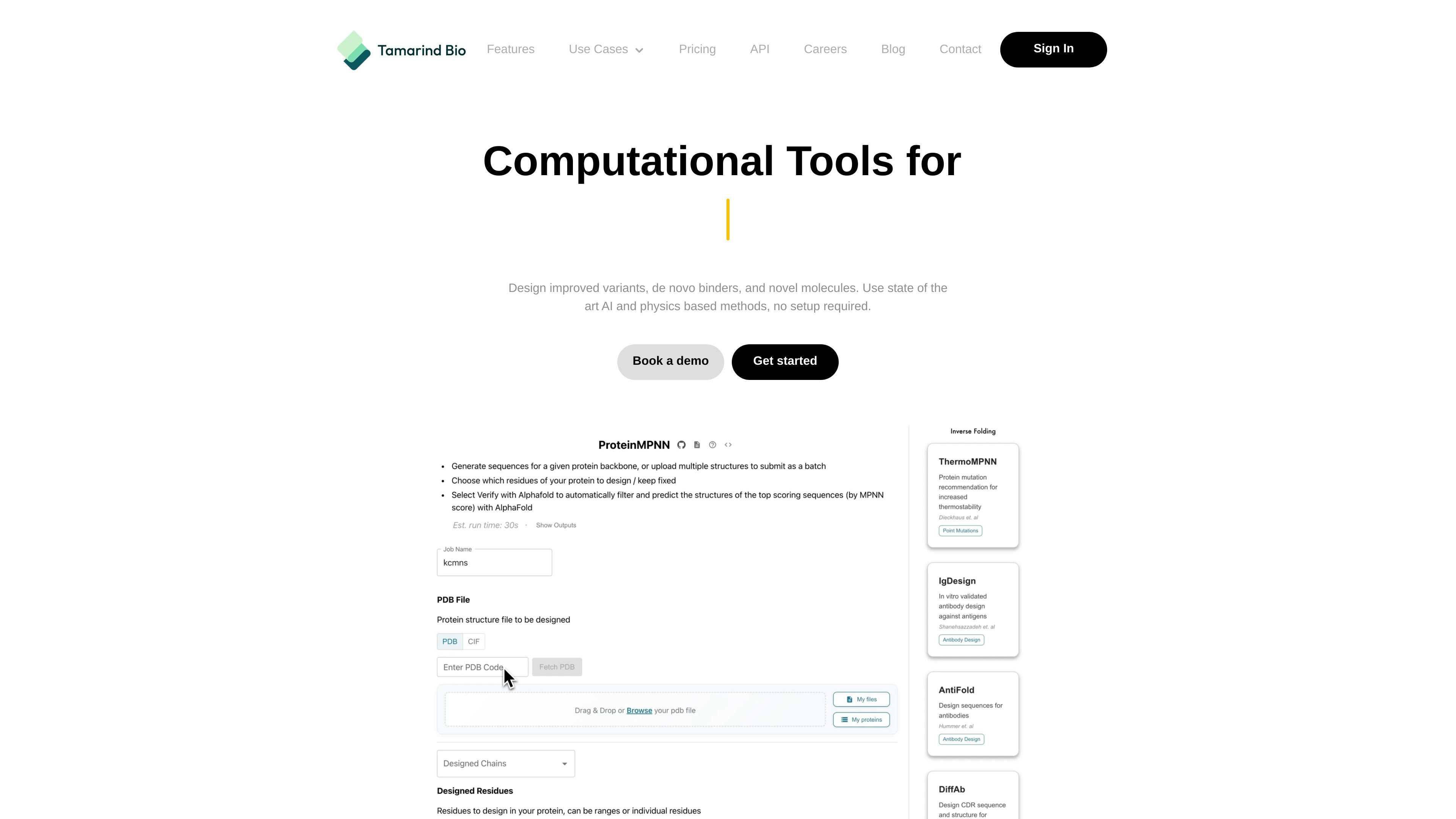
Tamarind Bio is an AI infrastructure platform for computational biology and biotech R&D. It gives researchers access to published models and workflows for designing and scoring proteins, peptides, small molecules, antibodies, enzymes, and related molecules.
The site positions the product as a no-code web platform with API access, aimed at users who want to run established tools such as AlphaFold, RFdiffusion, ProteinMPNN, and GROMACS without managing deployment, parallelization, or GPU infrastructure themselves.
Run published computational biology models through a web interface or programmatic API, without setting up the underlying infrastructure yourself.
Access a large catalog of tools, including AlphaFold, RFdiffusion, ProteinMPNN, GROMACS, and many other models mentioned on the site.
Use the platform for structure prediction, binder design, sequence optimization, and docking across proteins, peptides, enzymes, antibodies, and small molecules.
Scale jobs across large input sets while Tamarind handles parallelization and GPU orchestration on your behalf.
Keep work isolated in a secure cloud environment, with the site stating that users own their inputs and derivatives and that the platform is SOC 2 compliant.
Choose between commercial tiers with features such as open API access, admin controls, custom model hosting, custom security audits, SLA agreements, and SAML SSO depending on plan.
Predict monomer or multimer protein structures with AlphaFold, including workflows that need scalable structure prediction across many sequences.
Design and optimize antibodies, nanobodies, and mini proteins by generating binders, redesigning CDRs, and predicting antibody-antigen complexes.
Generate or refine peptides, enzymes, and small molecules using published models for design, scoring, and sequence optimization.
Run large computational batches without managing GPU orchestration or parallelization yourself, which is useful for teams processing hundreds of thousands of inputs.
Use the platform’s web interface or API to fit published models into an existing R&D workflow, including downstream analysis and custom pipelines.
Tamarind Bio provides a no-code web interface and a programmatic API for running computational biology tools. The source also says users can access the platform through the web interface or API, depending on their workflow.
The source describes support for design and analysis workflows involving proteins, peptides, small molecules, antibodies, enzymes, and other molecules. It highlights published tools such as AlphaFold, RFdiffusion, ProteinMPNN, and GROMACS.
The pricing page lists Free, Premium, and Enterprise plans, and an extended Academic Plan for university, government, or non-profit email addresses. The site also says pricing details can be discussed by booking a call.
The site states that data and intellectual property remain owned by the user, with isolated computations and SOC 2 compliant secure cloud hosting mentioned on the home page. For organization-specific access and enterprise needs, the site also references org-wide admin controls and SAML SSO on higher tiers.
The antibody page highlights structure prediction, binder design, CDR redesign, and docking for antibody discovery workflows. That makes it a fit for teams working on antibody and nanobody engineering.