
Knowledge management
Keep knowledge in a governed single source of truth so employees and support teams can find trusted answers quickly and reduce ticket volume.

Serviceaide enterprise service management software with AI-assisted knowledge, automation and workflow orchestration to reduce tickets and connect teams.
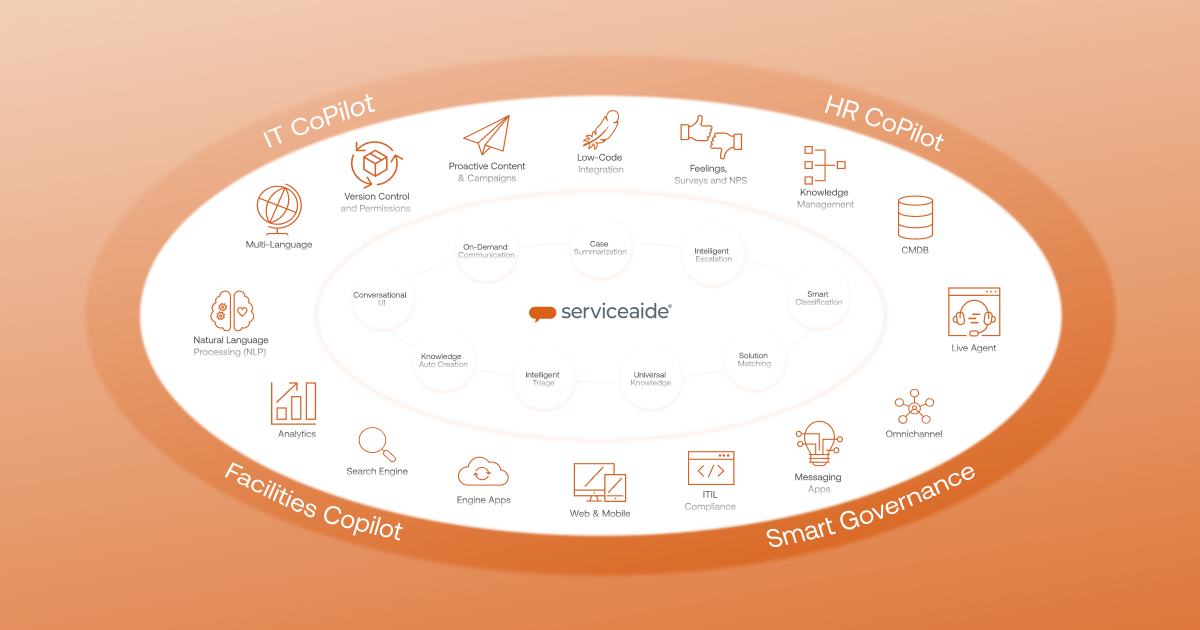
Serviceaide is an enterprise digital management and service management platform focused on knowledge, automation, and AI-assisted support. The site describes it as helping regulated teams access knowledge, deflect tickets, and build a stronger service and support environment across the enterprise.
Its product pages highlight solutions including Luma AI, an automation layer for service desks and virtual agents, and AISM, an AI-powered service management offering. The platform is presented for IT and broader business workflows such as requests, incidents, change management, asset management, and service delivery across departments.
Keep knowledge in a governed single source of truth so employees and support teams can find trusted answers quickly and reduce ticket volume.
Use agentic AI to guide users, collect context, and deflect requests before a support ticket is created when the issue can be resolved in conversation.
Support request fulfillment, approvals, access workflows, and incident triage with automation that can run natively in Luma or invoke external workflows.
Use policy-aware logic for conditional approvals, entitlement checks, segregation of duties, and audit-ready execution records.
Integrate with APIs, webhooks, service interfaces, and MCP servers where available, while preserving the chosen system of record.
Use the service platform across IT, HR, Facilities, Governance, and other enterprise functions for cross-functional service delivery.
Reduce repetitive support volume by giving employees guided answers and self-service options before a ticket reaches the service desk.
Automate request fulfillment, approvals, and status updates while keeping the chosen system of record intact.
Manage onboarding, offboarding, access, and other approval-heavy processes with policy checks and controlled execution.
Support incident, change, and asset-related processes across IT and related teams with a unified service platform.
Structure knowledge so support teams and end users can retrieve approved information quickly and consistently.
Serviceaide positions Luma AI as an automation solution for service desks and virtual agents, while AISM is described as an AI-powered service management offering for enterprise service delivery. The site also presents broader service management products such as ChangeGear and DSM, so the right fit depends on whether you need service desk automation, AI-assisted service management, or broader enterprise service workflows.
The pricing page shows named offerings with typical implementation times ranging from 4 to 12 weeks depending on the solution. It also notes that final pricing and effort vary based on scope, integrations, and customer requirements, with pricing shown for licensing only.
The FAQ content shows that Luma can automate request fulfillment, approvals, access workflows, onboarding and offboarding, asset and software provisioning, incident triage, knowledge-assisted resolution, service catalog interactions, status tracking, outbound notifications, and cross-functional workflows when the connected system exposes an API, service interface, or MCP server.
The FAQ page says the platform can integrate through APIs, webhooks, and service interfaces, and it prefers MCP-based integration when available. It also says Luma can act as the intelligent front end while an external platform remains the system of record.
The site describes Serviceaide as serving regulated teams and enterprise organizations across IT, HR, Facilities, Governance, and other business functions. The public pages also highlight use in service management, knowledge management, change management, asset management, and enterprise service management.