
Scheduling Cloud
Manage academic scheduling in a single system that Coursedog describes as the source of scheduling truth, with support for academic scheduling, event scheduling, faculty workload management, and course demand projections.

Coursedog unifies academic scheduling, curriculum, catalogs, assessment, and SIS integrations for higher education administrators and campus teams.
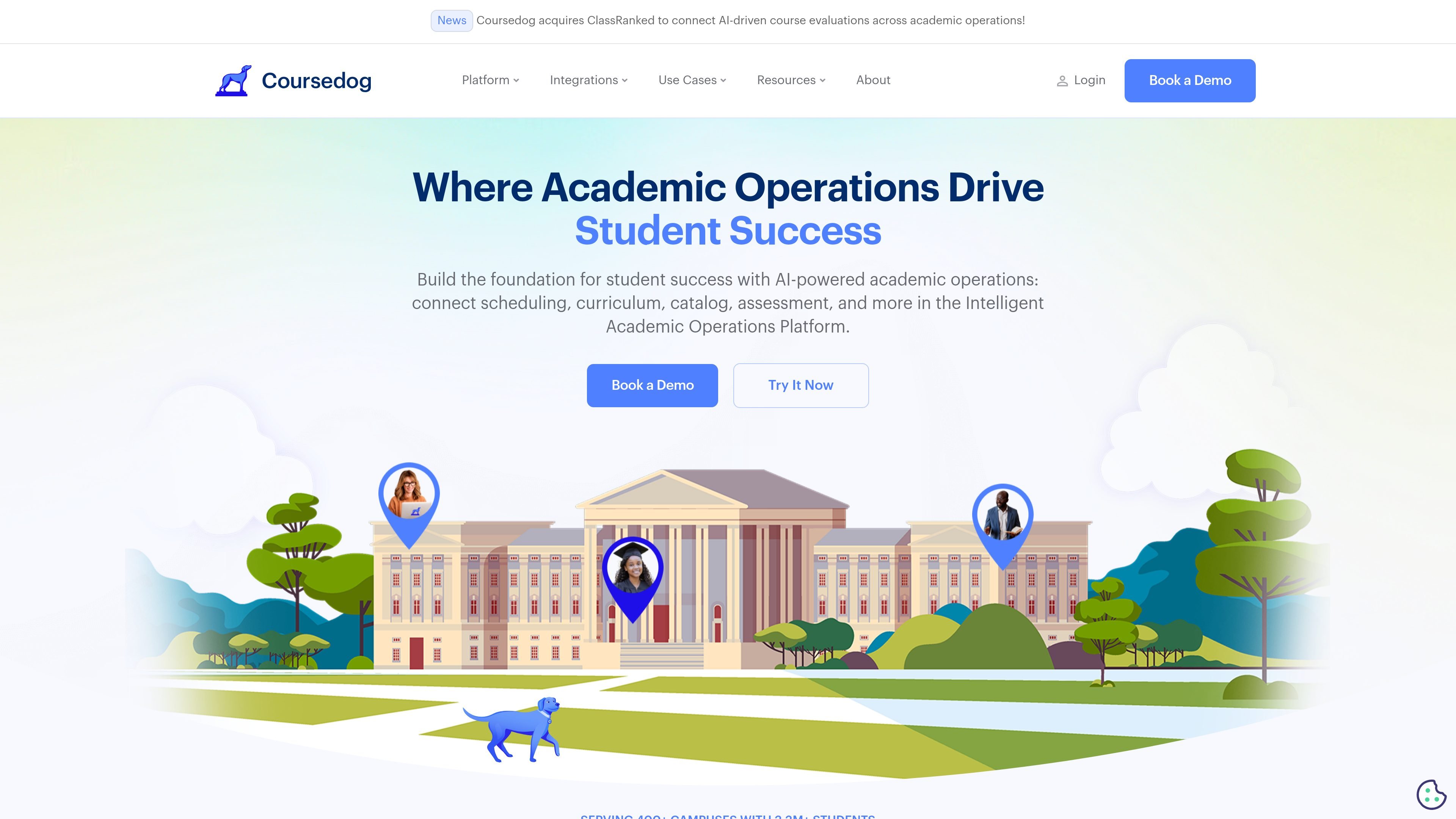
Coursedog is an academic operations platform for higher education. The site describes it as an integrated platform that unifies scheduling, curriculum, catalogs, assessment, and related workflows so administrators can manage core academic processes in one place.
The platform is presented as a way to connect operational decisions to student needs. Across its product pages, Coursedog emphasizes centralized workflows, real-time SIS sync, integrations with campus systems, and role-specific tools for registrars, provosts, CIOs, and accreditation teams.
Manage academic scheduling in a single system that Coursedog describes as the source of scheduling truth, with support for academic scheduling, event scheduling, faculty workload management, and course demand projections.
Create, route, and update curriculum workflows, with tools for curriculum management, syllabus management, catalog and handbook publishing, curriculum analytics, and labor market insights.
Run assessment workflows and course evaluations in the same platform, with assessment management positioned as part of the broader academic operations stack.
Connect Coursedog to external systems such as Ellucian Banner, Colleague, DegreeWorks, Ethos, Powercampus, Workday Student, Anthology, Jenzabar, and Google Calendar.
Monitor and manage integration activity through an integrations dashboard, centralized SIS field settings, and quick actions for CSV uploads or manual merges.
Support role-specific academic operations for provosts, registrars, CIOs, and accreditation teams, with pages and outcomes tailored to those workflows.
Use the scheduling and workload tools to coordinate academic schedules, event bookings, and faculty assignments from a shared operational system.
Route curriculum proposals through flexible workflows, add fields to forms and templates, and keep curriculum updates synchronized with the SIS and catalog.
Use catalog and handbook tools to publish course information and keep approved changes aligned across connected systems.
Track integration status, adjust SIS settings centrally, and process uploads or manual merges without relying on external support for every update.
Support provost, registrar, CIO, and accreditation workflows with a platform that links academic operations, reporting, and assessment in one environment.
Coursedog is designed for higher education institutions that want to manage academic scheduling, curriculum, catalogs, assessment, and related workflows in one platform. The source highlights use by administrators and role-specific teams such as registrars, provosts, CIOs, and accreditation teams.
The source does not show public pricing on the pricing page; instead, it routes visitors toward booking a demo or contacting sales. That suggests pricing is handled through a sales process rather than posted as a public price list.
Coursedog presents its platform as covering curriculum management, academic scheduling, event scheduling, faculty workload management, course demand projections, assessment management, catalogs, and syllabus management. The integrations page also shows SIS and related integrations with systems such as Banner, Colleague, PeopleSoft, Workday Student, and Google Calendar.
The integrations page highlights a hub for monitoring integration status, adjusting SIS settings in one place, and using quick actions such as CSV uploads or manual merges without external support. It also lists categories such as student information systems, single sign-on, communication, HVAC and audio/video, and payment processing.
The site positions Coursedog as a platform for academic operations rather than a standalone point tool. Its main purpose is to connect scheduling, curriculum, catalogs, assessment, and integrations so higher education teams can work from a shared operational system.