
Scales to large ERDs
Reduce clutter by choosing what appears in the diagram, including tables, columns, relations, and order, so large schemas stay readable.

Azimutt is a database explorer and analyzer for large or complex databases. Design, document, explore, and analyze schemas and data from the web app or command line.
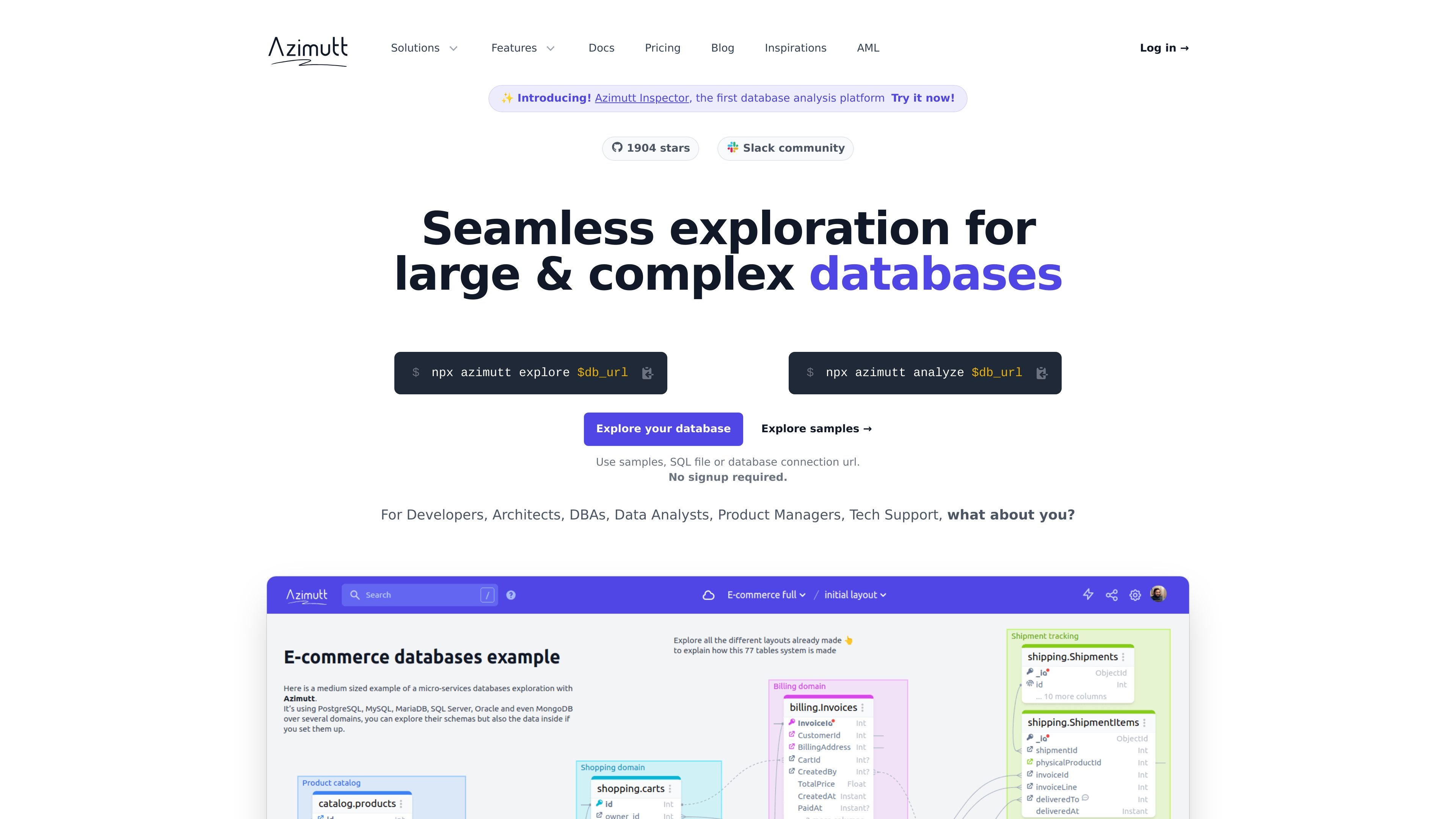
Azimutt is a database explorer and analyzer for understanding, documenting, designing, and inspecting schemas and data in large or complex databases. It combines ERD-style visualization with schema exploration, data exploration, documentation, and database analysis in one tool.
The product is aimed at teams and individuals who need to navigate databases that are too large for static diagrams alone. The site highlights workflows for developers, architects, DBAs, data analysts, product managers, and support teams, with a no-signup exploration flow and command-line entry points for database URLs or SQL files.
Reduce clutter by choosing what appears in the diagram, including tables, columns, relations, and order, so large schemas stay readable.
Design schemas with AML, a minimal DSL built for fast typing and permissive editing.
Add table and column notes, layout memos, and visual indicators to keep database documentation close to the diagram.
Review schema and runtime issues with analysis rules that surface inconsistencies and possible improvements.
Work with relational and document databases, and extend unsupported sources through JSON input.
Share diagrams through embeds or private links, and collaborate on projects with others on higher plans.
Start from a database connection URL or SQL file, then explore tables, relations, and paths without needing to load a full diagram at once.
Use notes, layout memos, and saved views to capture what a team has learned about tables and relationships and make it easier for others to onboard.
Apply analysis rules to look for inconsistencies, schema warts, and runtime issues when you need to improve database quality or review technical debt.
Follow relations and inspect live data when the schema alone is not enough to answer support or debugging questions.
Share diagrams through embeds or private links so teammates or guests can review the same model and context.
Azimutt says it supports common databases such as PostgreSQL, MySQL, SQL Server, MongoDB, Couchbase, Snowflake, BigQuery, and more through a database connection URL. It also supports any SQL schema, and other sources can be loaded as JSON after schema extraction.
The pricing page offers a Free plan, a Solo plan, a Team plan, and an Enterprise plan. The Free plan is for quick exploration, Solo is for personal use, Team adds collaboration and AI capabilities, and Enterprise adds higher limits plus security and control features.
Azimutt's pricing page says it includes database design, schema exploration, data exploration, database analysis, documentation, export options, and, on higher plans, collaboration and AI capabilities.
The pricing page describes sharing via private links and embeds, and the site also mentions Slack, Twitter, GitHub, and email as ways to reach the team.
The site presents Azimutt as a database explorer and analyzer for large and complex databases, especially when a system grows beyond easy-to-read diagrams.