
Multimodal data infrastructure
The platform combines wet lab, computational, and proxy biological data so AI models can be trained on multiple evidence types rather than a single dataset.

1910 is an AI-native biotech company offering the ITO™ platform for multimodal drug discovery. It helps pharma partners combine wet lab, computational, and proxy data to design therapeutics.
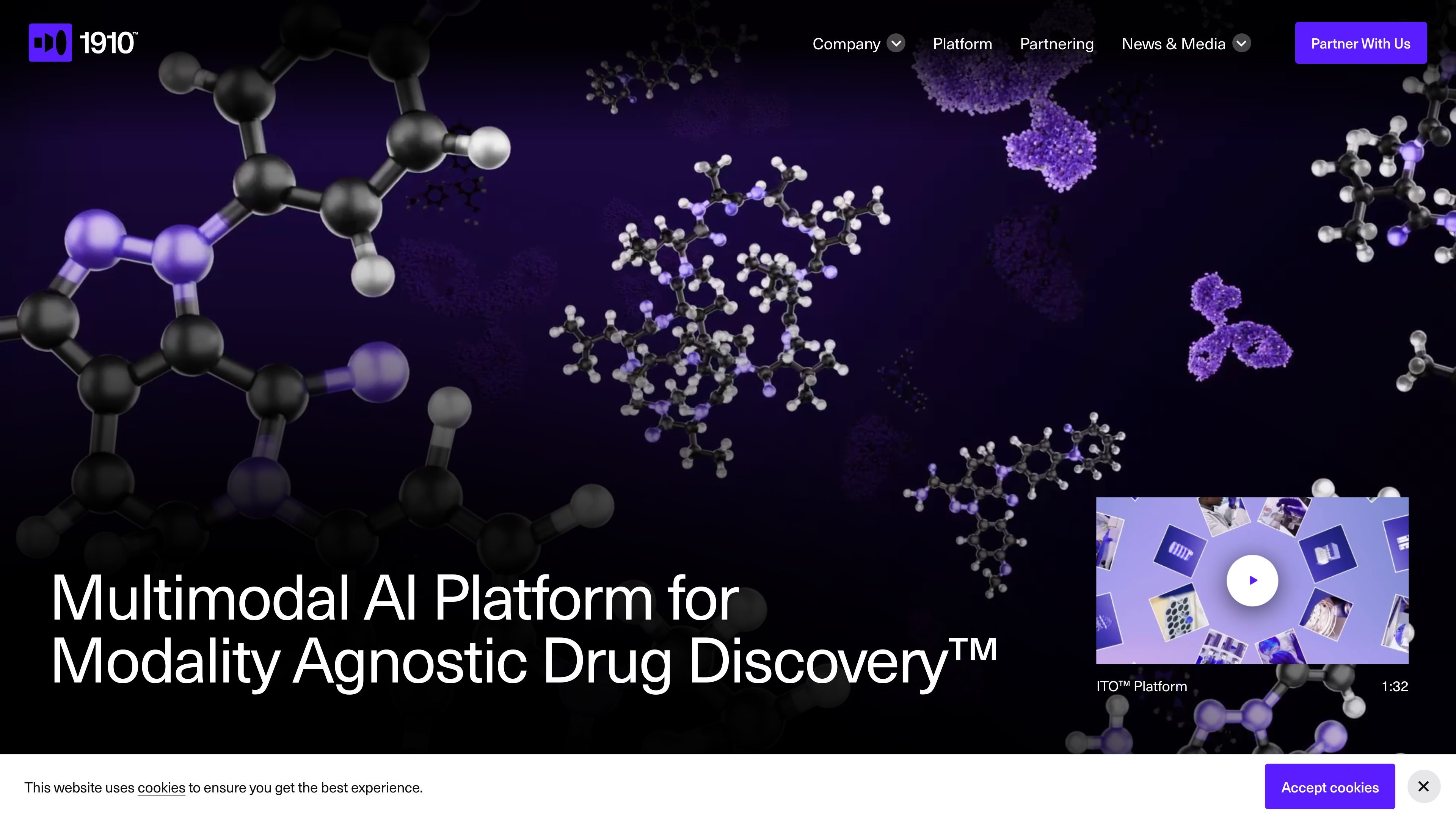
1910 is an AI-native biotech company built around its ITO™ platform, which it describes as a multimodal, modality-agnostic infrastructure for pharma. The platform is designed to integrate wet lab, computational, and proxy data with frontier AI models and high-throughput lab automation.
The company says the system is intended to help teams design, test, and develop small and large molecule therapeutics with a more iterative workflow. Public pages emphasize data orchestration, model training, federated learning, and robotics-driven validation as the main pieces of that workflow, along with partnering models for companies that want to embed or collaborate on the platform.
The platform combines wet lab, computational, and proxy biological data so AI models can be trained on multiple evidence types rather than a single dataset.
Its Data Orchestration step formats, analyzes, cleans, annotates, curates, and featurizes data before model ingestion.
The Model Foundry™ is described as a collection of hundreds of AI/ML models plus a multi-AI agent system for drug discovery optimization.
Federated learning is used in pre-competitive consortium settings so partners can train on blinded datasets without moving private data out of their own environments.
The platform includes robotics-driven lab validation and high-throughput assay generation to feed experimental results back into the design loop.
Partnering materials describe outputs and modules for small molecules, large molecules, data packages, and interactive tools such as dashboards and chatbots.
Teams building early-stage therapeutics can use the platform to combine multimodal data, model generation, and lab validation in one loop for small or large molecule programs.
Consortia or partner networks can use federated learning to fine-tune shared AI models without transferring private datasets between organizations.
Organizations with existing R&D teams can embed the ITO™ platform internally and customize it to address their own discovery bottlenecks.
Partners seeking a narrower commercial arrangement can license lead compounds or license disease-relevant multimodal data for model building and target identification.
1910 positions its ITO™ platform as an AI infrastructure for pharma that combines multimodal data, frontier AI models, and laboratory automation to support drug discovery and development. The platform is described as modality-agnostic and intended for small and large molecule programs.
The site describes the platform as integrating wet lab, computational, and proxy biological data. It also mentions features such as multimodal data orchestration, a Model Foundry™, federated learning, and robotics-driven wet lab validation.
1910 presents partnering options for embedding the platform inside an organization, co-engineering discovery modules, co-discovery of therapeutic candidates, platform-as-a-service access in development, asset licensing, and data licensing.
The platform page says the system is cloud-based on Microsoft Azure and notes that it can be replicated on other major cloud providers including AWS, Google Cloud, Oracle Cloud, and more.
No public pricing is shown on the site. The pricing URL currently returns a not found page, so commercial terms appear to be handled through partnering or direct inquiry rather than a published price list.