
Two-record completion checks
Compare what an agent says it did with what the host actually observed, turning disagreements into findings.

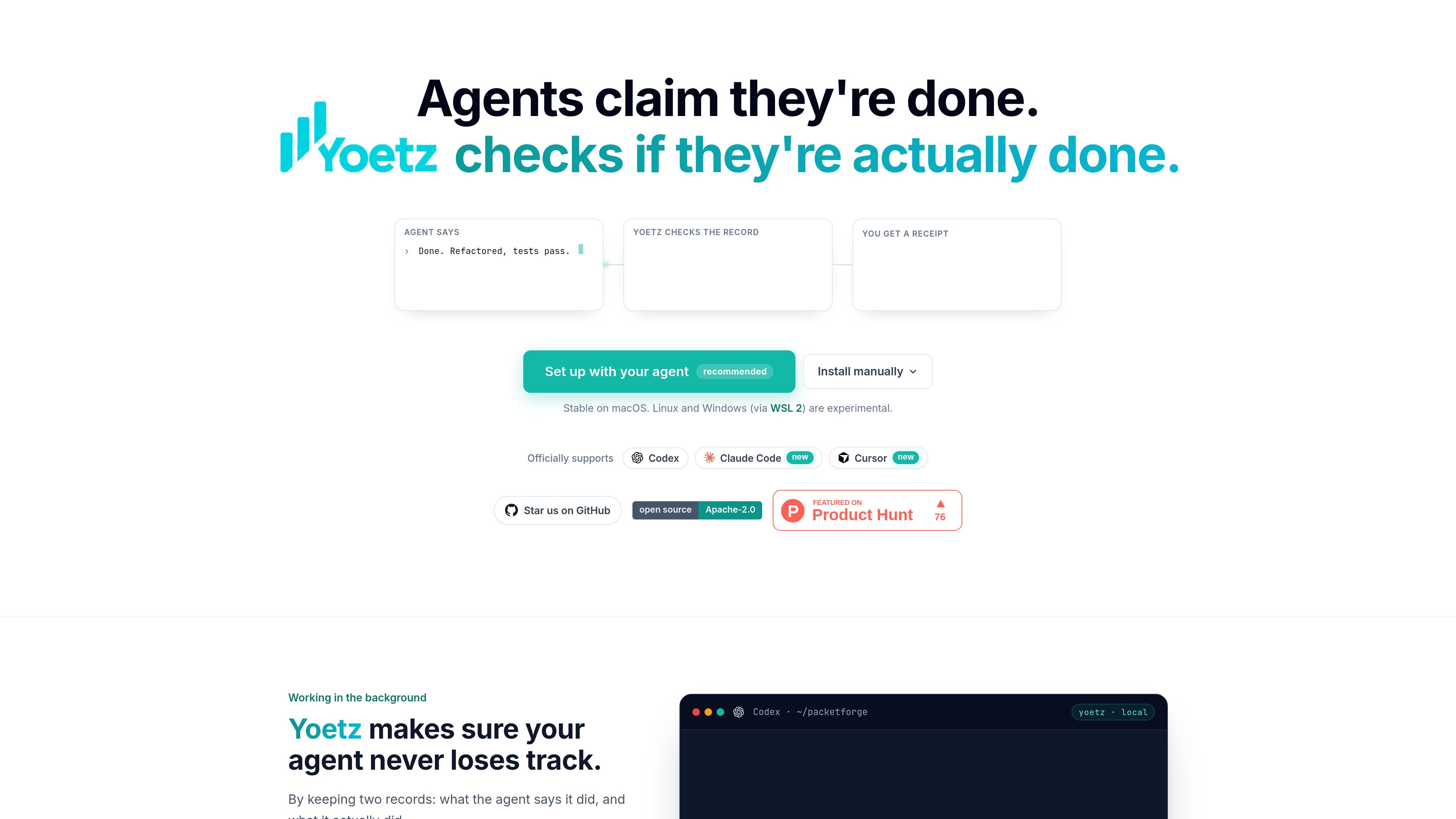
Yoetz is a local-first, open-source work ledger that checks completion claims from AI coding agents. It compares the agent’s declared work with host-side records and issues a receipt showing what was verified, the coverage reached, and any open findings.
Yoetz is a local-first work ledger for AI coding agents. An agent publishes its plan, work, claims, and evidence; Yoetz compares that record with host-side observations such as sessions, tool calls, and edits. When the records disagree, the disagreement becomes a finding rather than being hidden behind a simple “done” status.
The workflow produces a receipt for each completion claim. A receipt states what was verified, the coverage reached, and what remains open. The example workflow shows Yoetz identifying a test run that predates a later edit and an API response shape that was not verified, then preserving unresolved findings when the final receipt is issued.
Yoetz runs as one local service and uses MCP for agent communication and hooks for host reporting. The site describes the host record as structural facts rather than file contents. The product is officially supported for Codex, Claude Code, and Cursor, and the site presents it as open source under the Apache-2.0 license.
The homepage presents setup through an agent prompt that installs Yoetz and shows changes before proceeding, as well as manual installation options using PyPI or npm. The documented platform status is stable on macOS, while Linux and Windows through WSL 2 are described as experimental. The product currently has no account or network requirement according to the site, and is identified as alpha software at version 0.2.5.
Compare what an agent says it did with what the host actually observed, turning disagreements into findings.
Issue a receipt that identifies verified obligations, the checking coverage, and unresolved findings instead of treating every completion claim as equally confirmed.
Let the agent publish its plan, work, claims, and evidence over MCP while Codex, Claude Code, and Cursor report sessions, tool calls, and edits through hooks.
Keep both records in one local service so local rules can compare them without sending the ledger to a remote service.
Use a copied prompt to install Yoetz with an agent and review the changes first, or choose the manual PyPI and npm installation paths.
Ask an agent to change code and preserve an interface, then use the check to expose stale test evidence or an obligation that was never verified before accepting the work.
Use the local ledger to maintain a record of plans, edits, tool activity, and evidence while an agent works without requiring an account or network connection.
Use the receipt as a handoff or review artifact when a check finds problems, including cases where the final claim still carries open findings.
The site describes an alpha workflow for delegated child tasks, receipt rollups, and consent-based notices when two live tasks touch the same path; a clean child receipt does not prove integration.
It compares the agent’s published record of its plan, work, claims, and evidence with host-side records such as sessions, tool calls, and edits. Disagreements are reported as findings.
The receipt states what was verified, the coverage reached, and what remains open. The homepage example includes verified obligations and an unresolved finding for evidence that was stale or incomplete.
The site lists Codex, Claude Code, and Cursor as officially supported integrations. Yoetz communicates with the agent over MCP and receives host-side reports through hooks.
The site describes macOS as stable. Linux and Windows through WSL 2 are described as experimental.
The homepage says Yoetz works today with no account and no network. It describes the product as local-first, with one local service holding the records and performing the checks.

thecatenary.app
Catenary is a local-first desktop IDE for running and coordinating multiple AI coding agents on an infinite canvas. It helps developers keep terminals, editors, browsers, worktrees, and agent context visible in one workspace.
bentomux.takora.dev
An open-source desktop app for running coding-agent CLIs side by side in persistent workspaces.

harnessmanager.devmesh.xyz
Harness Manager is a free, open-source native Mac workspace for managing AI coding tools, MCP servers, skills, updates, and model comparisons. It helps developers inspect their local setup, discover additions, review updates, and compare models in one app.

entire.io
Git hosting and agent session tracking for developers working with coding agents.

cortexdocs.dev
Cortex Docs is an open-source API tooling workflow that turns API specifications and Markdown into interactive documentation, typed SDKs, and MCP servers. It helps developers publish API interfaces for human users, applications, and AI agents from a shared project.

www.analytiics.co
Analytiics is web and product analytics that a coding agent can set up in an application repository. It tracks visitors, pageviews, declared events, funnels, journeys, and revenue while keeping the tracking plan in code.