
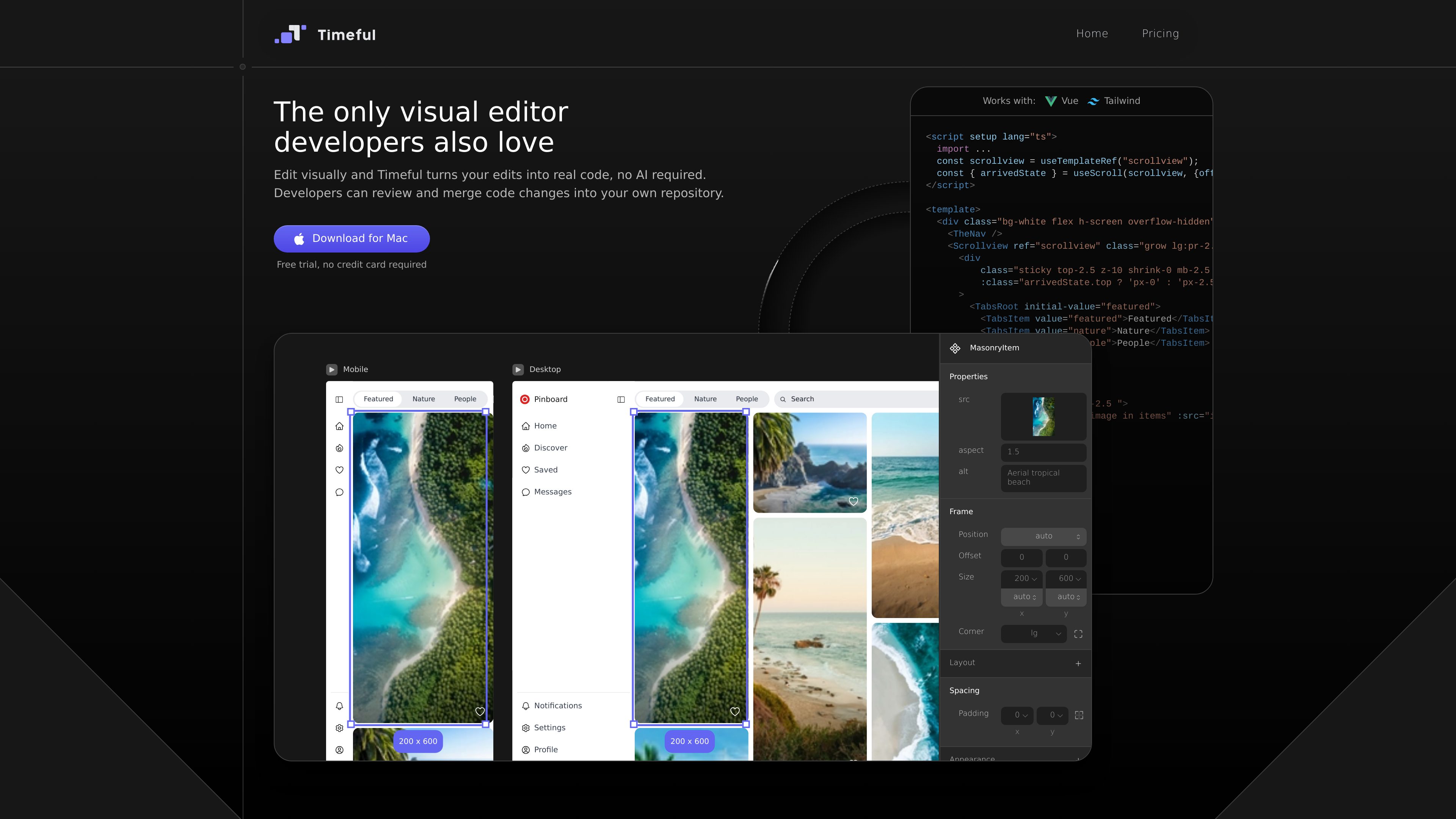
Canvas-based interface editing
Lay out and edit web application UI visually on a canvas instead of making every interface change directly in source files.

Timeful is a visual editor for designing web app interfaces on a canvas while generating and synchronizing standard Vue and Tailwind code. It helps developers and UI contributors move between visual editing and repository-based code workflows.
Timeful is a visual editor for web application interfaces. Users can design on a canvas, generate standard Vue and Tailwind code, and import or edit existing code. The product is intended to give developers a visual way to work on UI while keeping the resulting files in a conventional code and Git workflow.
Its central workflow is two-way synchronization between visual edits and code. Timeful says it uses deterministic algorithms rather than an AI model that consumes tokens or credits, so edits do not depend on an AI-credit allowance. Code is written to local files and can be reviewed and merged through a team’s own repository.
Lay out and edit web application UI visually on a canvas instead of making every interface change directly in source files.
Timeful turns canvas changes into standard Vue and Tailwind code that can be written to local project files.
Existing code can be brought into the visual workflow, allowing teams to work with current projects rather than only starting from a blank canvas.
The product supports synchronization in both directions, connecting visual changes with the corresponding code instead of treating design and implementation as separate deliverables.
Files are saved in a standard Git repository, allowing developers to review, pull, compile, edit, and push changes with their existing tools.
Timeful describes its algorithms as predictable and deterministic, with unlimited edits and no AI-credit or token usage.
A developer can use the canvas to arrange and refine UI components, then continue working with the resulting Vue and Tailwind files in the project repository.
Teams with an existing codebase can import or edit current code in Timeful when a visual view is useful for interface layout work.
A visual editor can make interface changes while developers use the team’s normal Git process to inspect, merge, compile, and distribute the code.
People who do not use Timeful’s visual canvas can still view or edit the plain repository files with their preferred IDE and do not need a Timeful license for that access.
Timeful writes standard Vue and Tailwind code to local files. The pricing page describes this output as production-ready and says the files belong to the user.
Yes. The product description says users can import or edit existing code as well as design on the visual canvas.
Timeful syncs with a standard Git repository. Developers can review, pull, compile, edit, and push the code using their existing development tools.
Anyone who wants to use Timeful to edit files on the visual canvas is considered an editor and needs a license. People who only view or edit the repository code do not need a Timeful license.
The site says the code remains safe in local environments and Git repositories, and that users retain ownership of the generated code. Access to Timeful ends according to the subscription terms, but the files are not locked in the product.

www.useshape.org
Shape is a desktop IDE that combines code editing, local project workflows, visual design inspection, Git tools, and AI chat for designers and programmers.

www.analytiics.co
Analytiics is web and product analytics that a coding agent can set up in an application repository. It tracks visitors, pageviews, declared events, funnels, journeys, and revenue while keeping the tracking plan in code.