
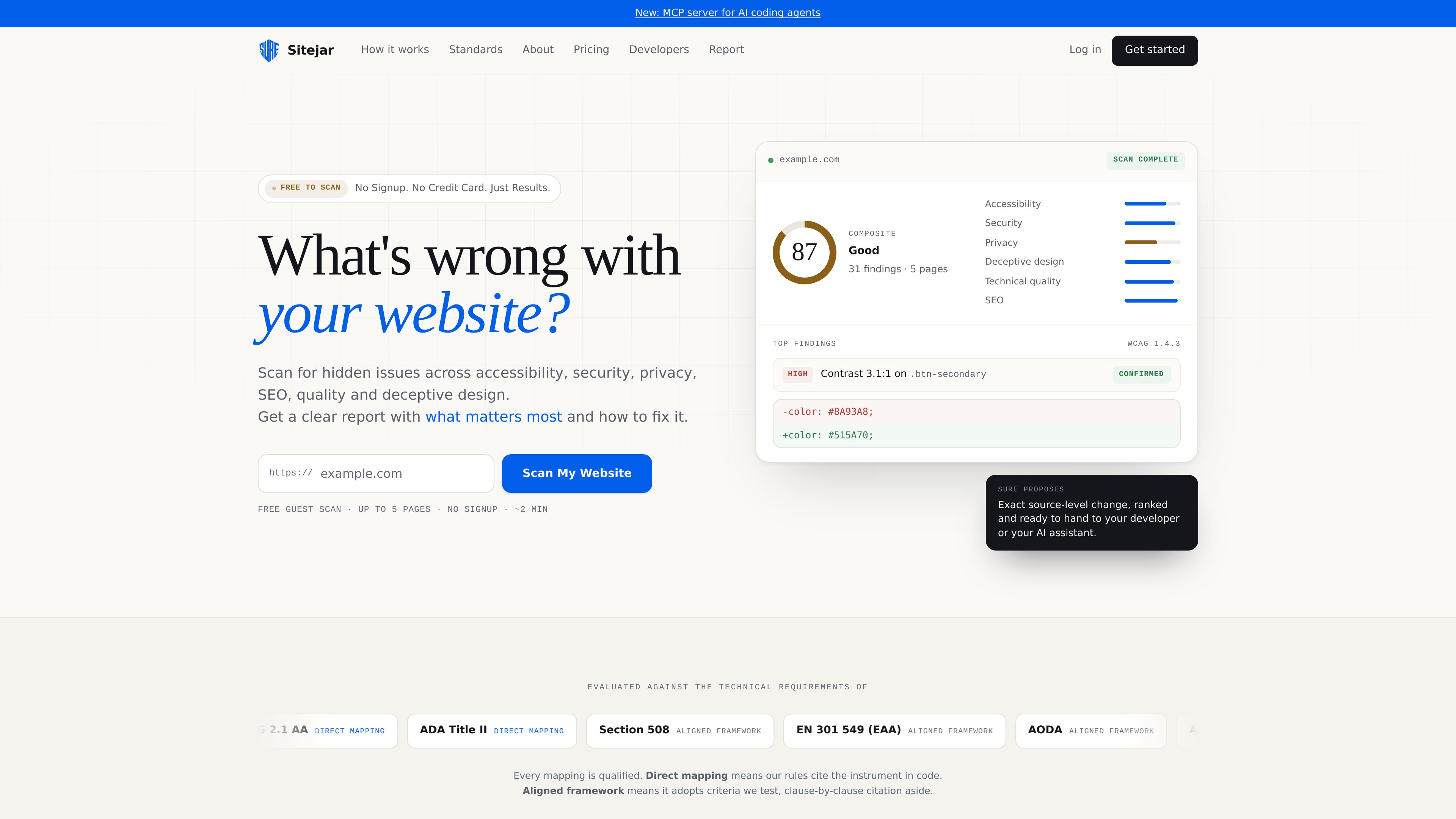
Six-dimension website scans
A single crawl evaluates accessibility, security, privacy, deceptive design, technical quality, and SEO. The crawler renders pages in a real browser so the assessment reflects the page visitors see.

Sitejar scans public websites across accessibility, security, privacy, deceptive design, technical quality, and SEO. It gives teams prioritized findings and source-level remediation suggestions without requiring an agent or embedded script.
Sitejar is a web compliance scanning platform that evaluates public websites across six dimensions: accessibility, security, privacy, deceptive design, technical quality, and SEO. It renders pages in a real browser, rather than checking only raw HTML, then produces a report showing what was found, where it occurs, and what should be addressed first.
The service is designed to help businesses and small to mid-sized teams understand compliance and quality issues without installing an agent or embedding a script. Accessibility checks are mapped to WCAG 2.1 AA criteria, while the site also describes relationships to frameworks and requirements including ADA Title II, Section 508, EN 301 549, AODA, and the Accessible Canada Act. Other dimensions cover areas such as security headers, TLS and mixed content, trackers and consent signals, deceptive design patterns, markup and broken references, and search-oriented structure.
For remediation, Sitejar uses SURE, its Semantic Unified Remediation Engine. Deterministic documented rules produce the findings; SURE then considers the surrounding markup and proposes a source-level change or an AI-ready prompt. Suggestions are reviewed by the team and are not automatically applied to the website.
A single crawl evaluates accessibility, security, privacy, deceptive design, technical quality, and SEO. The crawler renders pages in a real browser so the assessment reflects the page visitors see.
Findings are tied to documented rules and, for accessibility checks, the relevant WCAG criterion. The report names the affected element in plain language instead of relying only on generic best-practice labels.
Each result is labeled Confirmed, Likely, or Needs review, helping teams distinguish directly established issues from findings that warrant human inspection.
The Semantic Unified Remediation Engine reads the surrounding page structure and proposes an exact source-level change or a prompt for an AI assistant. Teams review and apply the change themselves.
Depending on the plan, Sitejar provides Markdown, CSV, JSON, PDF, and DOCX outputs, including accessibility statements, executive reports, VPAT/ACR drafts, and AI fix prompts.
The pricing information lists public API access on all plans and access to an MCP server for connecting an AI agent to Sitejar. Request rates and scan allowances vary by plan.
A development or quality team can scan a public staging or production URL to identify accessibility, security, privacy, technical, and SEO issues before release. The report provides a prioritized queue instead of requiring separate checks for each dimension.
A developer can use the named element, cited rule, and SURE source-level proposal to investigate an issue in context. The suggested diff or generated prompt can be reviewed and committed through the team's normal development workflow.
Organizations preparing formal documentation can use the available accessibility statement builder or VPAT/ACR draft builder on eligible plans. Executive reports provide a separate, non-technical format for leadership and stakeholders.
Agencies or organizations responsible for multiple websites can use plans with higher tracked-site and crawl allowances, plus branded or white-label report options on the Agency plan.
Teams using AI development tools can connect an agent through Sitejar's MCP server or use AI fix prompt exports. The documented rule remains the source of the finding while the AI-assisted output is positioned as a reviewable remediation proposal.
No. Sitejar says it works from a public URL, crawls pages in a real browser, and does not require an agent to install or a script to embed.
Yes. A guest scan covers up to five pages without signup or a credit card. Guest scans are deleted 24 hours after they finish. Creating a free account provides full findings across all six dimensions and retains scan history until it is deleted.
Every plan includes six dimensions: accessibility, security, privacy, deceptive design, technical quality, and SEO. The site describes checks such as WCAG 2.1 AA accessibility criteria, security headers and mixed content, trackers and consent handling, deceptive design patterns, markup and broken references, and page structure and semantics.
No. SURE proposes a source-level diff or AI-ready prompt, but the team reviews the proposal and applies any change itself. The site states that no model output is shipped as a finding and that every proposal cites the rule and criterion behind it.
Export availability depends on the plan. Listed outputs include Markdown, CSV, JSON, branded or white-label PDF reports, accessibility statements, executive reports, VPAT/ACR drafts, and AI fix prompts. The free plan does not include exports listed in the comparison table.
Os dados de tráfego são apenas para referência.

openseo.so
Open-source SEO research, rank tracking, audits, and AI-agent workflows for organic growth teams.

llmseoeeat.com
Score public pages across Experience, Expertise, Authoritativeness, and Trustworthiness to support structured content credibility reviews.

findableapp.com
Findable is an AI search visibility and Answer Engine Optimization platform for brands, agencies, and in-house marketing teams. It monitors brand recommendations and citations across AI search services, then helps teams identify content and technical improvements.

jevseo.vercel.app
jev-seo is an open-source Rust command-line toolkit for auditing websites and local content for SEO and generative engine optimization. It also tracks rank changes, gates CI checks, and exposes its capabilities through a 15-tool MCP server for coding agents.

simhadigital.com
Simha Digital is an AI-powered SEO analytics workspace that combines Search Console, Analytics 4, PageSpeed, site crawling, and AI-search visibility data. It helps website owners and SEO teams identify priorities, understand traffic and technical issues, and turn findings into an action plan.