
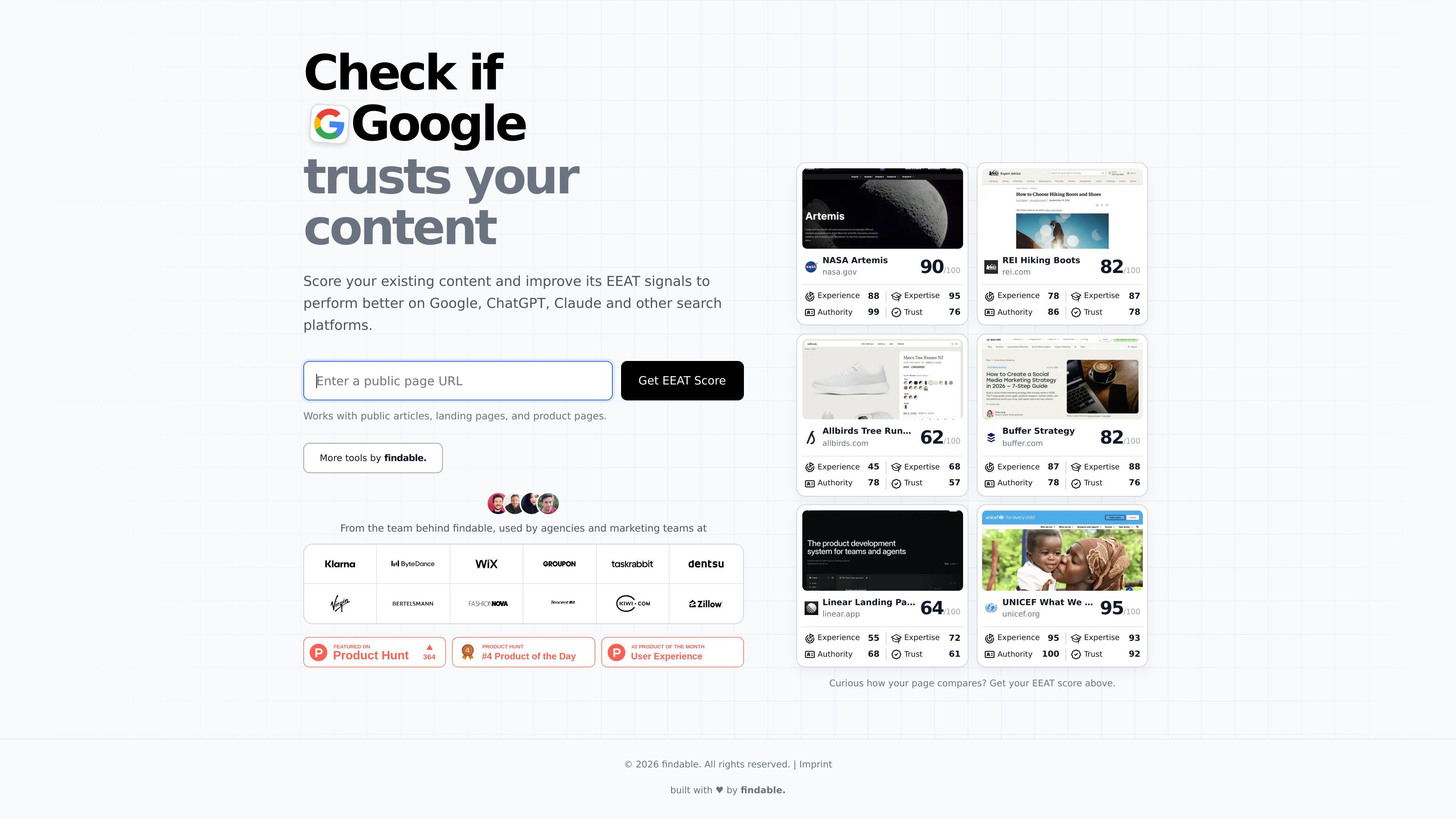
Four-dimension EEAT scorecard
Provides separate scores for Experience, Expertise, Authoritativeness, and Trustworthiness instead of only one combined result.

Score public pages across Experience, Expertise, Authoritativeness, and Trustworthiness to support structured content credibility reviews.
EEAT Scoring is a public-page analysis tool from Findable that evaluates content against four signals: Experience, Expertise, Authoritativeness, and Trustworthiness. It returns an overall average alongside separate scores for each dimension, giving teams a structured way to review how a page may communicate credibility.
The tool works with public articles, landing pages, and product pages. A page can be checked by its public URL, and the result is presented as a four-part scorecard rather than a single undifferentiated rating. This makes it possible to identify which aspect of EEAT is comparatively weaker and may need further review.
EEAT Scoring is intended for existing-content assessment and improvement. It can support SEO professionals, marketing agencies, and in-house teams reviewing pages for Google, ChatGPT, Claude, and other search platforms.
Provides separate scores for Experience, Expertise, Authoritativeness, and Trustworthiness instead of only one combined result.
Shows an overall EEAT average alongside the four component scores for a concise page-level summary.
Checks publicly accessible content, including articles, landing pages, and product pages.
Helps teams identify comparatively weaker EEAT dimensions when reviewing existing pages for possible improvement.
Positions EEAT review in the context of visibility across Google, ChatGPT, Claude, and other search platforms.
SEO teams can submit a public article and use the four component scores to structure a credibility review before revising the page.
Marketing teams can assess a public landing page and compare its Experience, Expertise, Authority, and Trust scores during content improvement work.
Teams managing product pages can use the scorecard as one input when checking how clearly a page communicates relevant experience and authority.
Agencies can use page-level EEAT results as a consistent starting point for discussions with clients about existing content and search visibility.
It measures Experience, Expertise, Authoritativeness, and Trustworthiness, and also reports an overall average of those four scores.
The site says the tool works with public articles, landing pages, and product pages.
They can help teams review existing content, identify comparatively weaker EEAT dimensions, and decide where further content improvement may be useful.
The site presents EEAT review as relevant to Google, ChatGPT, Claude, and other search platforms.
Os dados de tráfego são apenas para referência.

neopress.ai
Neopress is an AI-assisted website builder and publishing platform for creating pages, managing structured content, and improving website performance with SEO, AI-search controls, forms, and analytics.

www.aiogeoprotocol.com
AIO.GEO audits whether AI crawlers and generative answer engines can access, parse, understand, and cite a public website. It helps developers, agencies, content teams, and governance teams identify structural issues, apply dry-run fixes, rescore changes, and produce verifiable receipts.

findableapp.com
Findable is an AI search visibility and Answer Engine Optimization platform for brands, agencies, and in-house marketing teams. It monitors brand recommendations and citations across AI search services, then helps teams identify content and technical improvements.

rctrl.com
RankControl is an AI SEO platform for creating, publishing, and monitoring content across Google and AI search services. It helps brands identify citation gaps, produce brand-matched articles, track visibility, and manage link-building workflows on their own domains.

sitejar.app
Sitejar scans public websites across accessibility, security, privacy, deceptive design, technical quality, and SEO. It gives teams prioritized findings and source-level remediation suggestions without requiring an agent or embedded script.