
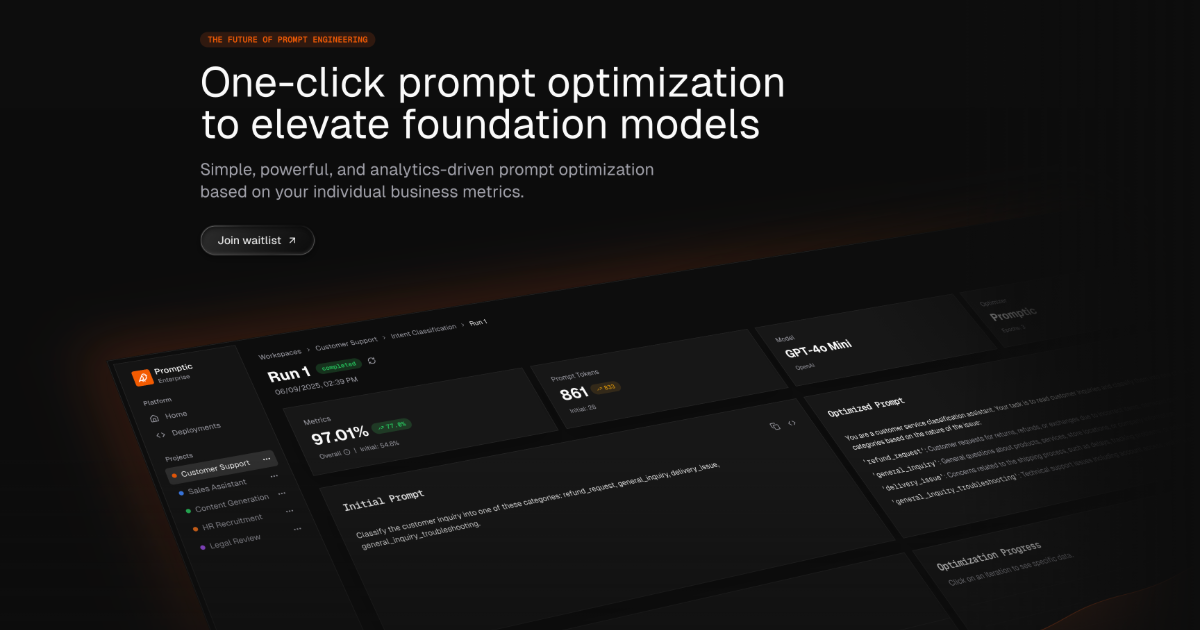
Prompt optimization
Optimize prompts against labeled examples, evaluators, and business metrics. Promptic supports multi-variable prompts and structured chat-message templates so experiments can match the format used in an application.

Promptic é uma plataforma de otimização de GenAI para avaliar modelos, aprimorar prompts e agentes e escolher configurações com base em métricas de negócio. Ela combina rastreamento baseado em OpenTelemetry com conjuntos de dados, benchmarks e fluxos de otimização para equipes que desenvolvem aplicações de IA.
Promptic helps teams evaluate and improve AI applications using representative data, expected outputs, and business metrics. It covers model comparison, prompt tuning, agent evaluation, information extraction, and tool-selection workflows.
Users can benchmark candidate configurations for quality, cost, and latency, inspect production behavior through OpenTelemetry traces, and retrieve or deploy a validated configuration from application workflows.
Optimize prompts against labeled examples, evaluators, and business metrics. Promptic supports multi-variable prompts and structured chat-message templates so experiments can match the format used in an application.
Benchmark different foundation models on the same task and compare quality, inference cost, and latency to identify a configuration that fits the project’s priorities.
Evaluate complete agents and compare their outputs, artifacts, trajectories, and architectures, including workflows that use routing, retrieval, or tools.
Capture LLM calls, tool calls, and workflow steps with provider-agnostic spans. Traces can include request and response payloads, token counts, cost, and latency for debugging and optimization.
Score only the output fields that matter, with per-field inclusion, weighting, required-field handling, strategy overrides, and configurable LLM-judge behavior.
Use the Python SDK, REST API, CLI, or documented dashboard workflows to instrument applications, manage experiments, and retrieve optimized prompts or configurations. The SDK supports first-class tracing for OpenAI, Anthropic, Google, LangChain, and Cohere.
Run the same evaluation dataset across candidate models and weigh output quality against inference cost and latency before choosing what to deploy.
Compare complete agent architectures, inspect failing traces and spans, and validate a revised implementation against fixed cases before shipping it.
Optimize prompts for documents or other structured tasks, then evaluate important output fields individually so optional or noisy fields do not obscure meaningful regressions.
Evaluate how reliably a model selects tools from an MCP server and use trace evidence to investigate incorrect routing, retries, or other tool-use failures.
Promptic can optimize prompts, compare models, evaluate agent architectures, improve information-extraction workflows, and optimize model tool selection. The documentation also describes support for multi-variable prompts, chat-message prompts, and structured-output evaluation.
Users provide representative inputs and expected outputs, define the metrics that matter, and benchmark candidate prompts, models, or architectures against the same dataset. Promptic surfaces differences in the results and helps select a configuration based on the chosen trade-offs.
Promptic uses OpenTelemetry-based instrumentation to capture LLM calls, tool calls, and workflow steps. Trace data can include payloads, token counts, cost, and latency, and can then be used for debugging, dataset creation, and optimization.
Yes. Promptic documents a Python SDK, REST API, CLI workflows, and dashboard-based workflows. The Python SDK provides drop-in initialization for tracing and supports OpenAI, Anthropic, Google, LangChain, and Cohere integrations.
The pricing page distinguishes Promptic Credits from model or token usage. Users can bring their own model keys, while managed model usage is optional on applicable plans and billed separately; enterprise terms are customized.
Os dados de tráfego são apenas para referência.

www.cybedefend.com
CybeDefend é uma plataforma de segurança de código desenvolvida para fluxos de trabalho de programação com IA. A camada VibeDefend analisa prompts dos agentes e diffs, aplica regras do projeto e do negócio, protege contra ações arriscadas e combina análises de código, dependências, segredos, infraestrutura e CI/CD antes de um pull request.

deepchecks.com
Plataforma para avaliar, testar e monitorar LLMs, prompts, modelos, pipelines RAG e agentes

pangea.cloud
Pangea é uma plataforma de segurança para aplicações de IA que adiciona proteções a prompts, resultados, acesso a dados e registos. Proteja fluxos de trabalho LLM através de APIs, SDKs, ferramentas de IA ou gateways de API.

braintrust.dev
Braintrust é uma plataforma de observabilidade de IA para rastrear o comportamento da IA em produção, executar avaliações e identificar regressões antes que cheguem aos usuários. Ela ajuda as equipes a criar e operar produtos de IA com traces, conjuntos de dados, pontuação e ferramentas de workflow.

omlx.ai
oMLX é um servidor de inferência LLM nativo do macOS, baseado em MLX, para executar localmente no Apple Silicon modelos compatíveis de linguagem, visão-linguagem, embeddings e reranking. Criado para fluxos de trabalho com agentes de programação, funciona com Claude Code, OpenClaw, Cursor e clientes compatíveis com OpenAI.

ultracite.ai
Ultracite é um preset sem configuração para ESLint, Biome e Oxlint que ajuda equipes e IA a escrever código consistente e type-safe. Ele gera configurações do editor, instruções para agentes e hooks para alinhar os padrões em fluxos de trabalho humanos e de IA.