
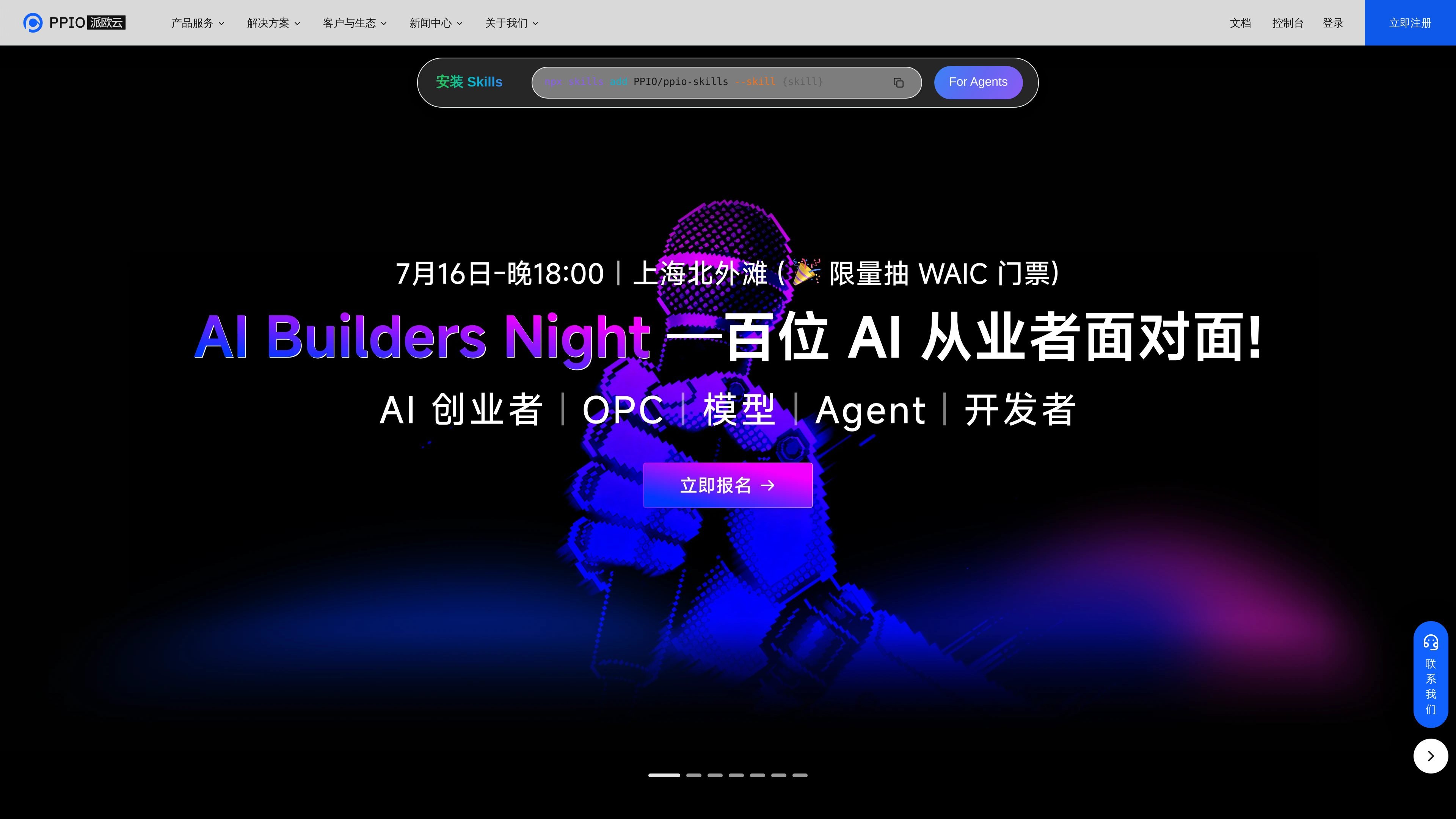
Multi-model API access
Provides APIs for large language models, image/video models, embedding models, and reranking, covering multimodal generation and retrieval scenarios.

PPIO é um provedor de nuvem distribuída para cargas de trabalho de IA, com APIs de modelos, sandboxes Agent, nuvem GPU e edge computing, além de pagamento conforme o uso, inferência em lote e interfaces compatíveis com OpenAI.
PPIO is a distributed cloud computing service provider that offers one-stop intelligent computing, model, and edge computing services for scenarios such as artificial intelligence, audio/video, and the metaverse. The site publicly presents product lines including model API, Agent sandbox, GPU cloud services, and enterprise private deployment, making it suitable for teams that need a unified way to access compute resources and AI capabilities.
At the model service layer, PPIO provides capabilities such as large language models, image/video models, embedding models, and reranking. It also supports batch inference, OpenAI API-compatible endpoints, and developer-oriented toolchains. For scenarios that need cost control or handle large volumes of offline requests, the platform also offers batch inference, cache billing prompts, and usage-based pricing.
Provides APIs for large language models, image/video models, embedding models, and reranking, covering multimodal generation and retrieval scenarios.
Batch inference supports asynchronous processing of large numbers of requests, is compatible with the OpenAI API standard, and is suitable for evaluation, classification, and offline summarization tasks.
The model API page shows usage-based pricing and provides billing prompts for cache reads and writes, helping control costs by call volume.
The Agent sandbox provides multiple sandbox forms, including browser, code, and custom, for running Agents in a controlled environment.
The MCP Server supports developer tools such as Claude Code, Claude Desktop, Cursor, VS Code, Codex, and Zed.
GPU cloud services provide GPU container instances and GPU Spot options for elastic compute needs.
Integrate large language models, image models, video models, or embedding models into chat, reasoning, classification, or content generation applications, and pay by usage.
Upload large volumes of offline requests in batches and use batch inference to complete evaluation, data analysis, bulk classification, or document summarization generation.
Run browser, code, or custom Agent workloads in a controlled sandbox to reduce the risk of exposing automation logic directly to production environments.
Use GPU container instances or Spot compute with elastic scaling when you need flexible GPU compute for training, inference, or temporary compute spikes.
When you want to embed model capabilities into existing development tools or workflows, integrate and manage them through the MCP Server or Sandbox CLI.
PPIO provides model API, Agent sandbox, GPU cloud services, and enterprise private deployment products, suitable for teams that need access to large-model inference, batch processing, Agent runtime environments, or elastic compute.
You can choose a model on its model API page and pay based on usage; for the batch inference API, first upload a `.jsonl` input file, then create a batch job. Results are returned through an output file after the job completes.
The batch inference API supports asynchronous processing of large numbers of requests, is compatible with the OpenAI API standard, and has a fixed completion window of 48 hours.
According to the source materials, PPIO's MCP Server supports Claude Code, Claude Desktop, Cursor, VS Code, Codex, and Zed; it also provides Sandbox CLI for managing sandbox instances.
The public materials show that batch jobs can include up to 50,000 requests and the input file can be up to 100MB; result output files are deleted 30 days after batch inference ends, and batch input files are retained for 15 days.
Os dados de tráfego são apenas para referência.
www.clarkchat.com
Clark Labs oferece Clark Agent para trabalho web autônomo baseado na nuvem e Clark Code para tarefas de programação locais ou baseadas em SSH. A plataforma também fornece um gateway de API compatível com OpenAI para chamar modelos Clark ou encaminhar modelos de ponta por meio do Clark.

nobodywho.ai
NobodyWho é um mecanismo de inferência para executar LLMs localmente e com eficiência em dispositivos compatíveis. É voltado a desenvolvedores que buscam inferência de modelos offline, entradas multimodais e fluxos de trabalho locais de voz e texto sem chaves de API.

tensorflow.org
Plataforma de machine learning de código aberto para criar, treinar e implantar modelos em desktop, dispositivos móveis, web, nuvem e edge.

blaxel.ai
Agent Drive é o sistema de arquivos em nuvem distribuído da Blaxel para agentes de IA. Ele é montado em sandboxes como um caminho comum, permitindo que vários agentes compartilhem arquivos e o contexto da sessão ao mesmo tempo.

abliteration.ai
API de IA compatível com OpenAI e gateway de políticas para acesso governado a modelos

opencodesuper.app
OpenCode Superapp é um espaço de trabalho nativo para Mac que permite usar modelos de IA locais, auto-hospedados ou na nuvem junto com programação, automação do navegador, voz, extensões, widgets e acesso remoto seguro. É voltado a quem busca um ambiente OpenCode local-first sem precisar de uma conta.