
Local, offline inference
Runs LLMs without API keys or hidden usage fees, which makes it suitable for private or network-limited workflows.

NobodyWho é um mecanismo de inferência para executar LLMs localmente e com eficiência em dispositivos compatíveis. É voltado a desenvolvedores que buscam inferência de modelos offline, entradas multimodais e fluxos de trabalho locais de voz e texto sem chaves de API.
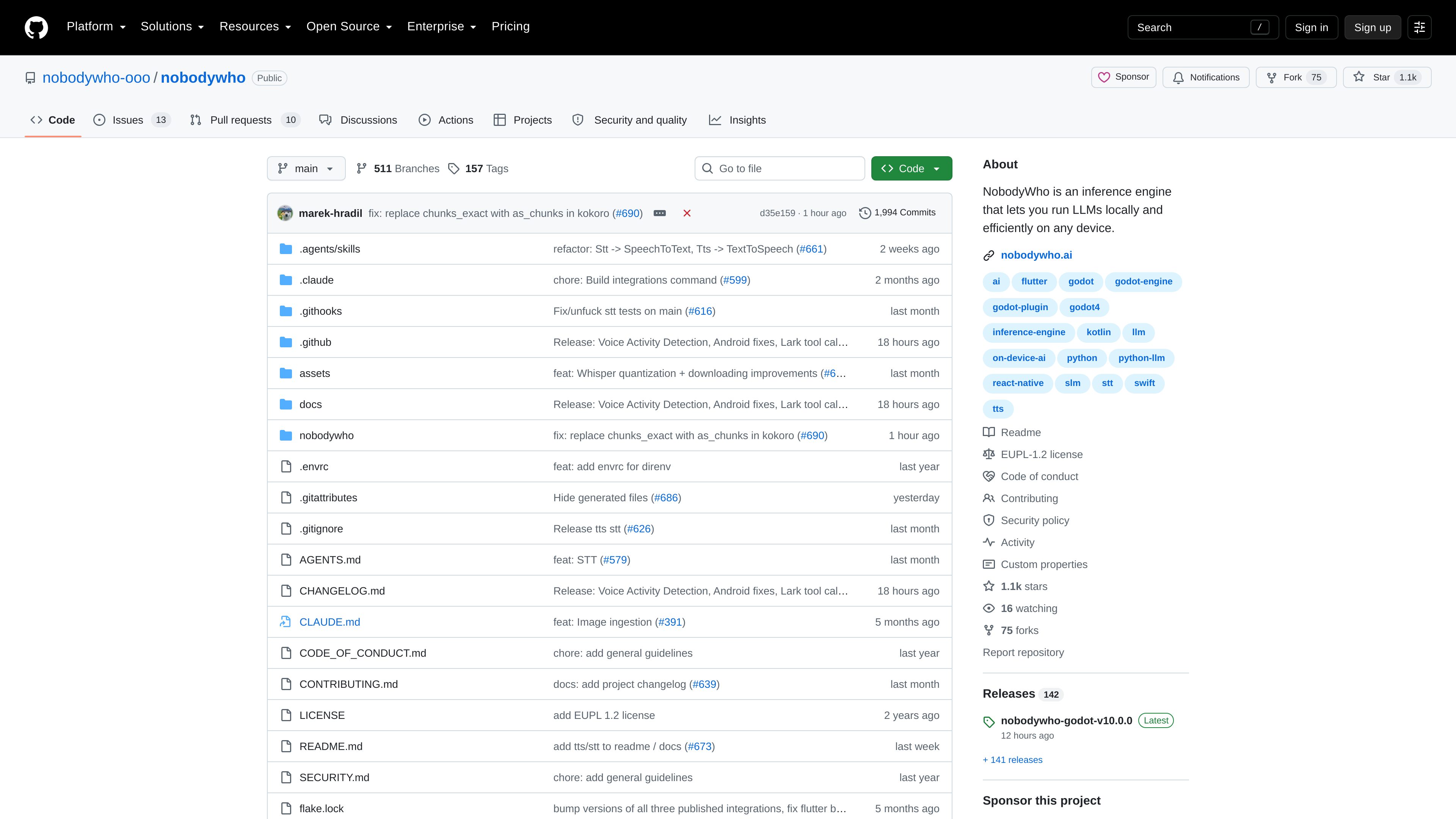
NobodyWho is an on-device inference engine for running large language models locally. The project describes itself as a way to use LLMs efficiently on any device, with an emphasis on offline operation and local execution rather than hosted API calls.
The repository README highlights support for chat models, structured tool calling, multimodal input, text-to-speech, speech-to-text, and model downloading from Hugging Face or any direct URL. It also points to GPU-accelerated inference through Vulkan or Metal, conversation-aware context shifting, and compatibility with GGUF models powered by llama.cpp.
Runs LLMs without API keys or hidden usage fees, which makes it suitable for private or network-limited workflows.
Works with chat LLMs such as Gemma, Qwen, and Mistral, with the broader claim of compatibility with many GGUF-format models.
Generates structured grammars from function signatures, reducing the need to write schemas manually.
Accepts image and audio information as part of LLM interactions.
Includes text-to-speech backends such as Kokoro, Pocket TTS, and Supertonic, plus speech-to-text via Whisper.
Can load models directly from Hugging Face or from any URL, which simplifies distribution and testing.
Build local chat experiences that do not depend on external model APIs.
Add LLM capabilities to Kotlin, Swift, Python, Flutter, React Native, or Godot projects using the documented platform packages.
Combine Whisper transcription with local text-to-speech for voice-enabled workflows.
Use type-safe function calling when you want the model to trigger structured actions from application code.
Load GGUF models from Hugging Face URLs and experiment with local inference across supported runtimes.
No. The README states that it runs locally and offline, with no API keys needed.
The repository says it can run chat LLMs such as Gemma, Qwen, and Mistral, and that it is compatible with thousands of pretrained LLMs in GGUF format.
Yes. The README mentions text-to-speech and speech-to-text support, including Kokoro, Pocket TTS, Supertonic, and Whisper.
The project lists Kotlin, Swift, Python, Flutter, React Native, and Godot.
The README says models can be loaded from Hugging Face or any URL.
Os dados de tráfego são apenas para referência.
| jun. | 0 |
|---|---|
| jul. | 0 |
| ago. | 0 |
As análises de tráfego ainda não estão disponíveis.
As análises de tráfego ainda não estão disponíveis.

ppio.cn
PPIO é um provedor de nuvem distribuída para cargas de trabalho de IA, com APIs de modelos, sandboxes Agent, nuvem GPU e edge computing, além de pagamento conforme o uso, inferência em lote e interfaces compatíveis com OpenAI.

caveman.so
Caveman é uma stack de eficiência de tokens para agentes de IA e fluxos de trabalho em produção. Ajuda as equipes a reduzir o contexto elegível, rotear o tráfego e medir economias verificadas com ferramentas locais, um SDK TypeScript e uma camada de nuvem gerenciada.

voidleap.com
Voidleap Code é um IDE para desktop voltado a desenvolvedores profissionais e engenheiros de IA que criam software com agentes de IA. Ele é executado localmente no Mac e no Windows, oferece suporte a contas de provedores de nuvem ou modelos locais e permite inspecionar e controlar prompts, chamadas de ferramentas, contexto e alterações em arquivos.

pi.dev
Pi Coding Agent é um agente de programação baseado em terminal para desenvolvedores que buscam um fluxo de trabalho CLI extensível, com uso interativo e programático, instruções de projeto, ramificação de sessões e amplo suporte a provedores de modelos.

minimaxi.com
MiniMax é uma plataforma de inteligência artificial de uso geral que oferece grandes modelos multimodais, uma plataforma aberta para desenvolvedores e produtos por assinatura para indivíduos e equipes. É indicada para quem precisa de programação, tarefas com agentes, processamento multimodal e integração de aplicações nativas de AI.

www.clarkchat.com
Clark Labs oferece Clark Agent para trabalho web autônomo baseado na nuvem e Clark Code para tarefas de programação locais ou baseadas em SSH. A plataforma também fornece um gateway de API compatível com OpenAI para chamar modelos Clark ou encaminhar modelos de ponta por meio do Clark.