
Distributed tracing
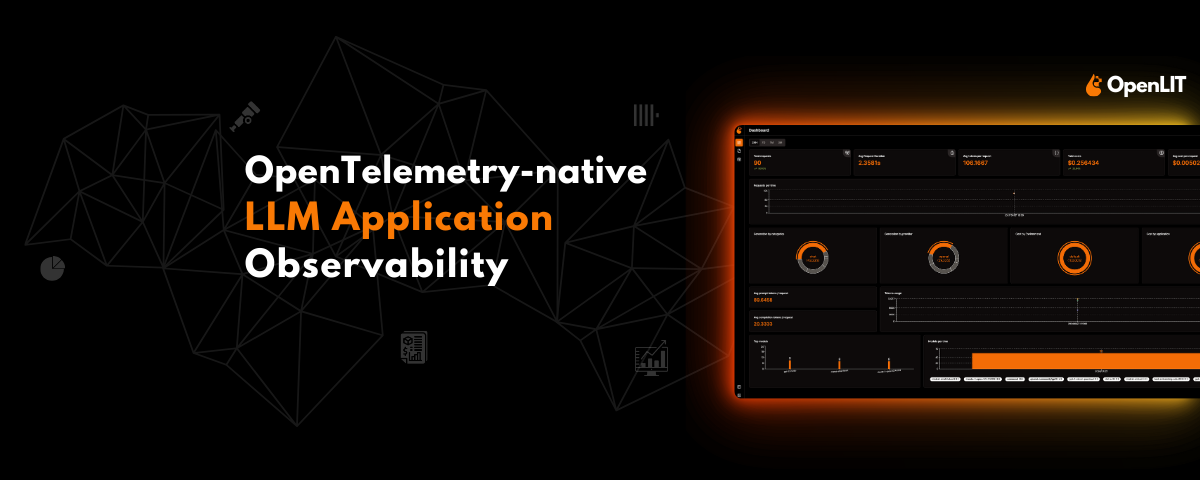
Monitor and trace LLM applications in real time with OpenTelemetry-powered distributed tracing. The site says this helps visualize request flows, identify bottlenecks, and follow the lifecycle of each AI interaction.

Plataforma open source de observabilidade LLM com OpenTelemetry para monitorar, rastrear e avaliar apps de IA.
OpenLIT is an open-source platform for AI engineering focused on LLM observability, tracing, and evaluation. It is built on OpenTelemetry and is positioned for production workloads that need monitoring across AI applications, prompts, models, and surrounding infrastructure.
The product is designed to work with existing SDK-based applications and observability stacks. The homepage emphasizes quick setup with a few lines of code, while the pricing page states the self-hosted edition is Apache 2.0 licensed, free forever, and available without usage limits or license keys.
Monitor and trace LLM applications in real time with OpenTelemetry-powered distributed tracing. The site says this helps visualize request flows, identify bottlenecks, and follow the lifecycle of each AI interaction.
Run online and offline evaluations either from the UI or through SDKs. The product positioning ties evaluation to prompts, models, and end-to-end application testing.
Centrally manage prompts with versioning and deployment controls. OpenLIT presents this as a way to experiment with prompt variations and track prompt performance over time.
Inspect telemetry across deployments with real-time dashboards and custom SQL queries. The homepage also mentions configurable widgets and layouts for visualizing OpenTelemetry data.
Manage multiple deployments from one view. OpenLIT describes Fleet Hub as a way to compare performance metrics across environments and coordinate an AI fleet from a single dashboard.
Track infrastructure signals alongside LLM activity, including GPU monitoring, vector database tracing, token usage, and cost tracking. The pricing page also mentions exports to Grafana, Datadog, and any OTLP backend.
Instrument an existing LLM application directly in the SDK and capture traces, token usage, and cost data without routing traffic through a proxy. This fits teams that want observability with minimal code changes and no added proxy latency.
Run prompt and model experiments in the UI or through SDKs, then use evaluations to compare outputs and iterate on application behavior. OpenLIT also includes prompt versioning so teams can track changes over time.
Monitor self-hosted or distributed AI infrastructure where GPU utilization, VRAM, temperature, and power draw matter. The comparison pages specifically call out NVIDIA and AMD GPU monitoring and vector DB tracing.
Manage several AI deployments from a single dashboard and compare performance across environments. Fleet Hub is presented as a multi-deployment view for teams operating more than one application or environment.
Export telemetry to existing observability tools such as Grafana, Datadog, or any OTLP-compatible backend. This suits teams that already have a standard monitoring stack and want to keep data flowing there.
Yes. OpenLIT is Apache 2.0 licensed and free to self-host, with no usage limits, no feature gates, and no license key required.
The pricing page says Docker and Docker Compose are enough to self-host. It also says you can run `docker compose up -d` in the repo to start the full stack, including the UI, ClickHouse storage, and OpenTelemetry Collector.
Yes. OpenLIT is OpenTelemetry-native and can export to OTLP-compatible backends such as Grafana, Datadog, New Relic, SigNoz, and Jaeger.
Yes. The pricing page says GPU metrics can be enabled with `openlit.init(collect_gpu_stats=True)`, and that OpenLIT collects utilization, VRAM usage, temperature, and power draw from NVIDIA and AMD GPUs.
A managed cloud service is listed as coming soon. The page says the Cloud tier is in development and invites users to join the waitlist by emailing [email protected].
Os dados de tráfego são apenas para referência.

braintrust.dev
Braintrust é uma plataforma de observabilidade de IA para rastrear o comportamento da IA em produção, executar avaliações e identificar regressões antes que cheguem aos usuários. Ela ajuda as equipes a criar e operar produtos de IA com traces, conjuntos de dados, pontuação e ferramentas de workflow.

deepchecks.com
Plataforma para avaliar, testar e monitorar LLMs, prompts, modelos, pipelines RAG e agentes

whylabs.ai
Observabilidade de AI e ferramentas open source para logging com privacidade, monitorização de AI e segurança de LLM

promptic.eu
Promptic é uma plataforma de otimização de GenAI para avaliar modelos, aprimorar prompts e agentes e escolher configurações com base em métricas de negócio. Ela combina rastreamento baseado em OpenTelemetry com conjuntos de dados, benchmarks e fluxos de otimização para equipes que desenvolvem aplicações de IA.

apipark.com
Portal de API empresarial e gateway de IA open source para APIs e LLMs em produção

confident-ai.com
Confident AI é uma plataforma de qualidade de AI para testar, monitorar e melhorar sistemas de AI.