
Function-to-UI interface
Wrap any Python function in a UI using `gr.Interface`, with inputs and outputs mapped to Gradio components.

Crie demos web e aplicações compartilháveis para modelos de ML com Python
Gradio is an open-source Python package for building demos and web applications around machine learning models, APIs, or arbitrary Python functions. Its main workflow is to turn a Python function into a web interface with a small amount of code, then share that interface locally or through Gradio's built-in sharing options.
The homepage and docs both position Gradio as a tool for moving from prototype to production-ready web apps without requiring JavaScript, CSS, or frontend experience for the basic path. The docs add that the ecosystem includes the core library, Python and JavaScript clients, and custom components for extending interfaces beyond the default set.
Wrap any Python function in a UI using `gr.Interface`, with inputs and outputs mapped to Gradio components.
Build more custom layouts and behaviors with Blocks, event listeners, and dynamic app patterns.
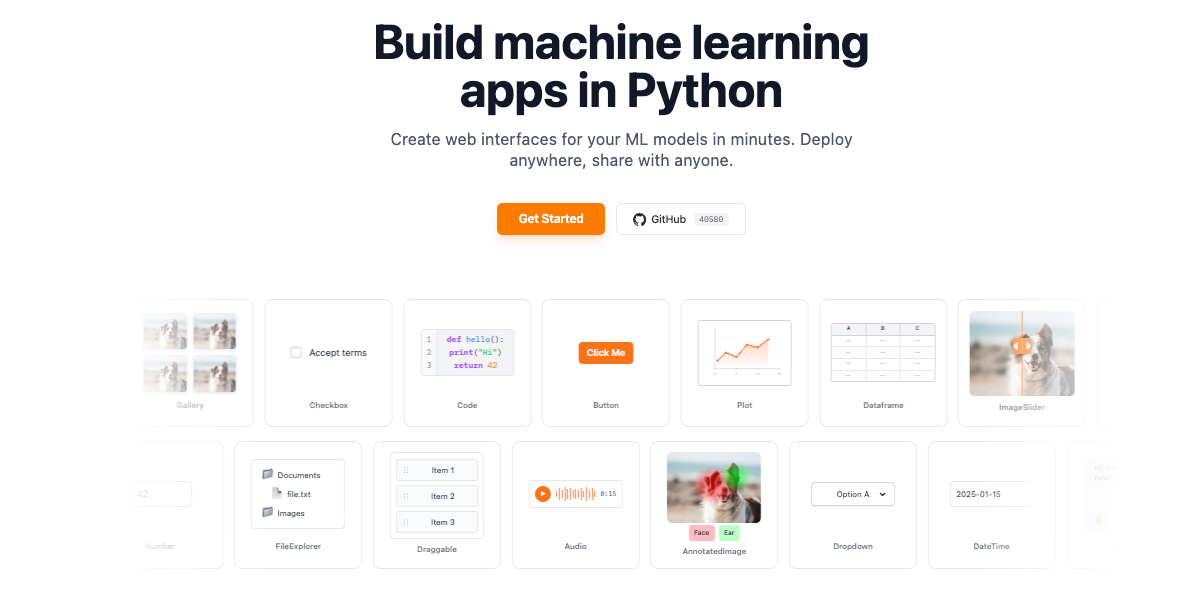
Choose from 40+ built-in components for common data types such as images, audio, video, 3D, dataframes, plots, JSON, text, and chat.
Share a running app locally with a public link in seconds, or deploy it to Hugging Face Spaces for always-on hosting.
Use the Python client or JavaScript client to make programmatic requests to Gradio apps from different environments.
Create custom components and use Gradio UI components in standalone JavaScript apps.
Build a quick demo for a model, API, or Python function and launch it in a browser with a few lines of code.
Create a shareable local link so colleagues or clients can try an app without cloning the project or running it themselves.
Use the interface classes, Blocks, and event listeners to assemble more interactive workflows with multiple inputs and outputs.
Call Gradio apps from Python or JavaScript when you want to connect a demo to another service, pipeline, or frontend.
Deploy a demo to Hugging Face Spaces when you want a hosted, always-on version with a public URL.
Yes. The quickstart shows Gradio can be installed with `pip`, and the docs say it requires Python 3.10 or higher. You can build interfaces in a Python file, notebook, or Google Colab.
Gradio is an open-source Python package for building demos and web applications around machine learning models, APIs, or arbitrary Python functions.
The docs highlight the core Gradio library, a Python client, a JavaScript client, and community-built clients for other languages. The core library is also available as a set of UI components in JavaScript applications.
Gradio supports sharing a local demo with a public link, and it can also be deployed to Hugging Face Spaces for free according to the homepage.
The source emphasizes that Gradio removes the need for JavaScript, CSS, or web hosting experience for the basic workflow, but it does not claim that every advanced app can be built without frontend work.
Os dados de tráfego são apenas para referência.

ai.gitee.com
Plataforma completa de modelos e computação AI para testar, executar inferências, treinar, implantar e criar aplicações.

build.reflex.dev
Reflex Build transforma prompts em aplicações Python para implantação no Reflex Cloud, na sua própria nuvem ou localmente, com templates prontos para produção e integrações para agentes e ferramentas de programação.

catdoes.com
CatDoes é um criador de apps com IA para aplicações móveis e sites, da ideia ao lançamento.

omlx.ai
oMLX é um servidor de inferência LLM nativo do macOS, baseado em MLX, para executar localmente no Apple Silicon modelos compatíveis de linguagem, visão-linguagem, embeddings e reranking. Criado para fluxos de trabalho com agentes de programação, funciona com Claude Code, OpenClaw, Cursor e clientes compatíveis com OpenAI.

www.hyperprobe.co
HyperProbe é uma ferramenta de depuração em produção com assistência de IA que insere sondas somente leitura no código de aplicações em execução para capturar o estado das variáveis em tempo real, sem redeploy ou reinicialização. Ajuda as equipes de engenharia e de plantão a investigar incidentes cuja causa não aparece nos logs e traces.

orate.dev
AI SDK é um toolkit TypeScript para criar aplicações e agentes de IA com vários frameworks e provedores de modelos.