
Input attribution algorithms
Apply Integrated Gradients, DeepLIFT, GradientShap, Occlusion, LRP, or LIME to examine how input features contribute to a selected model output.

An open source PyTorch library for developers and researchers interpreting model outputs.
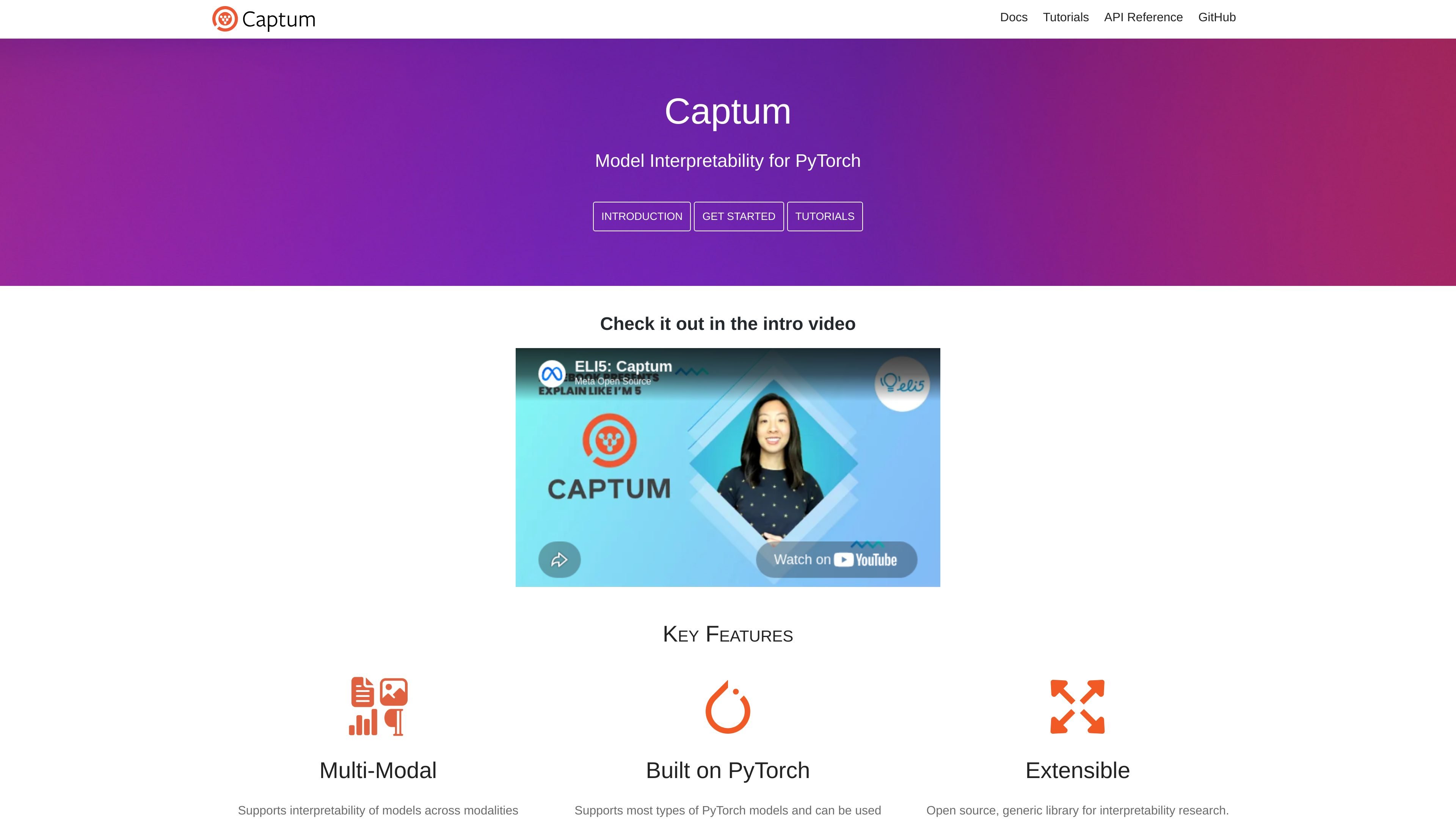
Captum is an open source, extensible library for model interpretability built on PyTorch. It helps developers and researchers examine which input features contribute to a model’s output and investigate how internal layers and neurons affect predictions.
The library supports most types of PyTorch models with minimal modification to the original network. Its algorithms and tutorials cover vision, text, tabular data, and multimodal models, providing a practical foundation for troubleshooting predictions and researching interpretability methods.
Apply Integrated Gradients, DeepLIFT, GradientShap, Occlusion, LRP, or LIME to examine how input features contribute to a selected model output.
Use conductance and internal attribution methods to investigate layer and neuron importance, including the input features associated with a particular neuron.
Interpret text generation with LLM attribution functionality. For multimodal LLMs, combine ImageMaskInput, image segmentation, and FeatureAblation to examine image regions contributing to generated text.
Explore concepts with Testing with Concept Activation Vectors (TCAV). Tutorials also demonstrate FGSM and PGD attacks and robustness metrics alongside attribution algorithms.
Implement new interpretability algorithms and benchmark them against methods available in the library. Tutorials demonstrate distributed attribution using torch.distributed and DataParallel.
Inspect influential words in sentiment predictions or image regions in vision models to investigate unexpected outputs.
Evaluate feature importance and internal attribution in a house price regression network to understand how the network uses its inputs.
Examine sparse and dense feature contributions in Deep Learning Recommender Models, including feature interactions involved in clicked and non-clicked ad predictions.
Study BERT embeddings, attention layers, and token interactions to understand a particular answer prediction.
Install with `conda install captum -c pytorch`, the website’s recommended method, or use `pip install captum`.
The tutorials assume familiarity with PyTorch and its basic features. The introductory Captum tutorial trains a neural network on Titanic survival data, then examines input, layer, and neuron importance.
The homepage example passes input and baseline tensors to an IntegratedGradients instance, selects a target output, and returns attribution scores. With return_convergence_delta=True, it also returns a convergence delta.
Os dados de tráfego são apenas para referência.
| mai. | 14880 |
|---|---|
| jun. | 14494 |
| jul. | 11580 |
As análises de tráfego ainda não estão disponíveis.

clipsai.com
An open-source Python library that helps developers turn longform video into clips and reframed formats.

harnessmanager.devmesh.xyz
Harness Manager is a free, open-source native Mac workspace for managing AI coding tools, MCP servers, skills, updates, and model comparisons. It helps developers inspect their local setup, discover additions, review updates, and compare models in one app.

payloadcms.com
An open-source, TypeScript-based Next.js CMS and application framework for developers and content teams.

cortexdocs.dev
Cortex Docs is an open-source API tooling workflow that turns API specifications and Markdown into interactive documentation, typed SDKs, and MCP servers. It helps developers publish API interfaces for human users, applications, and AI agents from a shared project.