
Agent-specific plugin installation
Plugins are installed on the Cosmic agent that already owns the work, which keeps the integration tied to the workflow rather than to a generic workspace-level connection.

Um marketplace para instalar plugins de fornecedores no agente Cosmic responsável por uma tarefa. É voltado a equipes que usam agentes Cosmic, ferramentas MCP e fluxos de trabalho relacionados a conteúdo ou operações.
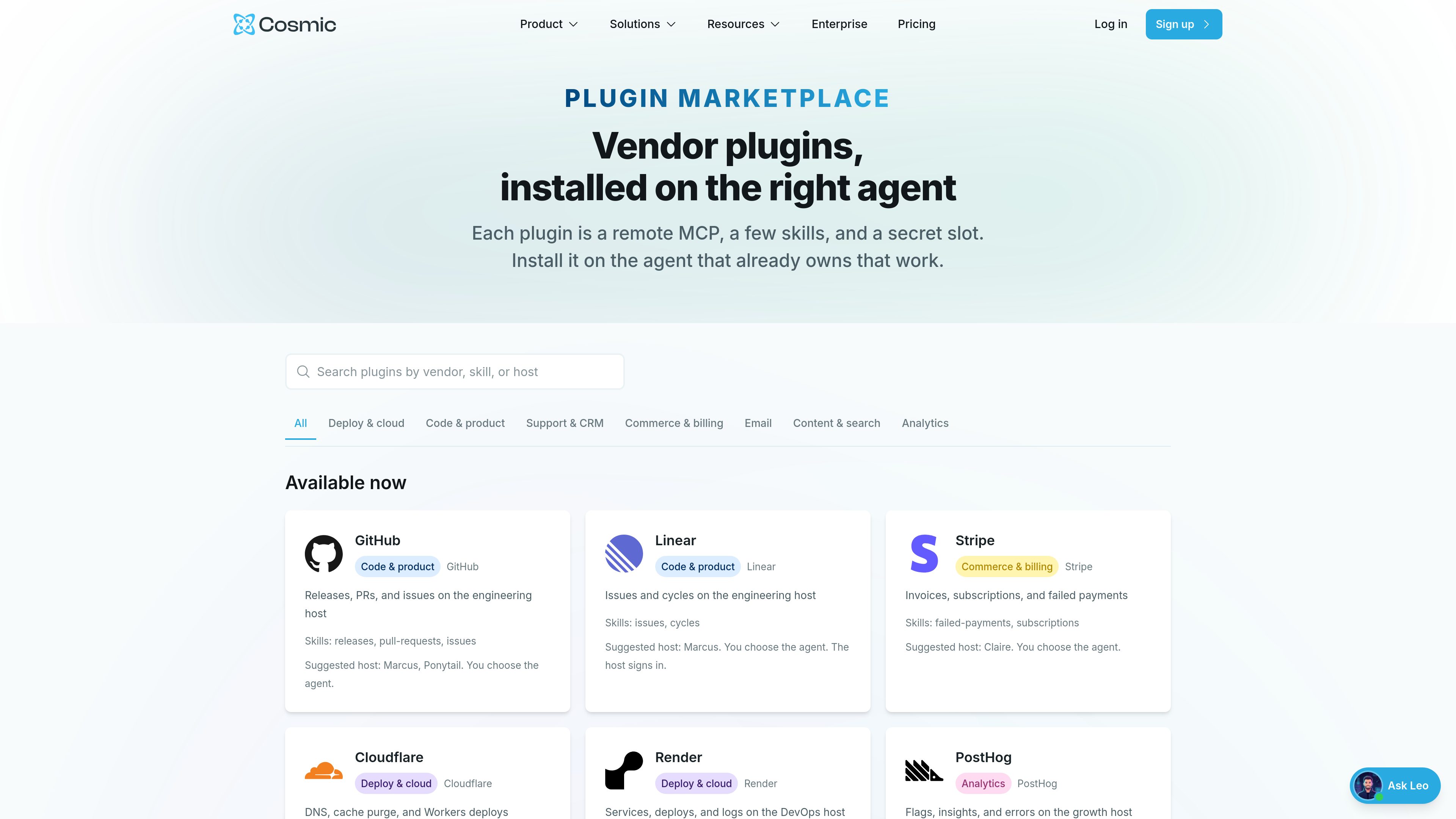
Cosmic’s Agent Plugin Marketplace is a catalog of vendor plugins designed to be installed on the specific Cosmic agent that owns a piece of work. The marketplace frames each plugin as a remote MCP connection with a small set of skills and a secret slot, so the capabilities and credentials stay attached to the agent that will actually use them.
The page presents plugins for several operational areas, including deploy and cloud, code and product, support and CRM, commerce and billing, email, content and search, and analytics. Some plugins are available now, while others are marked coming soon. The emphasis is on choosing the right agent for a workflow, then adding the plugin to that agent rather than sharing access broadly.
Plugins are installed on the Cosmic agent that already owns the work, which keeps the integration tied to the workflow rather than to a generic workspace-level connection.
Each plugin is described as a remote MCP with defined skills and a secret slot, indicating a structured way to expose external tools to an agent.
Listings include explicit skill paths such as releases, issues, deploy, insights, send, pages, and reindex, showing that each plugin exposes only selected actions.
Every listing names one or more suggested host agents, which helps teams map plugins to the agent responsible for a specific function such as engineering, content, growth, or support.
The marketplace includes a submission path for vendors, requiring an HTTPS MCP endpoint, skill documentation, and secret field names before review.
The catalog spans code, deployment, analytics, content, billing, and support workflows, so teams can choose plugins based on the job rather than the vendor alone.
A team can attach GitHub, Linear, or Atlassian to the agent that handles engineering work so the agent can work with releases, pull requests, issues, cycles, and pages.
Deploy-focused teams can use plugins like Cloudflare, Render, Netlify, or the coming soon Vercel integration on the agent that manages shipping and infrastructure tasks.
Teams can route support and commerce work through agents paired with Stripe, Intercom, Zendesk, HubSpot, or Slack-oriented plugins when those are available.
Content teams can connect Notion or Algolia to an agent that manages pages, databases, or reindexing tasks for content discovery and maintenance.
Growth or analytics agents can use plugins such as PostHog or Sentry to surface flags, insights, errors, and issue signals in one place.
Plugins are presented with suggested host agents, but the page says you choose the agent. The idea is to install the plugin on the agent that already owns that work.
No. The page separates plugins into available now and coming soon entries.
The submission form asks for a plugin name, tagline, publisher, work email, plugin.json or mcp.json URL, HTTPS MCP endpoint, secret field names, skill paths, and suggested host agents. The page also says listings stay pending until reviewed.
No. The page says secret field names are provided, but no credentials should be included in the listing.
Yes. The pricing page states there is a Free plan and a free forever starting point with no credit card required.
Os dados de tráfego são apenas para referência.

ultracite.ai
Ultracite é um preset sem configuração para ESLint, Biome e Oxlint que ajuda equipes e IA a escrever código consistente e type-safe. Ele gera configurações do editor, instruções para agentes e hooks para alinhar os padrões em fluxos de trabalho humanos e de IA.

www.mcphub.space
MCPHub é um catálogo pesquisável de servidores Model Context Protocol que ajuda a encontrar ferramentas para conectar assistentes de IA aos serviços e dados já utilizados. Os servidores são organizados por diretório, categoria, tarefa e coleções selecionadas para fluxos de trabalho comuns.

githubnext.com
Site de pesquisa do GitHub para prototipar futuras ferramentas e fluxos de trabalho

pangea.cloud
Pangea é uma plataforma de segurança para aplicações de IA que adiciona proteções a prompts, resultados, acesso a dados e registos. Proteja fluxos de trabalho LLM através de APIs, SDKs, ferramentas de IA ou gateways de API.

omlx.ai
oMLX é um servidor de inferência LLM nativo do macOS, baseado em MLX, para executar localmente no Apple Silicon modelos compatíveis de linguagem, visão-linguagem, embeddings e reranking. Criado para fluxos de trabalho com agentes de programação, funciona com Claude Code, OpenClaw, Cursor e clientes compatíveis com OpenAI.

weaveos.com
Weave Router é um roteador inteligente de modelos para agentes de programação. Ele avalia tarefas de código e direciona solicitações entre modelos abertos e fechados, ajudando desenvolvedores a manter os fluxos de trabalho atuais dos agentes e a gerenciar velocidade, qualidade e gastos com modelos.