
Similarity and originality checking
Check student writing against Turnitin’s similarity sources and identify likely plagiarism or contract cheating so instructors can evaluate originality in context.

Turnitin is an education and research integrity platform that helps institutions check originality, support grading and feedback, and deliver secure assessments. It is used across academic, certification, and research workflows.
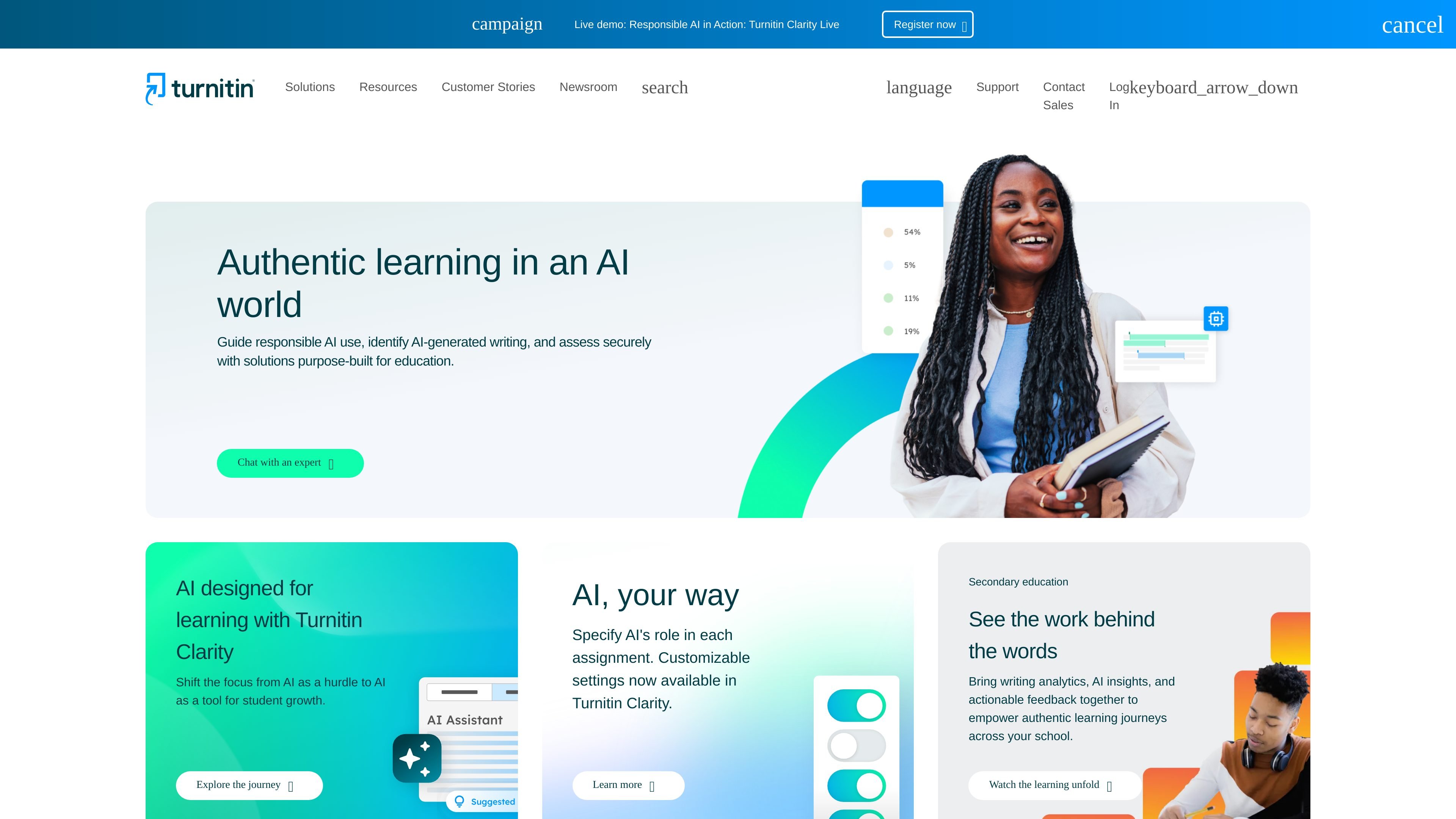
Turnitin is an education and research integrity platform that helps institutions check originality, support feedback and grading, and run secure assessments. The site groups its offerings into academic integrity, course assessment, high-stakes assessment, and research integrity.
Across its solution pages, Turnitin describes tools for detecting plagiarism and AI-generated writing, streamlining instructor feedback, protecting exam integrity, and helping researchers and publishers verify the originality of professional documents before publication. The same platform is positioned for higher and secondary education, certification and licensure, and research and publishing workflows.
The product site also emphasizes workflow fit: Turnitin solutions integrate with third-party platforms and systems, and several pages describe use inside existing learning environments. Pricing is not published on the collected pages, so the site copy focuses on solution fit and workflow outcomes rather than package details.
Check student writing against Turnitin’s similarity sources and identify likely plagiarism or contract cheating so instructors can evaluate originality in context.
Identify AI-generated writing and support responsible AI use in assignments and assessments, including within the learning workflow described on the site.
Provide formative feedback and grading workflows that help instructors respond more consistently and reduce manual review time.
Support secure exam delivery for high-stakes assessment, including offline delivery, device lockdown, and candidate verification as described on the assessment page.
Offer reporting and analytics that help institutions review progress, map curriculum to learning objectives, and analyze assessment performance.
Integrate with third-party platforms and systems, including learning management systems called out on the academic integrity page, to fit existing workflows.
Use Turnitin to check student submissions for similarity, likely plagiarism, and possible AI-generated writing while keeping review inside the teaching workflow.
Use the feedback and course assessment tools to give timely, consistent comments, reduce grading overhead, and help students improve their writing over time.
Use the high-stakes assessment tools to deliver secure, offline exams, control access during testing, and review performance data for certification or licensure contexts.
Use the research integrity tools to screen theses, dissertations, grant proposals, and professional documents before publication or submission.
Use Turnitin across institutions to support academic standards, reporting, and curriculum or assessment analysis in existing platforms and systems.
Turnitin provides solutions for academic integrity, course assessment, high-stakes assessment, and research integrity. The source pages describe the products as helping institutions check originality, identify AI writing, streamline grading and feedback, and deliver secure assessments.
The source materials say Turnitin solutions are used in higher and secondary education, certification and licensure, researchers and publishers, and corporate and government contexts. The product pages also call out support for instructors, administrators, students, institutions, and professional programs.
Turnitin’s academic integrity pages describe integrations with top learning management systems, and the high-stakes assessment page says Turnitin solutions integrate with a wide array of third-party platforms and systems. The source does not list specific platforms on the pages provided.
The source pages do not provide pricing details. The pricing URL in the collected sources returns a page-not-found error, so pricing would need to be confirmed directly with Turnitin.
The source pages describe different solution areas for different needs, including academic integrity, course assessment, high-stakes assessment, and research integrity. The pages do not present a single all-in-one product description for every workflow.