
Unified gateway endpoints
The homepage says TokHub is a unified AI interface platform that lets users switch their interface address to gateway routes instead of integrating each model separately.

TokHub is a web-based AI model gateway with OpenAI, Claude, and Gemini-compatible routes for centralized access to chat, embedding, image, and audio models.
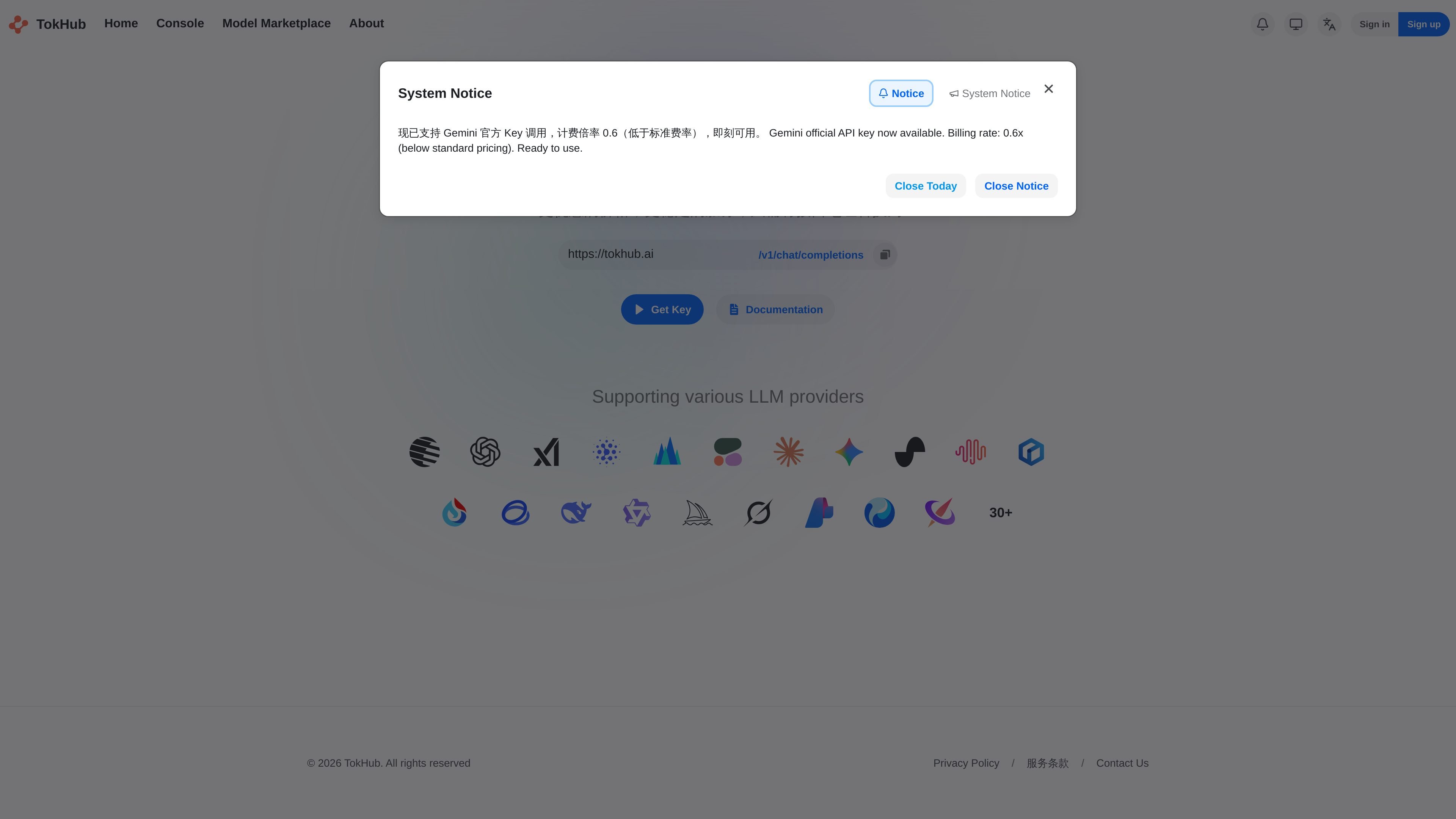
TokHub is an AI model aggregation and distribution gateway that presents itself as a unified interface for accessing many language and multimodal models. The homepage says users can replace their API base path with TokHub routes, while the site description says the service converts models into OpenAI-, Claude-, and Gemini-compatible interfaces.
The pricing page shows a catalog of 55 models from multiple vendors, with pay-as-you-go and pay-per-request billing visible in the listing. The public pages position the product as a centralized gateway for both individual users and organizations that want to manage multiple models through one entry point instead of wiring each provider separately.
The homepage says TokHub is a unified AI interface platform that lets users switch their interface address to gateway routes instead of integrating each model separately.
The site states support for OpenAI, Claude, and Gemini compatible interfaces, which points to cross-format request translation across common LLM ecosystems.
The homepage lists routes for chat, responses, embeddings, rerank, image generation and editing, image variation, speech, transcription, and translation, showing coverage across text, retrieval, image, and audio workflows.
The pricing page shows a marketplace of 55 models from multiple vendors, including Anthropic, DeepSeek, OpenAI, Google, MiniMax, Moonshot, ByteDance, Xiaomi, Zhipu, and Alibaba.
The pricing page supports filtering by vendor, token group, billing type, label, and endpoint type, which helps users locate models by capability and request style.
The pages expose sign up, sign in, console, documentation, and key-entry actions, indicating a self-service workflow for access and account management.
Teams that already integrate against OpenAI-style endpoints can route requests through TokHub while keeping a familiar API shape, reducing the need to redesign client code for each vendor.
Product builders can compare models from multiple vendors in one place and choose by capability, request type, or billing style before connecting an application to a specific model.
Apps that need more than text generation can use the listed image and audio endpoints, including generation, editing, variation, speech, transcription, and translation workflows.
Organizations that want a single place to manage access can use the console, sign-up, and key-based entry flow to centralize model gateway usage.
Developers or operators who need to work across different endpoint conventions can use the compatibility layer to translate between OpenAI, Claude, and Gemini-style interfaces.
TokHub presents itself as a unified AI model aggregation and distribution gateway. The homepage says it supports replacing the interface address with OpenAI-style, Claude-style, and Gemini-style endpoints, and the pricing page lists many models from multiple vendors.
The source shows OpenAI-compatible routes such as `/v1/chat/completions`, `/v1/responses`, `/v1/responses/compact`, `/v1/embeddings`, `/v1/rerank`, and image and audio endpoints. It also references Claude and Gemini-compatible interfaces, but the site text does not provide a full integration matrix.
The public pages indicate sign up, sign in, and a console area for log in. The homepage also surfaces a “Get Key” entry point, suggesting users obtain access credentials through the platform, but the exact setup flow is not fully documented in the provided content.
The pricing page indicates pay-as-you-go and pay-per-request billing across listed models. However, the public text in the provided sources does not describe plan tiers, free limits, or account minimums.
The site content shows both individual-facing language and enterprise-oriented language, describing centralized model management and gateway services. It does not provide detailed team features, permissions, or organization controls in the supplied text.