
Medical record retrieval
Manage medical record retrieval requests and fax/email inbounds from one place, with agentic workflows that retrieve records from thousands of providers nationwide and track request status in real time.

Tavrn is an AI-powered legal workflow platform for attorneys, streamlining medical record retrieval, chronologies, and demand letters into source-linked documents.
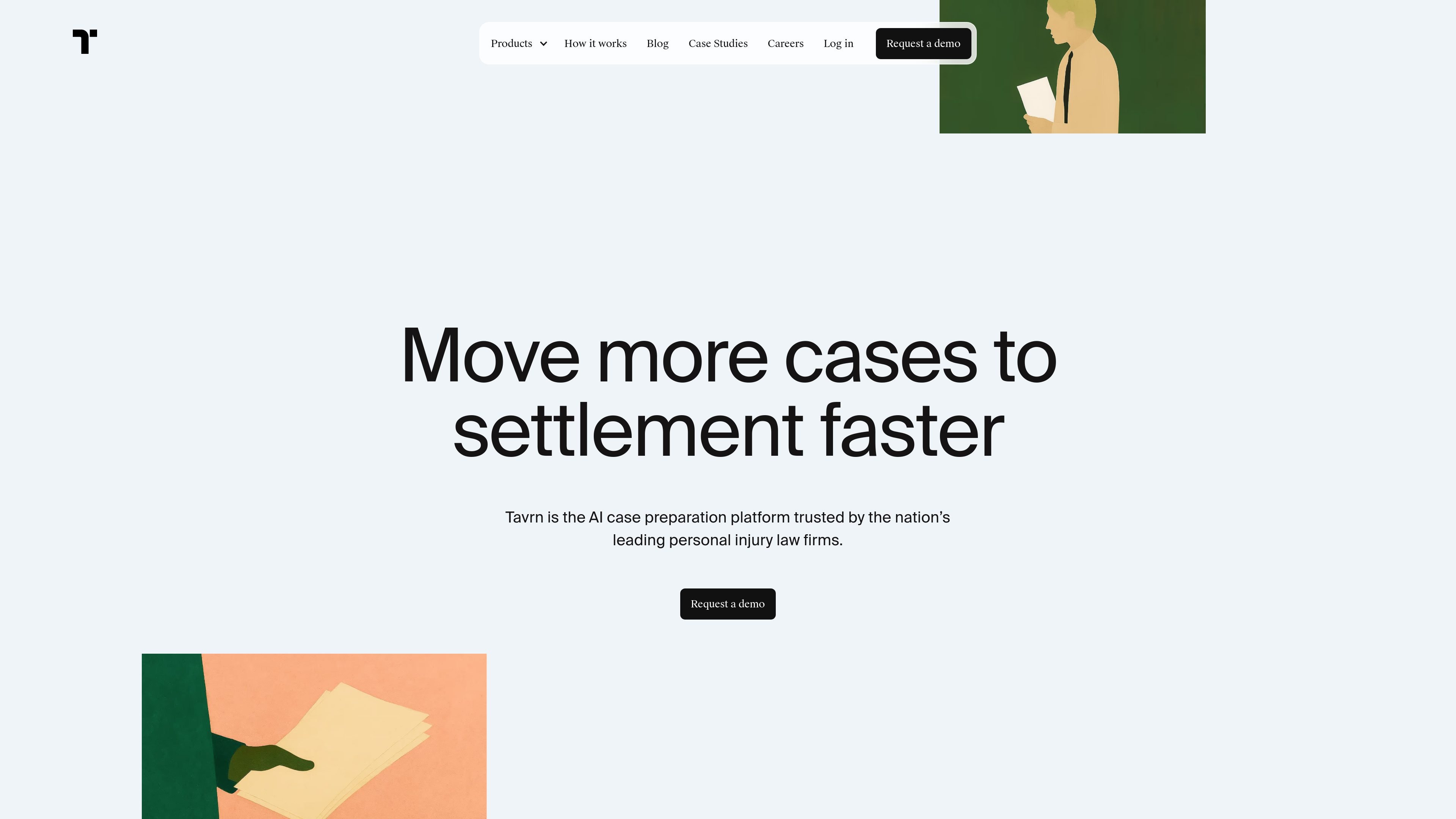
Tavrn is an AI-powered platform for attorneys that focuses on medical record retrieval, medical chronologies, and demand letters. The homepage presents it as a legal workflow tool built to help firms handle complex case materials more quickly and with clearer structure.
Its published workflows center on moving from records to usable case documents: retrieving records from providers, organizing dense medical files into structured summaries, and drafting tailored demand letters from the underlying case facts. The site also describes related modules for intake, evaluation, and eDiscovery, with outputs linked back to source material.
Manage medical record retrieval requests and fax/email inbounds from one place, with agentic workflows that retrieve records from thousands of providers nationwide and track request status in real time.
Convert dense medical records into structured, hyperlinked summaries that surface diagnoses, treatment timelines, procedures, and key providers.
Draft tailored demand letters from medical records and case facts, with AI pulling in injuries, treatments, damages, and financial context.
Support intake and evaluation by capturing, organizing, and triaging client data for early case analysis.
Surface relevant digital documents and correspondence with audit-ready clarity, aimed at eDiscovery workflows.
Link actions, files, and insights so outputs stay connected to source material and case context.
Use Tavrn to request and track medical records from multiple providers without managing separate retrieval steps across different intake channels.
Turn long medical files into a chronology that highlights diagnoses, treatment sequence, procedures, and the providers involved in the case.
Draft a demand letter from the case record and factual background when you need a structured document ready for review and sending.
Capture and organize early client information for preliminary evaluation before a matter is fully developed.
Review digital documents and correspondence in an audit-friendly workflow when the case involves broader electronic discovery needs.
Tavrn provides AI-powered tools for legal professionals, including medical chronologies, demand letters, record retrieval, intake and evaluation, and eDiscovery. The homepage positions the product for law firm workflows that need structured case materials and source-linked outputs.
The homepage states that medical chronologies and demand letters are delivered in hours, while medical chronologies are described as arriving in less than 24 hours.
Tavrn says its record retrieval workflow can manage retrieval requests and fax/email inbounds in one place, and it can retrieve records from thousands of providers nationwide with real-time status tracking.
The site says Tavrn creates structured, hyperlinked summaries and that outputs link directly to their source, which suggests an evidence-linked review workflow rather than a purely freeform text generator.
The homepage describes Tavrn as built for legal workflows with human oversight, but it does not provide pricing, integrations, or setup details on the pages reviewed.