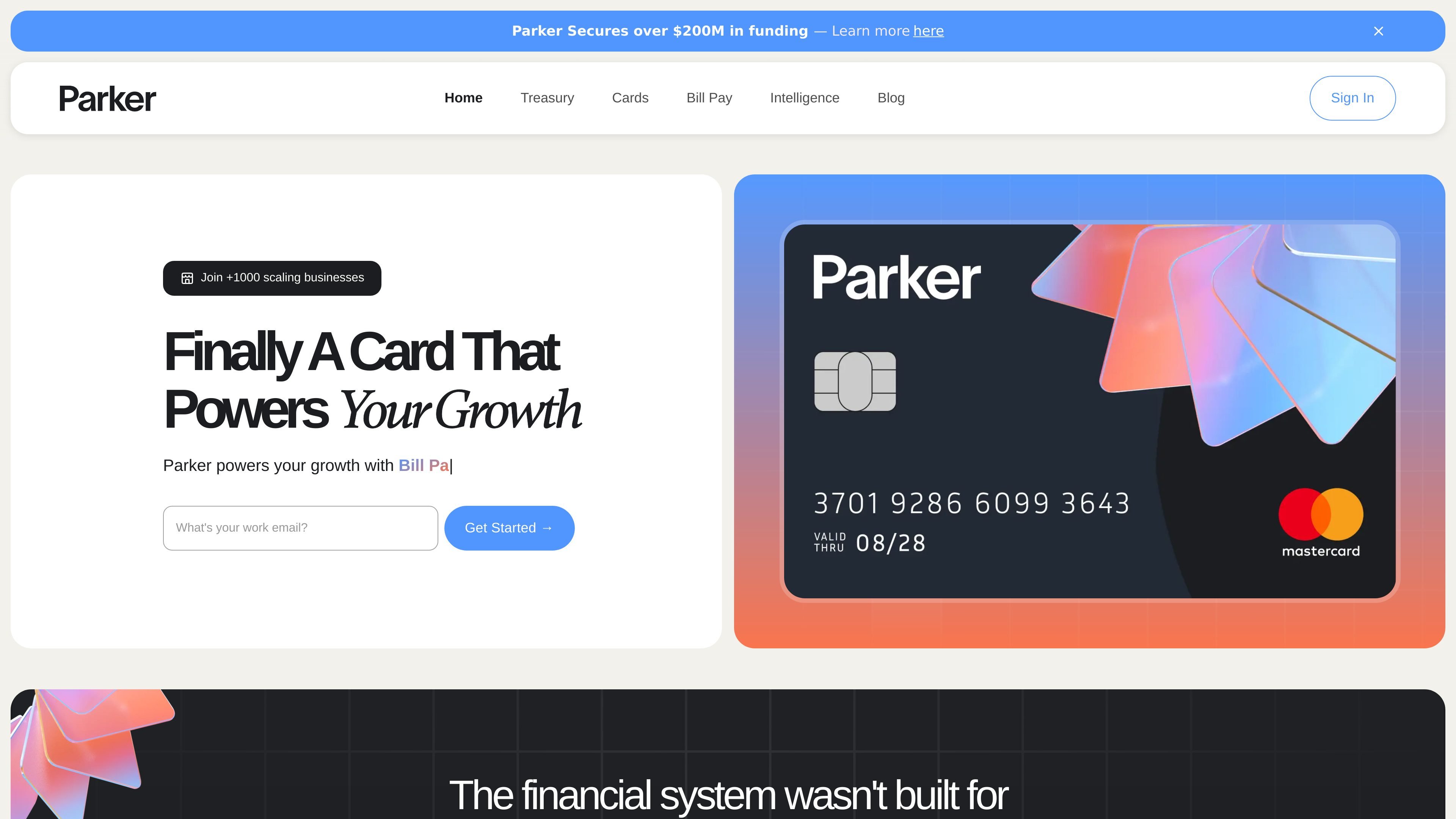
Parker is a financial platform for internet and digital businesses, combining cards, bill pay, treasury banking, and analytics to manage spend and cash flow.

Parker preview

Overview

Parker is a financial platform for internet and digital businesses that combines cards, bill pay, treasury banking, and analytics in one product. The site positions it as an alternative to traditional credit cards and banking tools that do not fit businesses with fast-moving revenue cycles.

Its card and bill pay products emphasize rolling terms, meaning each transaction or payment can have its own repayment schedule instead of a single monthly due date. Parker also says it offers business banking with deposit yield, treasury protection through partner banks and IntraFi relationships, and reporting tools that show profit, cash flow, and transaction-level categorization.

Core capabilities

Rolling credit terms

Parker says its card product uses rolling repayment schedules, so each purchase gets its own due date instead of a single monthly statement balance. The site says terms can run 30, 45, 60, or 90 days, which helps businesses line up repayment with revenue timing.

Performance-based underwriting

The cards page says Parker evaluates real business data rather than relying only on outdated tax returns or credit history. It names API connections to Shopify, Amazon, QuickBooks, and more as inputs for credit decisions.

Bill pay on the credit line

Parker Bill Pay lets businesses pay vendors that do not accept cards, including via wires and ACH, while still using the Parker credit line. The page says this extends rolling payment terms to domestic and international payments.

Business banking and treasury

The banking pages say Parker offers banking services with no hidden fees and no minimums, plus up to 3.0% APY on deposits. They also describe treasury protection through partner banks and IntraFi relationships.

Financial analytics

The site says Parker includes real-time P&L, cash flow, and predictive analytics. The cards page also mentions profit metrics by product, ROAS tracking by ad platform, cash-flow trend analysis, inventory runway projections, and AI categorization of transactions.

Virtual card controls

Parker says users can create unlimited virtual cards with separate limits and repayment schedules. The site positions this as useful for paid media teams, agencies, and department-level budgeting.

Common use cases

  • Finance spend with rolling terms

    A growth-stage ecommerce or online business can use Parker Card to extend payment timing on ad spend, inventory, or other purchases while keeping the repayment schedule tied to each transaction.

  • Pay non-card vendors

    Operations or finance teams can use Bill Pay to pay vendors that require wires or ACH transfers, while still drawing on the Parker credit line instead of paying everything up front.

  • Manage operating cash and reserves

    Founders and finance teams can use the banking and treasury tools to keep operating balances in one place while earning yield and maintaining the protection structure described on the site.

  • Monitor unit economics and runway

    Performance marketers and operators can use the analytics dashboard to track profitability, ROAS, cash flow, and runway instead of managing these views in spreadsheets.

  • Control team and channel spend

    Agencies and multi-team businesses can create unlimited virtual cards with different limits and repayment schedules for platforms, departments, or client work.

Pros and Cons

Pros

  • Combines cards, bill pay, banking, and analytics in one system.
  • Offers rolling repayment terms instead of a single monthly balance on every purchase.
  • Supports vendors that do not accept cards through bill pay, including wires and ACH.
  • Includes analytics for cash flow, profitability, ROAS, and inventory runway.
  • Supports unlimited virtual cards with separate controls and schedules.

Cons

  • The provided pages do not include a live pricing page, so the full fee structure is not visible in the source material.
  • Some claims refer to limits, APY, and credit terms, but exact eligibility and qualification criteria are not fully detailed in the provided pages.

FAQ

What is Parker built for?

Parker is positioned as a banking platform for internet businesses, with cards, bill pay, treasury banking, and analytics in one system. The site says it is built specifically for the internet economy and for modern digital businesses that need flexible working capital and cash flow visibility.

How do Parker’s payment terms work?

The site highlights rolling terms on card and bill pay transactions, with options such as 15, 45, 60, or 90 days on purchases, depending on the product and terms shown. It also says bill pay can be used for vendors that do not accept cards, including wire and ACH payments.

What does Parker offer on the banking side?

Parker says it offers banking services with no hidden fees and no minimums, plus up to 3.0% APY on deposits. The banking page also says Parker Treasury can provide up to hundreds of millions of dollars of FDIC coverage through partner banks and IntraFi relationships.

How are credit limits determined?

The cards page says Parker uses performance-based underwriting and API connections to real business data such as Shopify, Amazon, and QuickBooks, among others, to determine credit limits. The site also says limits can scale with business performance rather than relying only on older tax returns or credit history.

Where can I find Parker pricing?

The source material does not show a live pricing page. The available pages mention terms and fees in product examples, but a full pricing structure is not published in the provided content.

Quick Facts

Category
Business banking and spend management
Platform
Web-based financial platform
Primary users
Internet and digital businesses
Core workflow
Cards, bill pay, treasury, and analytics in one dashboard
Source domain
getparker.com
Pricing
Not published in the provided source pages