Hatchet logo

Hatchet is a workflow orchestration platform for AI agents, background tasks, and durable workflows, with code-first execution, retries, monitoring, and replay.

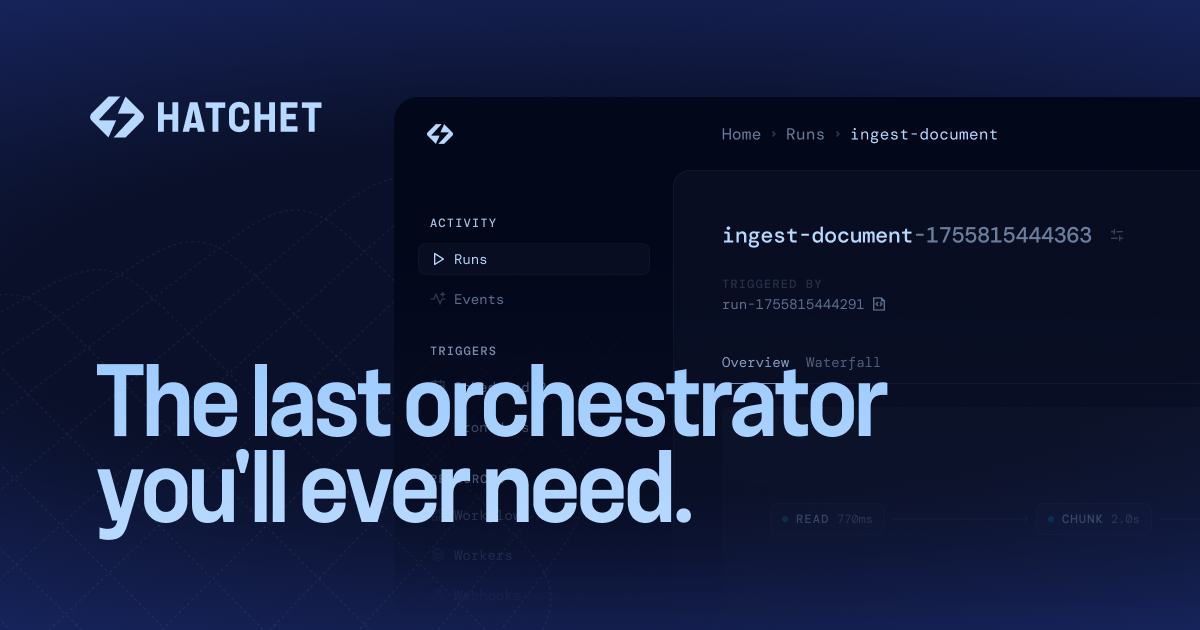
Hatchet preview

Overview

Hatchet is an orchestration platform for teams that need to run AI agents, background tasks, and mission-critical workflows from code. The product combines task execution, scheduling, retries, monitoring, and replay in one system so teams can build workflow-driven applications without assembling separate orchestration components.

The site presents Hatchet as a two-part system: an orchestration engine plus workers that run on your own infrastructure. The engine is available as a managed service or can be self-hosted, while workers run as standard long-lived processes on container platforms you already use.

Across the site, Hatchet is positioned for durable execution, parallel workloads, and AI agent orchestration. The emphasis is on preserving state, recovering from failure, and giving teams visibility into runs, step execution, and errors through a dashboard and exported metrics.

Features

Code-first workflows and task composition

Define tasks as simple functions and compose them into workflows for more complex logic. The platform handles retries and step dependencies so workflows can recover from failures without rebuilding orchestration in application code.

Durable execution and replay

Store every task and state transition in a durable event log with automatic retries and replay. This supports recovery from crashes, network partitions, or unexpected restarts without losing completed work.

Background jobs, scheduling, and triggers

Run scheduled tasks, cron jobs, event listeners, webhook triggers, and background jobs from the same platform. Hatchet also supports task routing with strict conditions or weighted worker affinity.

Throughput and fairness controls

Use priorities, rate limits, global deployments, fair scheduling, and worker slots to manage throughput and resource contention. These controls are designed for high-volume systems and parallel workloads.

Observability and troubleshooting

Inspect task, workflow, and worker activity in a real-time web UI with searchable status updates, logs, and metrics. The product also supports OpenTelemetry, Prometheus metrics, and alerting for troubleshooting.

Language-native SDKs and deployment flexibility

Build with native SDKs in TypeScript, Python, and Go, and run workers on Kubernetes, Docker, ECS, Cloud Run, Porter, Railway, or other container platforms. Hatchet also says it works with tools such as Claude Code and Cursor.

Use cases

  • Production AI agents

    Orchestrate AI agents that need state, guardrails, eventing, retries, and visibility into each tool call. The AI agent page emphasizes production use rather than one-off demos.

  • Massively parallel processing

    Run large batch jobs that fan out across many workers, such as document processing, data enrichment, and lead processing. The parallel workloads page highlights fairness controls, retry handling, and replay for failed batches.

  • Fault-tolerant business workflows

    Build workflows that need to survive crashes, restarts, or transient failures without duplicating completed work. The durable execution page describes durable event logs, automatic retries, and exact resumption from the last safe point.

  • Scheduled and event-driven automation

    Use a single platform to handle scheduled jobs, cron-style automation, background tasks, and event-driven triggers. The home page groups these primitives together for teams replacing home-grown orchestration systems.

  • Multi-team operational control

    Centralize task execution, monitoring, and user/tenant management across a larger team or product. The pricing page and home page both point to team and enterprise scenarios with more users, tenants, and operational controls.

Pros and Cons

Pros

  • Combines orchestration, scheduling, retries, and monitoring in one platform.
  • Supports durable execution, replay, and recovery for long-running or failure-prone workflows.
  • Offers native SDKs in TypeScript, Python, and Go instead of requiring a DSL or YAML workflow layer.
  • Includes real-time visibility, logging, and metrics for debugging workflow and agent runs.
  • Provides multiple deployment options, including managed service, self-hosting, and container-based environments.

Cons

  • The public pages do not provide detailed integration documentation or a full ecosystem list beyond selected SDKs, observability tools, and deployment targets.
  • Some pricing and enterprise terms are usage-based or contact-sales, so exact total cost depends on workload volume and deployment needs.
  • The site provides less detail on setup complexity and governance features than on execution, observability, and scaling capabilities.

FAQ

How does Hatchet work at a high level?

Hatchet is built around two components: the orchestration engine and your workers. The source says workers run on your own infrastructure, while the orchestration engine is available as a managed service or can be self-hosted.

What languages and deployment environments does Hatchet support?

The source shows native SDKs for TypeScript, Python, and Go, and says workers run as standard long-lived processes on the container platform you already use. It also notes that Hatchet can run locally with a single CLI command.

Is there a free tier or only paid plans?

Pricing starts with a free Developer plan, then adds paid Team and Scale plans with usage-based pricing. An Enterprise option is available for technical or compliance requirements and includes contact-sales style engagement.

Can Hatchet help with debugging and monitoring workflows?

Yes. The product pages describe replaying failed runs, automatic retries, monitoring, logging, and alerting from the Hatchet dashboard or via exported metrics to observability tools.

What kinds of workflows is Hatchet best suited for?

Hatchet’s use case pages position it for AI agents, parallel workloads, and durable execution, especially when tasks need retries, state, observability, or long-running workflows that recover from failure.

Quick Facts

Category
Workflow orchestration platform
Primary use cases
AI agents, background tasks, durable workflows, parallel workloads
Languages
TypeScript, Python, Go
Deployment
Managed service or self-hosted; workers run on container platforms
Pricing
Free Developer plan plus paid Team, Scale, and Enterprise options
Source domain
hatchet.run

Análises de Hatchet

Hatchet· Visitas mensais 50,5 mil· Classificação global #425.794

Os dados de tráfego são apenas para referência.

Visitas mensais
50,5 mil
Classificação global
#425.794
Ranking da categoria
#5.175
Taxa de rejeição
34.8%
Duração média da visita
10:56
Páginas por visita
7.90

Tendências de tráfego

51 mil34 mil17 mil0abr.: 44.510abr.mai.: 50.961mai.jun.: 50.545jun.
Visitas mensais - 3
abr.44510
mai.50961
jun.50545

Fontes de tráfego

  • Direto64.7%
  • Busca20.1%
  • Referências6.64%
  • Social6.61%
  • E-mail2.00%
  • Afiliados0.00%

Principais regiões

  • Nigéria23.5%
  • Estados Unidos22.8%
  • Reino Unido21.4%
  • Brasil7.50%
  • Tailândia5.33%
  • Outros19.4%