
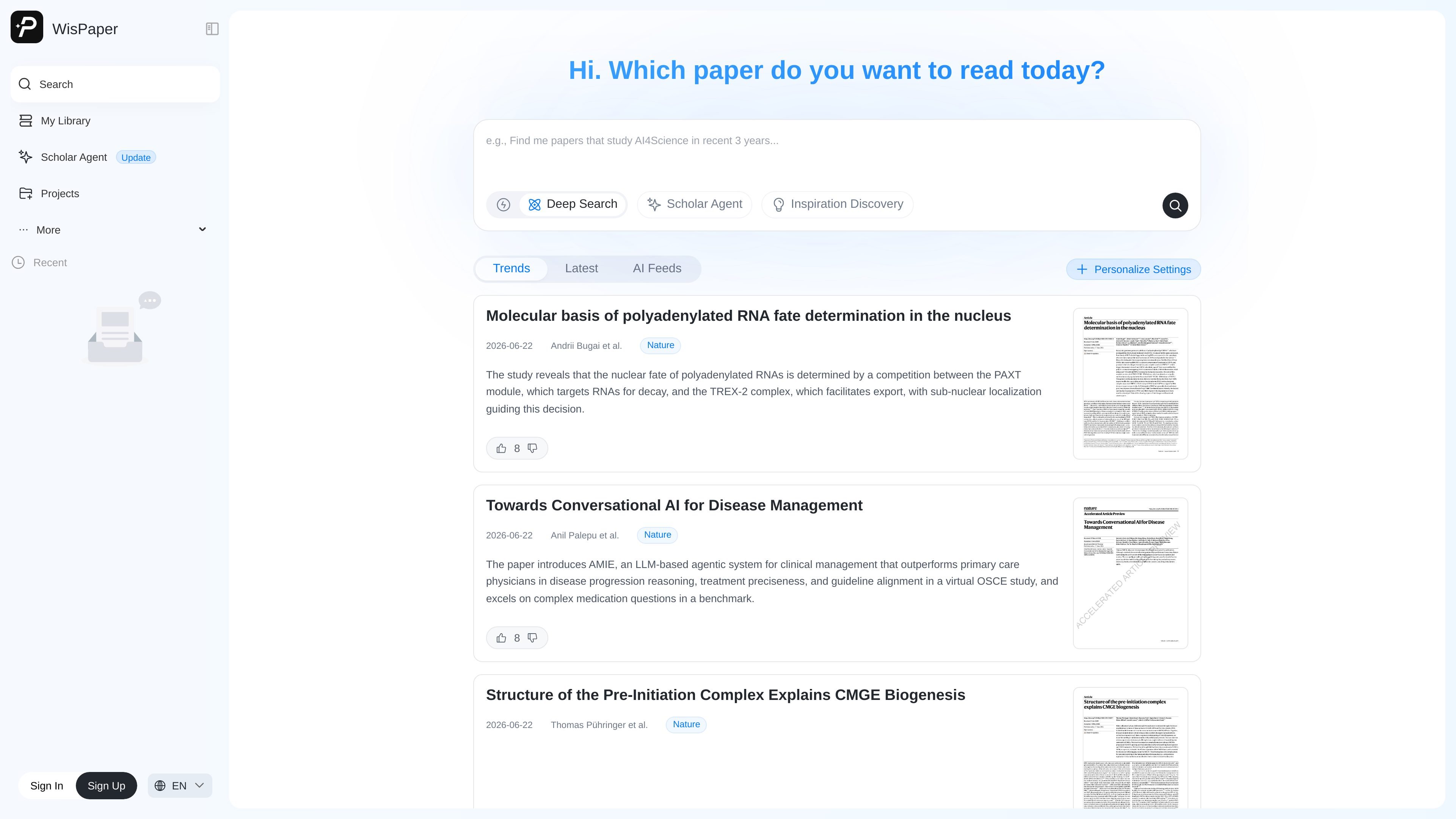
Search and screening workflows
Lets users run deep search and scholar search flows to find papers from broad literature results and narrow them to relevant reads.

WisPaper is an AI research workspace for scientists and scholars to search, screen, review, and track literature.
WisPaper is an AI research workspace for scholars and scientists that focuses on finding, screening, and working with academic papers in one place. The product positions itself as a search-and-screen system rather than a general chatbot, with tools for deep search, Scholar Agent workflows, AI Survey, and literature tracking.
The site says WisPaper can screen large sets of papers quickly and uses intent validation to interpret the underlying research goal behind a query. It also describes a workspace where search, library, projects, and AI feeds support literature review, gap discovery, hypothesis work, and manuscript drafting.
Lets users run deep search and scholar search flows to find papers from broad literature results and narrow them to relevant reads.
Uses intent validation to interpret the research question behind a query and filter results by research logic rather than only by keywords.
Includes Scholar Agent, AI Survey, Idea Discovery, and AI Feeds to support discovery, review, and ongoing tracking inside the same workspace.
Provides a library and project-oriented workspace so notes, citations, and records can accumulate across papers and projects.
Surfaces paper summaries and structured descriptions directly in the app, helping users inspect candidate papers before reading in full.
Offers a pricing structure with Free and paid tiers, plus plan-based storage and refresh-credit allowances shown on the pricing page.
Researchers can start from a research question, use deep search or intent validation to narrow a broad topic, and review candidate papers before reading in full.
Users preparing a review can use Scholar Agent, AI Survey, and related workspace tools to organize findings, compare papers, and build a structured reading list.
Scientists exploring a new topic can use the app to identify gaps, refine directions, and turn reading into hypothesis and experiment planning.
Teams or individuals can keep notes, citations, and project records in one workspace so prior reading accumulates into a reusable knowledge base.
Researchers screening many papers can use the product’s search-and-screen flow to reduce the number of articles they need to read closely.
WisPaper is an AI-native research workspace for scientists and scholars. It combines paper search, screening, literature review support, hypothesis generation, experiment design, code debugging, and manuscript drafting in one place.
The site says WisPaper grounds answers in real paper passages and uses in-house post-training to reduce hallucinations. It also describes answers as one-click verifiable and source-traceable.
WisPaper says normal search matches keywords, while intent validation interprets the underlying research logic and pre-reads and filters results for the user.
The pricing page shows a Free plan and paid tiers including Plus, Pro, Max X2, and Max X5. The free plan includes core features such as search and QA, while newer capabilities like AI Survey are not included on free accounts according to the site.
The source content does not list supported operating systems or export formats. It does show a web-based workspace with sections such as Search, My Library, Scholar Agent, Projects, and AI Feeds.
Traffic data is for reference only.

www.curieai.tech
Curie is an AI research assistant for searching scientific literature, analyzing uploaded documents, extracting evidence, and organizing references. It is designed for solo researchers, graduate students, systematic review teams, and R&D groups.

rayyan.ai
AI-powered platform for systematic and literature reviews

unriddle.ai
Anara is an AI research workspace for cited answers, document analysis, and web and library search.

windward.ai
Maritime AI for vessel screening, monitoring, and compliance

termo.ai
Termo is an AI agent platform with isolated VMs for research, automation, and build tasks.

researchgpt.com
AI-assisted equity research that turns tickers or questions into cited investment memos.