
Plain-language literature search
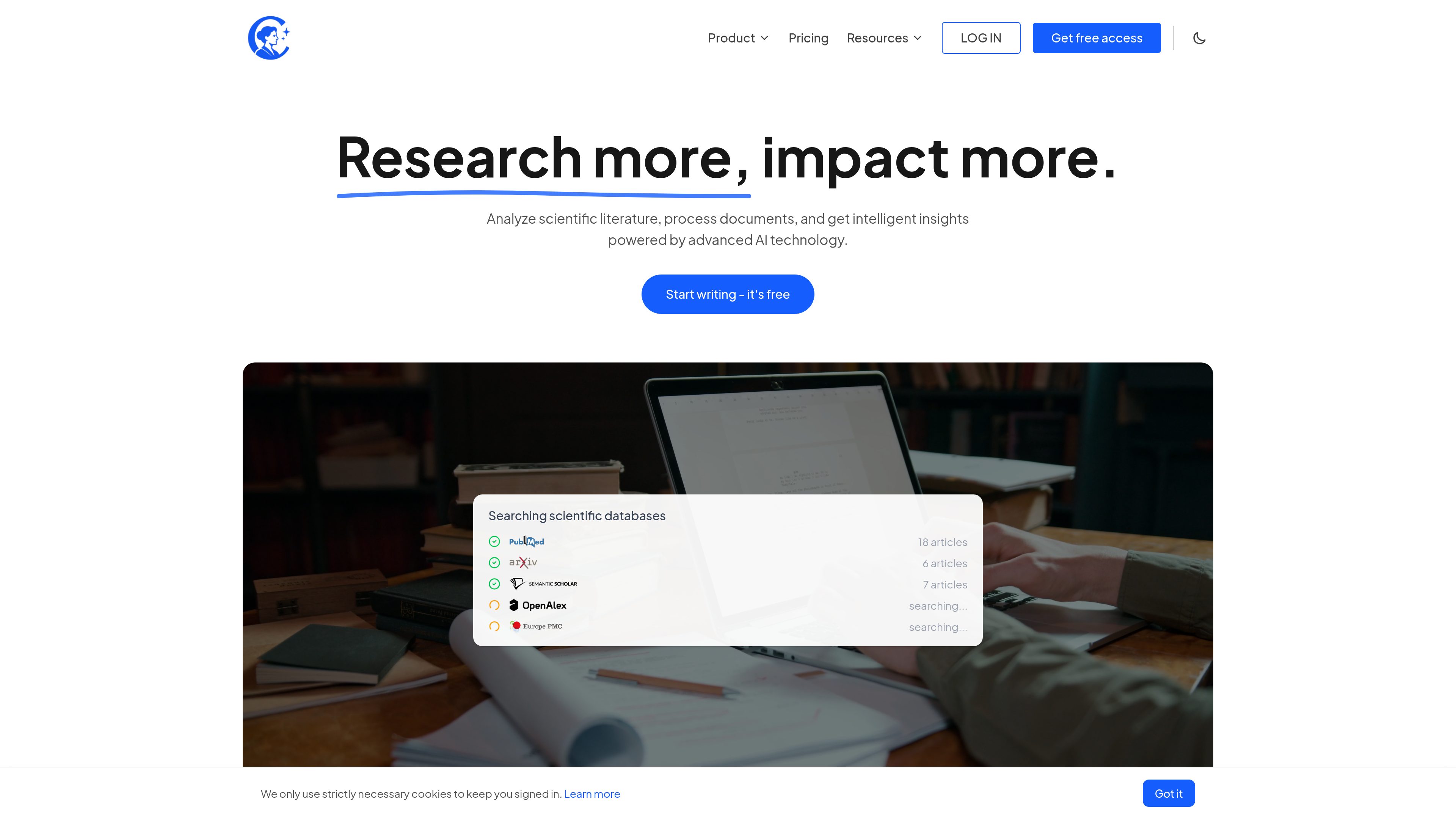
Ask research questions conversationally instead of writing query syntax or Boolean filters. Curie searches PubMed, arXiv, Europe PMC, OpenAlex, and Semantic Scholar in parallel.

Curie is an AI research assistant for searching scientific literature, analyzing uploaded documents, extracting evidence, and organizing references. It is designed for solo researchers, graduate students, systematic review teams, and R&D groups.
Curie is an AI research assistant for scientific literature and document analysis. It accepts research questions in plain language, searches five scientific databases in parallel, analyzes available full text, and checks answer claims against the source passages behind them.
The product combines literature search with document upload, systematic review support, a saved research library, and structured data extraction. It is intended for solo researchers, graduate students, systematic review teams, and industry R&D groups that need to search, screen, summarize, compare, or extract evidence from scientific documents.
Ask research questions conversationally instead of writing query syntax or Boolean filters. Curie searches PubMed, arXiv, Europe PMC, OpenAlex, and Semantic Scholar in parallel.
Curie checks claims in its answers against the source they came from and indicates when a claim cannot be verified. When full text is available, it can use the paper rather than only its abstract.
Upload PDF, DOC/DOCX, TXT, or Markdown files and analyze them alongside searched literature. The FAQ specifies a 50MB per-file limit and up to 20 files or 300MB in one upload.
Starter and higher plans support full systematic reviews, including a PRISMA diagram. Curie can also help with screening, evidence extraction, summaries, and review-protocol drafting.
Save articles and uploaded documents in one library, add tags and autosaved notes, filter by source or year, and export selected references as BibTeX, RIS, or CSV.
Define columns such as text, number, yes/no, or fixed categories for one document or saved article. Curie fills the table with an exact supporting quote behind each value and can export the result as CSV.
Ask a broad research question in natural language, review ranked results and source-backed answers, then save relevant articles into a tagged reading list for later screening.
Use literature search, document uploads, evidence extraction, and review support to assemble a structured workflow. Starter and higher plans include full systematic reviews and a PRISMA diagram.
Define a consistent set of columns—such as author, year, sample size, dose, or primary outcome—and run individual papers through Extract Data to produce quote-backed rows for a spreadsheet.
Filter a library by project, theme, source, or year and export the selected references as BibTeX, RIS, or CSV for a reference manager or shared research workflow.
Ask whether a claim is supported by the literature and inspect the source quote attached to the answer. If the claim cannot be verified, Curie reports that rather than leaving it unflagged.
No. Curie is designed for plain-language questions and does not require query syntax or setup training.
Curie searches PubMed, arXiv, Europe PMC, OpenAlex, and Semantic Scholar in parallel for each question.
Supported formats are PDF, Word (.doc and .docx), plain text, and Markdown. The stated limits are 50MB per file and up to 20 files or 300MB total in one upload.
Yes. Library selections can be exported as BibTeX, RIS, or CSV. Extract Data results can be downloaded as CSV.
Each plan has a monthly usage budget. When it is exhausted, further paid actions such as starting a new analysis pause until the next billing cycle.

wispaper.ai
WisPaper is an AI research workspace for scientists and scholars to search, screen, review, and track literature.

rayyan.ai
AI-powered platform for systematic and literature reviews

unriddle.ai
Anara is an AI research workspace for cited answers, document analysis, and web and library search.

windward.ai
Maritime AI for vessel screening, monitoring, and compliance

termo.ai
Termo is an AI agent platform with isolated VMs for research, automation, and build tasks.

researchgpt.com
AI-assisted equity research that turns tickers or questions into cited investment memos.